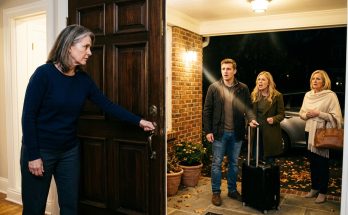
The photograph changed what Dr. Cho could say.
Not about George’s ultimate death.
He remained careful there.
Cancer had taken George seven weeks after the collapse.
His disease was advanced.
Nothing in the recovered evidence justified rewriting that medical reality.
But the events on the kitchen floor were becoming clearer.
George had photographed both the sedative and the sleep aid before the day Susan confronted him at home.
Both had been in Susan’s tote.
Both later appeared in his tea.
Both were detected in his blood.
Susan purchased a replacement sleep aid during the period after George collapsed and before she called emergency services.
Jessica remembered Susan transferring tablets between containers.
Susan washed the mug.
Removed Eleanor’s prescription bottle.
Took George’s lockbox.
Then told dispatch she knew nothing about his medication.
Those facts no longer looked unrelated.
Priya sat beside me when Dr. Cho explained.
“Can you say the tea contributed to his collapse?”
“Yes.”
The word landed hard.
“Can you say it caused the collapse?”
“I would phrase it as medically probable that the combination contributed materially to his acute symptoms.”
“Dizziness?”
“Yes.”
“Confusion?”
“Yes.”
“Low blood pressure?”
“Yes.”
“Collapse?”
“Yes, as a contributing factor.”
I closed my eyes.
Not murder.
Not a clean causal line from cup to death.
But harm.
Real, measurable harm.
“Could Susan have known it was dangerous?”
Dr. Cho refused to speculate about her knowledge.
“She should not have administered medication prescribed to another person without medical direction. Combining sedating substances in a medically fragile patient creates foreseeable risk.”
Foreseeable.
That word mattered legally.
The prosecutors would decide how much.
Jessica’s role remained under scrutiny too.
She had witnessed the earlier administration of Eleanor’s medication.
She had concealed the later incident.
She had helped create a false account.
She had impersonated Liam.
Her cooperation now did not erase those choices.
Liam struggled with that.
“She might be charged?”
“Yes.”
“She’s helping.”
“Yes.”
“Doesn’t that matter?”
“It can.”
“But it doesn’t erase it.”
“No.”
He nodded.
I could see him wanting me to tell him what outcome to hope for.
I did not.
“What do you want?” I asked.
“I don’t know.”
“That is allowed.”
“I don’t want her destroyed.”
“Then don’t wish for that.”
“But Dad deserved better.”
“Yes.”
“And Mom—you deserved better.”
“Yes.”
He looked down.
“I deserved consequences too.”
“You got some.”
“Not enough.”
“That is not for you to dramatize.”
He looked at me.
“Repay what you owe. Tell the truth. Stop using guilt as another way to make yourself the center.”
His eyebrows lifted.
“That sounded like Dad.”
“I had a good teacher.”
For the first time in days, he smiled.
Susan’s attorney began negotiating with prosecutors.
I was not part of those negotiations.
I was interviewed again.
Asked again what I remembered about George’s final months.
Asked whether he ever knowingly used sleep aids not listed in his medical chart.
I answered carefully.
“He occasionally used approved medications for sleep. I never saw him use the substances found in the tea voluntarily.”
“Could he have?”
“I cannot know what he did every minute.”
That answer hurt.
It was also true.
Susan’s defense would exploit uncertainty.
George was terminally ill.
George had many medications.
George sometimes became confused.
George could have knowingly accepted help.
George might have taken something himself.
The defense did not need to prove an alternate story.
It needed room for doubt.
Then Susan made a statement through her attorney.
She admitted putting medication in George’s tea.
I had to read that sentence twice.
She admitted it.
But her explanation was exactly what Jessica predicted.
George was agitated.
He knew she had Eleanor’s sedative.
He asked for something to calm down.
Susan gave him a small amount.
Later, she added an over-the-counter sleep aid because George complained the first medicine had not helped.
She claimed he consented.
Then why hide it?
Her attorney argued she panicked after he collapsed.
Why wash the mug?
Panic.
Why replace medication?
Panic.
Why lie to emergency dispatch?
Panic.
Why delay help?
Confusion about what to do.
Why conceal the truth for four years?
Fear of being blamed for the natural decline of a terminally ill man.
It was not a ridiculous defense.
That made me angrier.
The best lies were rarely ridiculous.
They attached themselves to plausible human weakness.
Susan probably had panicked.
She probably had been afraid.
Those feelings did not transform George’s missing consent into consent.
We had George’s voice memo.
Tea tastes strange.
Asked her what she put in it. Says honey. We don’t have honey.
That recording directly contradicted Susan’s claim that George knowingly accepted both medications.
Still, her attorney argued George could have consented later.
Then another recovered recording surfaced.
Maya found it.
Not police.
Not Crane.
Not Martin.
Maya.
She had been cataloging George’s temporary audio files from the old recorder.
One file had a damaged header and would not play normally.
A technician repaired it.
Timestamp placed it during the confrontation at my house, shortly before George’s collapse.
The recording began mid-conversation.
Susan’s voice:
“You need to calm down.”
George:
“I need you out.”
Susan:
“Drink the tea.”
George:
“No.”
A scrape.
Jessica:
“George, please.”
George:
“Both of you leave.”
Susan:
“You’re making yourself sick.”
George:
“I already am sick.”
His voice was weak but unmistakably lucid.
Then:
“That does not make you my doctor.”
I cried when I heard it.
Not because it proved everything.
Because it gave George his voice back.
For weeks we had spoken about him.
Interpreted him.
Remembered him.
Argued over what he might have wanted.
Now there he was.
Speaking for himself.
Susan:
“I’m trying to help.”
George:
“No. You are trying to decide.”
A pause.
Then he said the sentence that ended any doubt I personally had about consent.
“Do not put anything in my food or drink.”
Silence followed on the recording.
Then movement.
Jessica whispered, “Mom.”
Susan said something too faint to understand.
George:
“I mean it.”
The recording cut out.
Priya closed her eyes.
“That matters.”
“Yes.”
It did not record the moment the substances entered the tea.
It did not prove Susan’s intention.
It did establish George explicitly refused medication or additives shortly before the substances were found in his drink.
Susan’s consent defense weakened.
When prosecutors received the recording, the case changed again.
Potential charges were discussed.
I was warned that legal outcomes could take months or years.
Susan might plead.
She might fight.
Some allegations might proceed.
Others might not.
Financial crimes carried different evidentiary standards from medical misconduct.
Jessica’s cooperation could affect her treatment.
Victor Crane had his own exposure.
Patricia’s role remained under review.
I began to understand that “the case” was not one case.
It was a web.
Money.
Forgery.
Unauthorized access.
Identity misuse.
Medication.
Delay in emergency care.
Evidence concealment.
Some threads were strong.
Some frayed when pulled.
George’s death sat emotionally at the center but legally might remain separate from much of it.
That distinction was painful.
Necessary.
One afternoon Daniel came to return copies of records.
We sat on the porch.
“I spent years telling myself Susan was simply impossible with money,” he said.
“You knew about your mother’s medication.”
“I knew something was wrong.”
“You didn’t know this.”
“No.”
He stared at the yard.
“I should have warned you directly.”
“You warned George.”
“I should have warned you.”
“Yes.”
He looked surprised.
I had learned not to absolve people just because they apologized.
Then I added, “I also understand why you trusted George to handle it.”
Daniel nodded.
“I’m sorry.”
“I know.”
He did not ask for forgiveness.
I appreciated that.
Jessica began therapy.
I learned that from Liam, not because she told me.
He saw her occasionally.
Coffee.
A walk.
Once, dinner.
They were not engaged.
I did not ask whether they would reunite.
That was their future.
My boundary was simpler.
If Jessica came into my life again, it would not be because I financed the arrangement.
Liam continued repayment.
The second month, he called before the due date.
“I can only do five hundred.”
“Why?”
“Car repair.”
“Can you prove it?”
Silence.
Then he laughed.
“Yes.”
“I’m teasing.”
“No, actually, I should be able to explain.”
“You don’t need my permission to spend your money.”
“But I promised eight hundred.”
“Then call before you miss it.”
“I am.”
Exactly.
He was learning.
So was I.
Maya stopped checking my bank account every day.
I had given her temporary access during the investigation.
One morning she handed the authentication device back.
“You don’t need me watching anymore.”
“I might make mistakes.”
“Probably.”
“Comforting.”
“You’ll survive.”
George would have loved that.
The house changed too.
I finally cleared part of his office.
Not everything.
His photograph stayed.
His chair stayed.
The absurd collection of labeled cables stayed because I could not face them.
But the medical boxes went into organized storage.
The hidden toolbox remained downstairs.
I no longer thought of it as a place where George had hidden fear.
It was simply a toolbox again.
Then Alvarez called with news about the financial case.
Investigators had recovered a portion of the money Susan received through transactions connected to unauthorized access.
Not all.
Some had been spent years ago.
Some could not be traced.
Some transfers might never be legally recoverable because Liam or Jessica had initiated them voluntarily, however manipulated the circumstances were.
“How much is missing?”
“We’re still calculating.”
“Will I get it all back?”
“Probably not.”
I surprised myself.
“All right.”
He paused.
“That’s not the reaction I expected.”
“I want accurate numbers. I don’t need a fantasy.”
Money mattered.
It represented work.
Security.
Consent.
But recovering every dollar would not restore George.
It would not repair Liam.
It would not undo Jessica’s choices.
It would not give Maya back the years she spent feeling responsible for protecting me.
I wanted what could be repaired.
Not what could only be mourned.
Then Alvarez told me Susan wanted to speak to me.
“No.”
“You don’t have to.”
“I know.”
“She requested it through counsel.”
“No.”
“Understood.”
I almost hung up.
Then curiosity caught me.
“What does she want?”
“She says she wants to explain what happened with George.”
For one dangerous second, I considered it.
Then I remembered every explanation Susan had already supplied.
She had helped.
George consented.
Daniel lied.
Jessica was confused.
I was emotional.
The money would eventually belong to family.
Every explanation placed Susan at the center as the only person qualified to interpret everyone else’s wishes.
“No.”
This time the word felt clean.
I did not need her explanation to make my own reality legitimate.
That evening I took the train alone.
Not far.
Just to visit an old friend two towns away.
I bought a window seat.
When I boarded, a young man was sitting in it.
He looked at the number, realized his mistake, and immediately stood.
“Sorry.”
“That’s all right.”
He moved.
No argument.
No family conference.
No accusation that I was difficult.
No demand that I prove the seat mattered enough.
I sat by the window.
As the train began moving, I thought of George’s recovered recording.
Choices are how family proves it respects you.
I had spent years believing generosity meant making myself easy to use.
George had seen the danger before I did.
But he had made his own mistake too.
He tried to protect me by withholding truth.
Love had made both of us decide things for people we cared about.
The difference was that now I understood what I wanted.
Ask.
Tell the truth.
Accept the answer.
Let other adults carry the consequences of their own choices.
My phone buzzed.
Liam.
For a moment I expected an emergency.
Money.
A problem.
A request.
Instead the message said:
Hope you have a good trip. No need to call. Love you.
I smiled.
Then another notification appeared.
From Detective Alvarez.
The prosecutor had made a charging decision concerning Susan.
I stared at the message while fields slid past the window.
Months earlier, I would have called immediately.
I would have needed the answer before I could breathe.
Instead I put the phone facedown.
The train was moving.
The seat was mine.
The decision could wait until I reached my stop.
Then the phone buzzed once more.
A second message from Alvarez.
One sentence visible on the screen.
Before we proceed, there is one final recording from George you need to hear.
I looked out at my reflection in the darkening glass.
For weeks, every recovered piece of George had pulled me backward.
This one frightened me differently.
Because I was beginning to understand that the final truth might not tell me exactly how to feel.
And this time, I intended to let George speak without asking him to solve my life for me.
Click here to continue reading: PART 21: George’s Final Recording Named the Mistake He Feared Most, but One Sentence About Daniel Reopened the Part of the Case We Thought We Understood
A Stranger Was Sitting in My Reserved Window Seat, but My Son’s Explanation Made the Real Insult Impossible to Ignore
Part 20 of 32