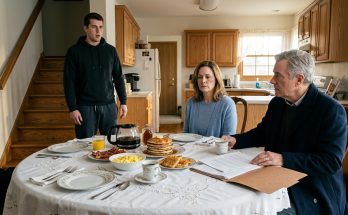
For several seconds, nobody in Patricia Cole’s conference room spoke.
Ava’s face had lost all color.
Rachel pulled out a chair opposite her.
“Sit down.”
Ava did.
I remained standing.
“How long have you known?”
“That my name was on Bennett Family Holdings?”
“Yes.”
“A few years.”
I laughed once.
Patricia glanced toward me.
Ava rushed on. “Dad said it was estate planning.”
“Of course he did.”
“He said putting me on the company would make things easier if something happened to him.”
“And three months ago he asked you to help sell the land.”
“Yes.”
“Did you know the land was purchased with trust money?”
“No.”
“Did you know Grandma’s trust existed?”
“Yes.”
“So what did you think funded the purchase?”
“I didn’t connect them.”
I stared at her.
That answer was becoming Ava’s refuge.
She saw pieces.
She suspected.
She did not connect.
At some point, refusing to connect convenient facts became its own kind of choice.
Rachel’s tone remained professional. “What exactly did you sign?”
“A letter of intent.”
“With whom?”
“A development company.”
“Name?”
Ava gave it.
Rachel wrote it down.
“Purchase price?”
“Two point one million if the zoning contingency clears.”
The room seemed to contract.
More than two million dollars.
Dad had taken money intended partly for me and Norah, used it to acquire land, placed the holding company partly in Ava’s name, and begun arranging a sale while trying to remove me from the one property containing evidence.
I sat.
“When was closing supposed to happen?”
“There wasn’t a final date.”
“Ava.”
“Soon.”
“How soon?”
“Dad said before the end of the month.”
Rachel immediately stepped into the hallway to make another call.
Patricia remained with us.
Ava rubbed her palms against her jeans.
“I didn’t know.”
“You knew enough to hide the map.”
“Yes.”
“You knew enough to accept my house.”
“Yes.”
“You knew enough to sign a sale document for property Dad claimed would become yours.”
“Yes.”
“Then stop telling me what you didn’t know as though ignorance is the only part that matters.”
She began crying.
I did not stop.
“You benefited from never asking the next question.”
“I know.”
“Do you?”
“Yes.”
Her voice cracked.
“I knew Dad was hiding things. I knew Grandma wanted you to have the carriage house. I knew he was angry about the trust. I didn’t know the money trail. But I knew enough to understand something was wrong.”
That was the first honest version.
Not innocence.
Not full guilt.
Complicity.
Patricia quietly asked, “Why did you go along with it?”
Ava stared at the table.
“Because I thought if Dad finally gave me something big enough, I wouldn’t always be the failure.”
I almost answered angrily.
Then I saw what Grandma had meant.
Ava had confused rescue with love.
Dad offered property instead of confidence.
Money instead of responsibility.
A future instead of requiring her to build one.
And she accepted because dependence had become familiar.
“That doesn’t excuse you,” I said.
“I know.”
“Stop saying you know unless you’re going to do something different.”
Ava wiped her face.
“What do I do?”
For years, that question would have activated me immediately.
Make a plan.
Call someone.
Fix Ava.
I heard Grandma’s recorded voice in my head.
Stop carrying people who complain about the way you carry them.
“I’m not deciding that for you.”
Ava looked startled.
“You need a lawyer.”
“I thought Rachel—”
“Rachel is my lawyer.”
Rachel returned at exactly that moment.
“Correct.”
Ava swallowed.
Rachel gave her the names of two attorneys with no connection to the firm.
“You need independent advice before answering detailed questions about the company or sale.”
“Am I in trouble?”
Rachel did not soften it.
“You signed documents involving an entity that may hold property acquired with misappropriated trust assets. I cannot tell you what your exposure is.”
Ava looked at me.
I did not rescue her.
She called one of the attorneys.
While she waited for a response, Rachel explained that her office was preparing emergency filings to prevent the commercial land from being sold or further encumbered.
“Can Dad stop us?”
“He can oppose us.”
“Will he?”
Rachel gave me a look.
“Yes.”
Patricia offered copies of Grandma’s archived documents. Marcus arranged formal preservation. By early afternoon, the conference room had become a temporary command center of paper, calls, timestamps, and signatures.
I kept thinking about Norah.
At three, I left.
Not because the legal work was finished.
Because my daughter needed her mother to show up for something ordinary.
Carla had taken her to a small park near school.
When Norah saw me, she ran across the grass.
I crouched and caught her.
“Are we still staying at our house?”
“Yes.”
“Did you find the thing under the floor?”
I looked at Carla.
She shrugged apologetically. “She figured out more than I told her.”
“Yes,” I said.
“Was it treasure?”
“In a way.”
“Money?”
“No.”
She looked disappointed.
“Papers.”
“That’s boring.”
I laughed.
“You have no idea.”
We bought ice cream.
Norah told me about a girl at school who claimed turtles could breathe through their bottoms.
For ten glorious minutes, inheritance fraud disappeared.
Then Norah asked whether Grandpa was in jail.
I nearly dropped my spoon.
“Who told you that?”
“I heard Carla talking.”
Carla looked mortified.
I chose my words carefully.
“Grandpa is talking to police because some adults think he may have done things he wasn’t allowed to do.”
“Is Grandma with police too?”
“Yes.”
Norah studied her ice cream.
“Are they bad people?”
The question hurt.
“No.”
She looked up.
“They did bad things.”
“Yes.”
“Then how aren’t they bad?”
I wished Rachel were there.
Legal questions were easier.
“People can do things that hurt other people and still be more complicated than one word.”
Norah considered that.
“Like when Jasper ate my birthday cupcake?”
“Much more serious than that.”
“But I still love Jasper.”
“Yes.”
“Do you still love Grandma?”
I looked toward the playground.
“Yes.”
“Grandpa?”
My throat tightened.
“Yes.”
“Are you mad?”
“Very.”
She nodded.
That seemed enough.
Children sometimes accepted contradictions adults spent decades trying to erase.
That evening, Claire called again.
I answered after Norah went to bed.
She had spoken with Rachel.
Only about documents Claire could provide.
Bank records.
Transfers.
Emails from Dad.
“You kept his emails?”
“All of them.”
“Why?”
“Because Evelyn told me never to trust a financial promise that wasn’t written down.”
I smiled despite everything.
“That sounds like her.”
Claire hesitated.
“I booked a flight.”
My body tightened.
“To here?”
“Yes.”
“When?”
“Tomorrow.”
I stood from the couch.
“You didn’t ask me.”
“I know.”
The disappointment in her voice came before I said anything.
“I’m not coming to your house unless you invite me. Rachel said investigators may need me in person. I thought… since I have to be there…”
She stopped.
“You thought we could meet.”
“Yes.”
I walked to the window.
The main house across the yard was dark.
“I said I wanted to meet you.”
“You did.”
“I still do.”
Claire exhaled.
“But?”
“I don’t want you appearing at my door.”
“I won’t.”
“I don’t want you meeting Norah yet.”
A longer silence.
“Okay.”
That answer mattered.
No guilt.
No argument.
No reminder that she was my mother.
Just okay.
“We can meet somewhere public.”
“Anywhere you choose.”
I looked toward the porch.
For thirty-five years, other people had controlled when Claire and I could see each other.
Now even deciding where to meet felt enormous.
“I’ll tell you tomorrow.”
“All right.”
Before ending the call, she said Ethan wanted me to know something.
“What?”
“He said you don’t owe him anything.”
I frowned.
“He thinks you might feel pressured to treat him like a brother immediately.”
That made me laugh softly.
“He sounds sensible.”
“He gets that from his father.”
“Not you?”
Claire laughed too.
It was the first time I heard her laugh.
Something about it struck me.
Not because it sounded like mine.
Because it did not.
This woman was related to me and still a stranger.
That distinction felt healthy.
The next morning, Rachel called before seven.
The court had granted temporary restrictions preventing transfer of the commercial property until ownership and trust claims could be examined.
Dad’s attempted sale was frozen.
I sat at the kitchen table.
“So he can’t sell it?”
“Not for now.”
“What about the company?”
“Also restricted from moving certain assets.”
I exhaled.
Then Rachel added, “There’s something else.”
I closed my eyes.
I had begun to hate that sentence.
“What?”
“Ava met with independent counsel last night.”
“And?”
“She contacted investigators this morning.”
My eyes opened.
“What did she tell them?”
“Everything she says she knows.”
The map.
Dad’s promise about the carriage house.
The sale.
The holding company.
The conversations about Grandma’s documents.
The forged occupancy agreement.
She surrendered her phone.
Her email.
Her copies of the preliminary sale papers.
“She did that voluntarily?”
“Yes.”
I sat quietly.
It did not erase what Ava had done.
But it was a choice.
For once, she had chosen the harder option without asking me to make it for her.
Rachel continued.
“And the phone contains messages from Robert.”
“What kind?”
“Messages about getting you out of the carriage house.”
My pulse quickened.
“How explicit?”
“Explicit enough that I want you to hear them from me before somebody else leaks or summarizes them.”
“Read one.”
Rachel hesitated.
“Please.”
She did.
Dad had written to Ava weeks before the lawsuit.
He told her not to worry about where I would go.
He said I always found a solution.
Then came the line that made my hand tighten around the phone.
Once Megan is out, we get what Evelyn left under the floor and this entire problem disappears.
I stopped breathing.
Dad knew.
Not exactly what Grandma hid.
But he knew where.
He knew before filing the eviction case.
The house had never merely been a gift promised to Ava.
She was part of the plan to gain possession.
“Rachel.”
“Yes?”
“He sued me so he could search the floor.”
“That message strongly supports that interpretation.”
“And Mom knew?”
“We don’t know yet.”
Another message from Dad to Ava discussed moving quickly before I “started asking estate questions.”
Another warned Ava not to mention Grandma’s map.
Another promised her that after the commercial property sold, she would receive enough money to buy whatever house she wanted.
“So why did she still want mine?”
“Because Robert told her the hidden material had to be recovered first.”
I closed my eyes.
My parents had taken me to court not because I was an ungrateful guest.
Not even primarily because Ava needed somewhere to live.
They needed control of the carriage house long enough to remove evidence.
Norah’s camera had interrupted the plan.
A seven-year-old watching videos of a dog stealing socks had done what decades of family loyalty never could.
She had made the truth visible.
My doorbell rang.
I froze.
The security app opened.
A woman stood on the porch.
Not Claire.
Mom.
She looked exhausted.
No makeup.
Same clothes from the night before.
She carried no purse.
No box.
Nothing.
Rachel was still on the phone.
“Who is it?”
“My mother.”
“Do not discuss the investigation.”
“I know.”
“Megan.”
“I know.”
I opened the door but did not invite Mom inside.
She looked at me for a long time.
Then she said, “They released me pending further proceedings.”
I nodded.
“I’m not asking you to forgive me.”
“Good.”
Her eyes filled.
“I’m not asking to see Norah.”
“Good.”
She absorbed that.
Then she held out a small envelope.
“What is this?”
“Something I should have given you years ago.”
I did not take it immediately.
“From Claire?”
Mom nodded.
“One of her letters?”
“No.”
“What, then?”
“Something Robert never knew I kept.”
I took the envelope.
Inside was an old photograph.
Claire.
Young.
Holding me.
I was maybe two years old.
My arms were around her neck.
She was kissing my cheek.
On the back, Mom had written a date.
Below it was another line.
I turned the photograph toward her.
“What does this mean?”
Mom began crying.
“I was there.”
“Where?”
“The day Claire left.”
My stomach tightened.
“You knew her?”
“Yes.”
“How well?”
Mom covered her mouth.
I waited.
When she finally answered, the ground beneath thirty-five years of family history shifted again.
“Claire and I were friends before I ever married your father.”
Click here to continue reading: PART 9: Mom Finally Told Me Why Claire Left, and Her Version Exposed the Bargain My Father Had Forced Them Both to Keep
My Parents Called Me an Ungrateful Guest Until My Daughter Found Something Their Lawsuit Could Never Survive
Part 8 of 27