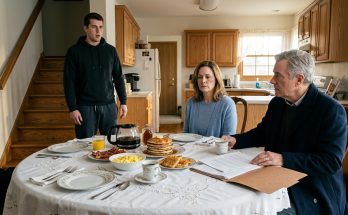
Martin arrived with Naomi before noon.
I did not waste time.
“Why did Daniel have my medical information?”
Martin looked genuinely confused.
“What?”
I showed him Dale’s message.
He read it twice.
“I don't know.”
“That answer is becoming expensive.”
Naomi glanced at me but said nothing.
Martin handed back the phone.
“Daniel did have medical files.”
“Mine?”
“I never looked closely.”
“Why would he have them?”
“Estate planning, maybe.”
“That's a guess.”
“Yes.”
“Then don't give me guesses.”
He nodded.
Patrice had taught me well.
The drive found in Dale’s office was already being imaged by digital forensics. We would not have access until investigators preserved it properly.
But Briggs had sent Patrice an inventory of nonprivileged categories recovered during the search.
One item stood out.
MERCER – FAMILY RISK.
“Do you recognize that?” I asked Martin.
He frowned.
“No.”
“Could it relate to Daniel’s heart condition?”
“Possibly.”
Again.
Possibly.
I was learning to live inside that word.
By late afternoon, Briggs confirmed the recovered flash drive matched the type Rebecca described and contained files dated before Daniel’s death.
The first accessible directory was labeled CAH.
My initials.
Inside were scanned medical records.
Blood-pressure readings.
Family history.
A cardiology referral I had forgotten about.
I stared at the date.
Sixteen years earlier.
Two years before Daniel died.
I remembered the appointment.
Barely.
I had experienced chest tightness at work.
The doctor believed it was stress but referred me because our father died of heart disease.
Tests were normal.
I had told Dale.
Apparently I had told Daniel too.
There were handwritten notes attached.
Daniel’s handwriting.
Carol needs better coverage. Dale’s company plan is garbage.
I laughed despite myself.
That was Daniel.
Blunt even on paper.
Another file contained life-insurance comparisons.
But not policies.
Quotes.
Daniel had apparently investigated buying insurance for both of us.
Beneficiary structures.
Estate planning.
Family risk.
“He wasn't secretly insuring me,” I said.
Patrice nodded.
“He was planning.”
Martin stared at the documents.
“I remember this now.”
I looked at him sharply.
“What?”
“Daniel talked about key-person coverage and family policies.”
“Why?”
“Because your father died young.”
“So Dale’s message was technically true.”
“Yes.”
My medical information had been in Daniel’s files.
But the implication Dale wanted me to draw was false.
Daniel had been trying to protect me.
Dale had later used those old records as a source.
We kept examining the directory.
Then Elise found metadata linking the later insurance applications to scanned documents originating from Daniel’s archive.
The same old address template.
The same transposed ZIP code.
That explained the repeated mistake.
Daniel’s secretary had typed the wrong ZIP years earlier.
Dale copied the profile repeatedly.
One clerical error had survived sixteen years of fraud.
I almost admired the stupidity of it.
Almost.
“Can the policies be voided?” I asked.
Patrice answered carefully.
“We'll notify the insurers through appropriate channels. Their legal teams will investigate issuance and ownership.”
“And the premiums?”
“Part of the financial tracing.”
The policies were no longer mysterious.
Still disturbing.
Still unauthorized.
But not evidence by themselves of a plan to kill me.
That mattered.
I felt some fear loosen.
Not disappear.
Loosen.
Then the digital examiner opened another directory.
DANIEL – FINAL.
Inside were copies of the documents Daniel had planned to give me.
The disputed distributions.
Property schedules.
Emails with Ray.
Messages with Martin.
Draft complaints.
And a spreadsheet titled RECOVERY.
Daniel had calculated what Dale needed to return.
$612,440.
Beside the amount, he had written:
Give him until Friday. Then Carol gets all of it.
No hidden murder accusation.
No mysterious criminal conspiracy beyond the money.
Daniel had believed he could confront Dale, recover what was taken, and tell me afterward.
He had underestimated what Dale would do when cornered.
The final folder contained audio.
Several recordings.
We listened with investigators present.
Daniel had recorded meetings.
Ray complaining that Dale’s paperwork was too aggressive.
Martin warning that signatures could not simply be “cleaned up.”
Dale insisting nobody would question transfers among closely connected businesses.
Then one recording stopped everyone.
It had been made in Daniel’s office nine days before his death.
Dale said, “If Carol ever sees the whole structure, she'll divorce me.”
My heart tightened.
Daniel answered, “Then maybe stop stealing from her brother.”
Dale laughed.
“I'm not stealing.”
“You moved money without permission.”
“I moved money where it could work.”
“You forged an authorization.”
A pause.
Then Dale:
“It was administrative.”
Daniel laughed bitterly.
“You have a word for everything.”
The recording continued.
Dale argued that Daniel was overreacting.
Daniel said he would tell me.
Then Dale replied:
“You tell Carol and you blow up my family.”
Daniel answered:
“You did that yourself.”
I closed my eyes.
Fourteen years earlier, my brother had understood something I had only learned now.
The truth does not destroy what betrayal built.
It reveals that the damage already exists.
The recording ended without threats.
Again, that mattered.
No promise to harm Daniel.
No plan.
Financial conflict.
Fear.
Desperation.
But nothing that allowed me to simplify the story into murder.
The next recording was different.
It had been made the afternoon Daniel died.
Ray’s voice.
“Dale wants the originals.”
Daniel:
“He can want.”
Ray:
“He thinks you're going to the police.”
Daniel:
“If he doesn't fix it.”
Ray:
“You know what that does to Carol.”
Daniel:
“Stop using my sister.”
That sentence made my chest tighten.
Ray continued.
“I'm telling you, give him time.”
“He's had time.”
“Friday.”
“No.”
Then Daniel said something that made Martin sit upright.
“I already changed the trust.”
Patrice paused the recording.
“What trust?”
Martin shook his head.
“I don't know.”
We resumed.
Ray asked the same question.
Daniel answered:
“The one Dale doesn't know about.”
Then the recording ended.
Another trust.
Patrice looked at Martin.
“Any idea?”
“No.”
“Could Daniel have created one without you?”
“Yes.”
“With another lawyer?”
“Absolutely.”
“Who?”
“I don't know.”
We searched Daniel’s archived records.
Nothing.
Then I remembered the photograph.
First one together.
The warehouse.
Daniel had written notes on the back.
Maybe he stored personal records outside the business system.
I called my sister.
“Do you have any of Mom and Dad’s old boxes?”
She thought I had lost my mind.
“Which boxes?”
“Daniel’s things.”
“Some are in my attic.”
“Did anything come from his house?”
“Yes.”
“How much?”
“Carol, that was fourteen years ago.”
“I know.”
She heard something in my voice.
“I'll look.”
Two hours later, she called.
“I found a metal file box.”
My heart jumped.
“Locked?”
“No.”
“Anything labeled trust?”
“Not exactly.”
“What is there?”
“Old insurance papers. Family documents. Something from a law office.”
“Which law office?”
She read the name.
HENDERSON & PIKE.
Not Ray Dunning.
Not anyone we knew.
Patrice searched immediately.
The firm still existed.
One partner from that era remained.
Samuel Pike.
Eighty-one years old.
Semi-retired.
Patrice called.
He remembered Daniel.
Not immediately.
Then she mentioned Mercer Holdings.
His tone changed.
“Yes.”
“What did you do for him?”
“I would need authorization before discussing a former client.”
“Mr. Harris is deceased.”
“I understand.”
“We represent his sister, who may be beneficiary of a trust.”
A long pause.
“What is the sister’s name?”
“Carol Ann Harris.”
Another pause.
Then Pike said, “I've been wondering when she would call.”
I gripped the edge of the table.
Patrice put him on speaker with permission.
“What trust?” I asked.
Pike’s voice was elderly but clear.
“Your brother came to me because he no longer trusted his existing business counsel.”
“Ray Dunning.”
“Yes.”
“When?”
“About two weeks before his death.”
“What did he create?”
“A contingent asset trust.”
“For what assets?”
“Any interest recovered from disputed transfers involving Mercer Holdings.”
I stared at Patrice.
“Who was beneficiary?”
“You.”
“And trustee?”
“Initially Daniel.”
“After his death?”
Pike hesitated.
“A bank trust department.”
Not Martin.
Not Ray.
Not Dale.
Daniel had cut them all out.
“Why didn't anyone contact me?”
“Because the trust was unfunded.”
I frowned.
“What does that mean?”
“Daniel had not yet transferred assets into it.”
“So it's worthless?”
“Not necessarily.”
Pike explained that the trust contained assignments of claims.
Rights to recover property improperly transferred.
Rights connected to Daniel’s disputed ownership.
Those rights might have survived even though Dale later moved the assets.
Patrice became intensely focused.
“Do you have originals?”
“Yes.”
“Where?”
“Our archive.”
For the first time, Daniel had left something Dale never touched.
A legal structure outside his reach.
Pike agreed to coordinate with Patrice after verifying authority.
I sat back.
“What does this change?”
Patrice chose her words carefully.
“It may strengthen the chain between Daniel’s estate claims and you.”
“So Dale can't say everything became his.”
“He can say anything. Proving it is another matter.”
I almost smiled.
By evening, we had another piece of Daniel’s planning.
But the recovered flash drive still contained unopened encrypted files.
The examiner called Briggs shortly before seven.
“One archive just unlocked.”
Briggs put him on speaker.
“What is it?”
“Video.”
My stomach tightened.
“From where?”
“Looks like a dash camera.”
Daniel’s vehicle.
The date was the night he died.
The camera had recorded portions of the drive automatically.
Not everything survived.
Files were corrupted.
But one segment opened.
We watched Daniel’s dashboard view as headlights moved along a dark road.
Rebecca’s younger voice was audible.
Then Daniel.
Then the image jolted as he turned into the garden-center lot.
Several minutes passed.
Another vehicle arrived behind him.
Dale’s truck.
My breathing stopped.
The video did not show inside Daniel’s car.
But audio continued.
Rebecca said, “Dad, call somebody.”
Dale’s voice:
“Give me the phone.”
Daniel:
“Call an ambulance.”
Then doors.
Movement.
Dale:
“Where's the folder?”
Daniel swore at him.
Rebecca began crying.
The recording crackled.
Then Daniel said:
“Dale, I'm serious.”
Dale answered:
“So am I.”
The video froze.
Corruption.
We waited while the examiner recovered the next segment.
When it resumed, Daniel’s breathing sounded terrible.
Rebecca was begging.
Then Dale said something I had never expected.
Not about money.
Not about documents.
About me.
“If I call now, Carol finds out why we're all here.”
Daniel forced out a reply.
“Then let her.”
Silence.
Then Dale:
“You always get to be the good brother.”
Daniel:
“Call.”
The next section was damaged.
When audio returned, a truck door slammed.
Rebecca screamed, “We can't leave him.”
Then the recording ended.
Nobody spoke.
We finally had Daniel’s own dash camera confirming the essential sequence.
Dale had known Daniel wanted medical help.
Rebecca had begged him.
And Dale had taken her away.
But the video also clarified something else.
He had not delayed because he wanted Daniel dead.
At least not from anything recorded.
He delayed because calling immediately would expose the meeting, Rebecca, the folder, the financial dispute, and his own presence.
He chose concealment.
Perhaps he told himself it would take only minutes.
Perhaps he believed Daniel would survive.
Perhaps he did not think at all beyond the next problem.
Whatever he believed, he chose.
That night I returned to my sister’s house exhausted.
At ten twelve, Rebecca called.
“I finished with the investigators.”
“How are you?”
“Terrible.”
“Me too.”
She gave a small, broken laugh.
Then she asked, “Mom, do you hate me?”
“No.”
The answer came immediately.
“Are you angry?”
“Yes.”
She cried.
“So am I.”
“At me?”
“At everyone.”
We sat in silence across miles.
Then Rebecca said, “There's one thing I didn't tell them until today.”
My chest tightened.
“What?”
“Dad contacted me three months ago.”
“About Daniel?”
“Yes.”
“What did he want?”
“He said the old statement needed to disappear.”
I sat upright.
“Why three months ago?”
“I asked him.”
“What did he say?”
Rebecca hesitated.
“He said he was finally leaving you and couldn't have old family garbage surfacing during the divorce.”
Ashley.
The timetable.
The dismantling.
Everything connected.
“What did he ask you to do?”
“Sign a new statement.”
“Saying what?”
“That Uncle Daniel never asked Dad to call an ambulance.”
I closed my eyes.
“Did you sign?”
“No.”
“What happened?”
“He got angry.”
“How angry?”
“He said if I refused, he could prove I stole from Daniel.”
After fourteen years, he was still using the same fear.
“Rebecca, why didn't you tell me then?”
“I almost did.”
“What stopped you?”
She began crying again.
“Because Dad said you had finally started being happy.”
I stared into the dark room.
Happy.
That was how he had described my ignorance.
Then Rebecca said, “Mom, I think that's when he bought Ashley the ring.”
Three months ago.
The same period Dale began pressuring Rebecca.
The same period large transfers accelerated.
The same period he prepared documents for my signature.
The divorce had not been an emotional decision.
It had been a project.
And Dale had started cleaning old evidence before I ever knew there was another woman.
Click here to continue reading: PART 15: Dale’s Divorce Plan Had Begun Months Before Ashley’s Ring, and the Asset Map Showed He Intended to Leave Everyone Else Holding His Risk
Every Thursday She Sat in My Chair and Confided in Me About a Married Man She Thought Would Soon Be Hers
Part 14 of 24