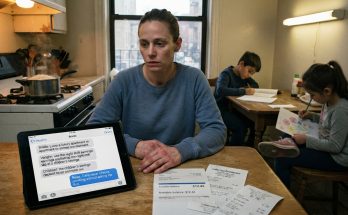
The email came through an account created that morning.
No signature.
No explanation.
Only the photograph and one sentence.
ASK VAUGHN WHO HELD CALEB UNDER.
Serrano told me not to reply.
I replied.
Who are you?
He swore when I admitted it.
“I told you not to engage.”
“You told me after I read an accusation that my husband killed his brother at sixteen.”
“That doesn’t make unknown contacts safe.”
“No. It makes silence impossible.”
Denise sat beside me on the protected apartment’s sofa.
“She’s already responded. Focus on preserving it.”
Serrano looked as though he wanted to argue.
Instead, he asked cybercrime investigators to trace the message.
The sender responded eleven minutes later.
Someone Daniel should have listened to.
Then:
Ruth has him.
My heartbeat changed.
Daniel was alive.
Or had been when the sender knew.
Where?
No response.
Serrano instructed me to stop.
This time I did.
Investigators traced the email through several layers of anonymizing services.
No useful location.
But the attached photograph carried an older embedded scan label.
MERCER_ARCHIVE_04.
Daniel’s archive.
The sender had access to his files.
“Ruth?” I asked.
Serrano shook his head.
“Why would Ruth accuse Vaughn?”
“Leverage.”
“Against who?”
“Could be anyone.”
Another person from Daniel’s hidden network seemed just as likely.
Every time we uncovered what I thought was the whole structure, another invisible participant appeared.
I looked toward the bedroom.
June slept with Mrs. Weaver beside her.
Emmett was awake reading but turning the same page repeatedly.
I lowered my voice.
“Can you question Vaughn about Caleb?”
“We can.”
“Will he talk?”
“That depends on his attorney.”
“He’ll lie.”
“Possibly.”
“No. Definitely.”
Serrano gave me a tired look.
“Then sometimes the lie is evidence too.”
That afternoon, police formally questioned Vaughn about his brother.
I was not allowed to watch.
I did not need to.
Serrano summarized later.
Vaughn admitted Caleb existed.
Claimed they had barely known each other.
Said the boating accident happened during a summer visit.
“He told me he was an only child.”
“Apparently false.”
“What happened on the boat?”
“Vaughn says Caleb stood, lost balance, hit his head, fell overboard.”
“Did Vaughn try to save him?”
“He says yes.”
“Any witnesses?”
“No.”
“Autopsy?”
“Drowning. Minor head injury consistent with striking part of the boat.”
“Alcohol?”
“None.”
“Why the insurance?”
“Ruth had policies on both boys.”
Both.
“What was Vaughn’s?”
“Same amount.”
Fifty thousand each.
Two sons turned into symmetrical policies.
“Did Daniel believe Vaughn killed Caleb?”
“His notes suggest he suspected it.”
“What notes?”
Serrano showed me a scan recovered from the Michigan basement.
C. bruising inconsistent with fall? Ask R.
V’s statement changes twice.
R pushes no autopsy extension.
Policy paid 11 days.
Then:
V not sleeping. Says C “wouldn’t stop fighting.”
My stomach tightened.
“How old was Vaughn?”
“Sixteen.”
A child.
Old enough to understand death.
Young enough to have been shaped by an adult.
“What does that mean?”
“We don’t know.”
But I imagined a sixteen-year-old Vaughn sitting somewhere after his brother drowned, telling his father Caleb would not stop fighting.
Not stop drowning.
Fighting.
The word mattered.
“What did Ruth tell police?”
“That Vaughn was traumatized and confused.”
Of course.
Protect the surviving asset.
Collect.
Move on.
“Where was Marla?”
“Eleven years old.”
“And Daniel?”
“Not present.”
Another absence.
Another reason he might have spent decades collecting papers afterward.
The unknown sender emailed again.
This time directly to me.
You are asking the wrong question.
I showed Serrano without replying.
“What’s the right one?” I asked.
He did not know.
Another email arrived.
Not who killed Caleb.
Who got paid after Caleb died.
We knew Ruth.
Fifty thousand.
Then a second attachment loaded.
Bank record.
Forty-eight thousand six hundred dollars transferred three days after Ruth received the insurance payout.
Recipient:
DANIEL MERCER.
I stared at it.
“He got the money.”
Denise leaned closer.
“Almost all of it.”
“So Daniel was part of it.”
Serrano cautioned, “A transfer alone doesn’t prove why.”
I barely heard him.
The father who supposedly spent years documenting Ruth’s crimes had taken the first insurance money after his son died.
Maybe his files were not conscience.
Maybe they were insurance of another kind.
Protection.
Blackmail.
A record kept by a participant afraid the others might turn on him.
“Find out what Daniel did with the money.”
Investigators did.
Part paid a mortgage.
Part went into a company.
Mercer Risk Consulting.
The original fraud business connected to Daniel’s old investigation.
Caleb’s death had funded it.
My skin crawled.
The family enterprise had not merely existed around death.
Death capitalized it.
The email sender wrote again.
Now you understand why Ruth needs the file.
I broke Serrano’s rule.
What does the file prove?
The answer came quickly.
That Caleb was not first.
I read it aloud.
No one spoke.
“Who was before him?”
No answer.
Instead:
Daniel hid the first death because it made Caleb look like a pattern.
Then:
Ruth hid Caleb because it made Vaughn useful.
Denise whispered, “Useful.”
The same word again.
I typed:
WHO ARE YOU?
This time the sender answered.
Evelyn Shaw.
The name meant nothing.
Serrano searched immediately.
Evelyn Shaw.
Sixty-four.
Retired claims investigator.
Worked for an insurance carrier that handled Caleb’s policy.
“She investigated it?”
“Apparently she reviewed the claim.”
“Why is she contacting me now?”
Serrano called the number listed for her.
Disconnected.
Property records showed Evelyn lived outside Green Bay.
Local officers were sent.
She was there.
Alive.
And willing to speak.
By video, Evelyn looked smaller than I expected.
White hair cut short.
Sharp eyes.
No hesitation.
“I contacted Daniel after Caleb died,” she said.
“Why?” Serrano asked.
“The claim bothered me.”
“What specifically?”
“Timing. Family structure. A prior claim.”
There it was.
“Whose?” I asked.
Evelyn looked directly into the camera.
“Ruth’s husband.”
“Which husband?”
“The one before Daniel.”
I felt my stomach tighten.
Name:
Peter Keene.
Marla’s father.
He had died when Marla was three.
“Cause?”
“Workplace accident.”
“How much insurance?”
“Seventy-five thousand dollars.”
“Beneficiary?”
“Ruth.”
“Did Daniel know Peter?”
Evelyn nodded.
“They worked together.”
Silence settled.
“Was Daniel involved in Peter’s death?”
“I never proved anything.”
“What did you suspect?”
“Peter fell from scaffolding at a warehouse. No witnesses except Daniel.”
Of course.
One survivor.
Again.
“What did Daniel say?”
“That Peter slipped.”
“What did Ruth do afterward?”
“Collected the policy.”
“And Daniel?”
“Moved in with her four months later.”
My mouth went dry.
Vaughn had not invented the architecture.
He had inherited it from adults who had already rehearsed the shape.
“How does Caleb connect?”
Evelyn continued.
“When Caleb drowned, I recognized Ruth’s name. Different carrier. Same pattern. Accident. One witness. Quick pressure for payment.”
“Witness Vaughn.”
“Yes.”
“You thought a sixteen-year-old killed his brother for insurance?”
“I thought a sixteen-year-old might have been taught what accidents could accomplish.”
The sentence chilled me.
“Did you tell police?”
“I tried.”
“What happened?”
“Daniel intervened.”
“How?”
“He said the boys were grieving. Ruth was unstable. Another investigation would destroy the family.”
“And you accepted that?”
“No.”
“Then why wasn’t it reopened?”
“Because suspicion is not evidence.”
I looked at Serrano.
The phrase was painfully familiar.
Evelyn continued.
“I started keeping copies.”
“With Daniel?”
“Eventually.”
“Why trust him?”
“I didn’t.”
That answer surprised me.
“He contacted me years later.”
“When?”
“After Ruth started using Vaughn in financial schemes.”
“What did he want?”
“To stop her.”
“After taking Caleb’s insurance money?”
Evelyn’s expression did not change.
“Yes.”
“Why should anyone believe him?”
“They shouldn’t without proof.”
Finally, someone connected to this story who did not ask for trust first.
“What’s in the original Mercer file?”
Evelyn looked away from the camera.
“Everything Daniel never gave police.”
“Such as?”
“Caleb’s statement.”
I leaned forward.
“Caleb gave a statement?”
“Before he died.”
The room went still.
“When?”
“Three months before.”
“To whom?”
“To a school counselor.”
“What did he say?”
Evelyn answered carefully.
“He said his mother wanted Vaughn to help scare him.”
“Scare him how?”
“Make him believe he could lose his place in the family.”
“That sounds vague.”
“It was. But he mentioned the lake.”
“What about it?”
“He said Ruth kept telling Vaughn that if Caleb disappeared, Vaughn would finally be ‘the important son.’”
My stomach turned.
Children competing for love.
One adult assigning value.
One policy waiting.
“Did the counselor report it?”
“Family conflict. No direct abuse disclosed.”
“What happened to the statement?”
“Daniel obtained a copy after Caleb died.”
“Why didn’t he give it to police?”
Evelyn’s face hardened.
“That is the question you should ask him.”
If he was alive.
I asked, “Why are you contacting me instead of Serrano?”
“I tried law enforcement years ago. Files vanished.”
Serrano straightened.
“What agency?”
“Local.”
“Are you alleging corruption?”
“I’m alleging Ruth had help.”
Another layer.
“Who?”
“I don’t know.”
“Then why now?”
“Because Daniel called me yesterday.”
My heartbeat changed.
“What did he say?”
“That Ruth finally knew he had preserved the original file.”
“Did he sound afraid?”
“Yes.”
“What else?”
“He said if anything happened to him, I should contact Celia Mercer.”
I stared at the screen.
“Why me?”
Evelyn’s eyes softened for the first time.
“Because he said you were the first person Vaughn chose who might survive long enough to expose all of them.”
I did not know whether that was meant as praise.
It felt like another burden.
Then Serrano’s phone rang.
Michigan State Police.
Daniel had been found.
Alive.
Barely.
At a hunting shed twelve miles from his property.
Head injury.
Dehydrated.
Hands bound.
Ruth gone.
“Conscious?” I asked.
“Intermittently.”
“Can he talk?”
“Some.”
“Did he say where Ruth went?”
Serrano listened.
His expression changed.
“What?”
“He said one word.”
“What word?”
“Lake.”
I thought of Caleb.
The boating accident.
The place where the family’s first confirmed death had taught them what one surviving witness could accomplish.
Evelyn spoke from the screen.
“There was only one lake Daniel ever meant when he talked about Ruth.”
“Which?”
“Black Pine Lake.”
Serrano asked Michigan officers to secure it.
Evelyn interrupted.
“You’re late.”
Everyone looked at her.
“What do you mean?”
She swallowed.
“Ruth kept a second property there under another name.”
“What name?”
Evelyn hesitated.
Then said:
“Caleb Mercer.”
A dead boy had apparently owned property for nineteen years.
And Ruth might be there now with the file that could prove why he died.
Click here to continue reading: PART 15: Black Pine Lake Held the Boat Caleb Died In, and Beneath Its Floorboards Police Found the Evidence Daniel Could Never Bring Himself to Destroy
My Husband Handed Me an Eighty-Dollar Grocery Limit, but the Numbers in Our Account Told a Much Stranger Story
Part 14 of 19