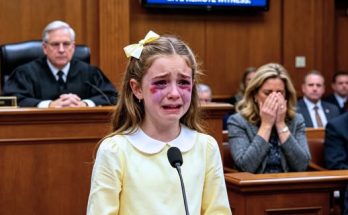
The courthouse looked disappointingly ordinary. I had imagined something heavier, more imposing, a building capable of acknowledging the magnitude of what could happen inside it. Instead there were gray steps damp from overnight rain, metal detectors, fluorescent corridors, and signs directing people toward departments identified by numbers. Families entered carrying folders and fear. Attorneys walked quickly while checking phones. Somewhere down the hall, a child was crying.
Harper walked beside me in a blue dress and black shoes she disliked because they pinched her toes.
The tablet was inside a canvas shoulder bag.
She had packed it herself.
Caleb arrived separately with his attorney, Victoria Hale, a woman whose courtroom manner was so polished that even insults sounded reasonable when she delivered them.
Caleb wore a charcoal suit.
His hair was freshly cut.
When he saw Harper, he smiled broadly.
"There she is."
Harper moved closer to me.
Caleb's eyes dropped to the canvas bag.
"What did you bring?"
"Stuff."
"You don't need electronics in court."
"I want it."
"Give it to me. I'll put it in the car."
"No."
The word was quiet.
Victoria looked over from her files.
Caleb maintained his smile.
"Harper."
"I said no."
People were walking around us. A court officer stood twenty feet away.
Caleb could not use the tone he used at home.
His expression tightened instead.
"Fine."
He turned away.
I felt Harper exhale.
Mara arrived carrying two thick binders and a coffee she had clearly forgotten to drink.
She greeted Harper, then looked at me.
"You okay?"
"No."
"Good. People who tell me they're completely fine before custody hearings are usually about to fall apart."
Despite everything, I almost smiled.
She lowered her voice.
"Remember what we discussed. Answer what you're asked. Don't volunteer theories. Don't react to Caleb's attorney."
"I know."
"You know intellectually. I'm reminding your nervous system."
We entered the courtroom shortly after nine.
Harper sat with her court-appointed advocate in the gallery rather than at either parent's table. She placed the canvas bag beneath her chair.
I noticed she kept one shoe pressed against it.
The judge entered.
Everyone stood.
Her name was Elena Marwood. I had seen her twice during procedural hearings. She was in her late fifties, silver hair cut at her jaw, with the patient expression of someone who had learned not to mistake confidence for truth.
The hearing began slowly.
That almost made it worse.
No dramatic accusations. No raised voices. The machinery of the law moved through exhibits and declarations while my future with my daughter sat somewhere inside stacks of paper.
Victoria presented Caleb's case first.
She described him as structured, dependable, financially responsible, and deeply involved in Harper's daily life.
All technically defensible statements.
Then she described me.
Not as a bad mother.
That would have sounded excessive.
She called me loving but emotionally inconsistent.
She said I struggled with stress.
She mentioned missed appointments, periods of crying, unusual spending, and conflict inside the home.
Every phrase had been calibrated to create concern without sounding cruel.
Caleb testified.
He was excellent.
I hated recognizing that.
He did not attack me.
He expressed concern.
"I don't want Claire separated from Harper," he said.
My fingers curled beneath the table.
"I believe children need both parents. My concern is simply that Claire has been under significant emotional pressure, and she sometimes has difficulty regulating that pressure."
Victoria nodded sympathetically.
"Can you give the court an example?"
Caleb hesitated beautifully.
"I don't enjoy discussing private moments."
Mara wrote something on a legal pad and slid it toward me.
PERFORMANCE.
Seeing the word helped.
Caleb continued.
He described arguments in which I cried.
He described the day I arrived late at school.
He described expensive purchases from the household account.
Then Victoria introduced the written statement allegedly made by Harper.
My pulse became so loud I could hear it.
The document was short.
Mara objected to its admission without proper foundation.
The judge allowed limited discussion.
Victoria asked Caleb how the statement had been created.
"I spoke with Harper because she seemed anxious. I asked if she wanted to write down what she was feeling."
"Did you tell her what to write?"
"Absolutely not."
"Did she write it voluntarily?"
"Yes."
I looked toward Harper.
She was staring at him.
Not blinking.
Caleb continued.
"I tried very hard not to put her in the middle."
Mara's pen stopped moving.
Across the room, Harper's hand tightened around the edge of her chair.
Victoria read a portion of the statement.
Harper sometimes felt frightened when her mother became upset.
I looked at my daughter.
She looked down.
The urge to run to her was almost unbearable.
Instead I sat still.
Mara's cross-examination began gently.
"You testified that you manage the majority of family investments?"
"Historically, yes."
"And yet you characterize Mrs. Dawson as financially irresponsible based partly on spending from an account you funded?"
"Claire controlled that account."
"Did you transfer money into it immediately before several of the expenses identified in your declaration?"
"Money moved between our accounts regularly."
"That's not what I asked."
Victoria objected.
Judge Marwood overruled.
Caleb answered carefully.
"I would need to review each transaction."
Mara shifted to the missing funds.
"Do you recognize Arizona Property Holdings?"
Caleb's face remained neutral.
"Vaguely."
"Did you transfer thirty-seven thousand dollars to that entity?"
"I would have to review the records."
"Did you authorize the transfer?"
"I don't recall."
"You work professionally in financial consulting?"
"Yes."
"You keep an eighteen-month record of occasions when your wife cried but can't recall moving thirty-seven thousand dollars?"
Victoria objected immediately.
Judge Marwood's mouth tightened.
"Sustained. Rephrase."
Mara did.
Caleb continued avoiding direct answers.
Nothing collapsed.
No hidden account suddenly appeared.
No dramatic confession arrived.
By late morning I felt the hearing drifting exactly where Caleb wanted it.
Then Victoria presented the Household Incidents document.
Caleb explained that he had created it because he became concerned about patterns in my behavior.
"When did you start it?" Mara asked during cross-examination.
"Approximately eighteen months ago."
"When did you first consult a divorce attorney?"
Caleb hesitated.
"I don't recall the exact date."
Mara lifted a document.
"Would fourteen months ago refresh your recollection?"
Victoria objected.
The judge reviewed the exhibit.
Caleb's first legal consultation had occurred months before he claimed our marriage seriously deteriorated.
It helped.
But not enough.
A person could consult an attorney and still genuinely fear a spouse was unstable.
The story remained contestable.
Then it was my turn.
I swore to tell the truth.
My mouth felt dry.
Mara started with simple questions.
My job.
Harper's routines.
School responsibilities.
Medical appointments.
Household expenses.
Then she asked about Caleb's behavior.
I described the finances.
The conversations.
The way questions became evidence of confusion.
The coaching I suspected.
Victoria objected repeatedly when I moved beyond what I personally knew.
Judge Marwood sustained several objections.
Every time she did, I felt Caleb's narrative tightening around me again.
Finally Victoria stood for cross-examination.
She smiled politely.
"Mrs. Dawson, would you describe the last year as stressful?"
"Yes."
"You've cried frequently?"
"Sometimes."
"You've become angry?"
"Sometimes."
"You've forgotten appointments?"
"A few."
"So when Mr. Dawson describes you as emotionally affected by the breakdown of your marriage, he's telling the truth."
Mara objected.
The judge instructed Victoria to ask a question.
Victoria nodded.
"Have you ever raised your voice in Harper's presence?"
"Yes."
"Have you ever cried in front of her?"
"Yes."
"Have you ever told her negative things about her father?"
"No."
"Never?"
"Not intentionally."
Victoria paused.
"That wasn't my question."
I saw the trap too late.
"No. I have not tried to turn Harper against Caleb."
"Again, that wasn't my question."
Judge Marwood looked toward me.
"Answer directly, Mrs. Dawson."
I could feel heat rising into my face.
"Yes. I have said things about him that were negative."
Victoria let silence do the work.
"Thank you."
When I returned to the table, my hands were shaking.
Mara whispered, "You're doing fine."
It did not feel fine.
A recess was called.
Harper remained with her advocate.
I wanted to go to her.
The advocate asked me not to.
"Give her space."
Across the corridor, Caleb stood with Victoria.
He looked calm again.
Certain.
For the first time all morning he met my eyes directly.
There was no smile.
He did not need one.
His confidence said enough.
You're going to lose.
I remembered the kitchen.
I looked away.
Harper sat at the far end of the corridor with the canvas bag between her shoes.
She unzipped it.
Checked inside.
Closed it again.
Caleb noticed too.
His head turned slightly.
He said something to Victoria.
She followed his gaze toward Harper.
Then they whispered.
When the hearing resumed, the atmosphere had changed in a way I could not explain.
Perhaps only I felt it.
Harper sat straighter.
Caleb glanced toward her repeatedly.
Victoria requested that the court give considerable weight to the written statement attributed to Harper.
Mara renewed her objection.
The judge looked toward the child's advocate.
"Have you discussed this statement with Harper?"
The advocate rose.
"Not this particular document, Your Honor."
Judge Marwood frowned.
"Why not?"
"I was not provided a copy until this morning."
That mattered.
For the first time Victoria looked uncomfortable.
The judge examined the paper.
"Mr. Dawson testified this was created approximately three weeks ago."
"Yes, Your Honor," Victoria said.
"And the child's advocate did not receive it?"
"It was an oversight."
Judge Marwood looked at Caleb.
His posture remained perfect.
"An unfortunate one."
She set the document aside.
"I am not giving significant weight to a child's statement created privately with one litigating parent and withheld from her appointed advocate."
My lungs finally took a full breath.
It was not victory.
But something had shifted.
Victoria began explaining the circumstances.
Judge Marwood raised a hand.
"I've ruled."
Silence.
Then Harper stood.
At first I thought she needed the restroom.
Her advocate touched her arm.
Harper whispered something.
The advocate's expression changed.
She looked toward the judge.
"Your Honor."
Everyone turned.
"My client is asking whether she may address the court."
Caleb stood immediately.
"I don't think that's appropriate."
Judge Marwood looked at him.
"Sit down, Mr. Dawson."
He obeyed.
Harper remained standing.
Her face had gone pale, but her shoulders were straight.
The judge softened her voice.
"Harper, do you want to tell me something?"
"Yes."
"You don't have to do anything you're uncomfortable doing."
"I know."
She bent down and picked up the canvas bag.
Caleb's chair moved.
Not much.
Just enough for me to hear the wooden legs scrape.
Harper opened the bag.
She removed the tablet.
Everything inside me went cold.
The judge watched her.
"What would you like me to know?"
Harper held the tablet against her chest exactly as she had held it on the night she came downstairs for water.
Then she said the sentence that divided our lives a second time.
"Your Honor, can I show you something my mom doesn't know about?"
No one moved.
Mara looked at me.
I shook my head because I genuinely had no idea.
Across the aisle, Caleb's face changed.
It happened in less than a second.
The calm disappeared.
Not completely.
But enough.
His shoulders tightened.
His jaw flexed.
His eyes fixed on the tablet.
"Harper," he said.
His voice still carried the gentle fatherly tone he used around other people.
But underneath it was something I knew well.
"Sweetheart, this isn't the time."
Harper looked directly at him.
What she said next seemed to confuse everyone except Caleb.
"You said the judge should know the truth."
Caleb's fingers closed around the edge of his table.
"That's not what I meant."
Victoria stood.
"Your Honor, I have serious concerns that this child may have been influenced."
Mara rose immediately.
"Not by my client. She has no idea what is on that device."
Judge Marwood looked at me.
"Mrs. Dawson?"
"I don't."
My voice cracked.
"I swear I don't."
Harper's face tightened when she heard me.
The judge turned toward her.
"Why didn't you show this to your mother?"
Harper swallowed.
Her fingers trembled around the tablet.
"Because she already cried a lot because of Dad."
I stopped breathing.
Harper continued.
"And I thought if I showed her, she'd cry more. I didn't want her to know until somebody else could see it too."
The courtroom fell into a different kind of silence.
Not legal silence.
Human silence.
The judge leaned forward.
"What is on the tablet?"
Harper looked at Caleb once.
He shook his head almost invisibly.
I saw it.
Mara saw it.
The judge may have seen it too.
Harper turned back toward the bench.
"A video."
Caleb stood.
"This is absurd."
Judge Marwood's voice hardened.
"Mr. Dawson, sit down."
"You cannot allow a ten-year-old to ambush a custody proceeding with some recording nobody has authenticated."
"Sit down."
Victoria touched his sleeve.
Caleb lowered himself into the chair.
I had never seen him obey anyone with such visible effort.
Judge Marwood asked Harper's advocate to approach.
The attorneys joined them.
They spoke quietly at the bench for several minutes.
I caught fragments.
Private review.
Child protection.
Foundation.
Potential evidence.
Caleb whispered urgently to Victoria.
She did not answer him.
Finally Judge Marwood announced that she would review the material in chambers before deciding whether it could be considered in the hearing.
Only the parties, counsel, Harper's advocate, and necessary court personnel would attend.
Harper would be asked a few preliminary questions but would not remain for any discussion the court considered inappropriate for her.
We moved toward chambers.
My legs felt weak.
Harper carried the tablet.
As we entered the smaller room, Caleb attempted one last time.
"Harper."
She stopped.
For twelve years I had watched Caleb control conversations through timing, tone, and the confidence that everybody around him would eventually yield.
For the first time, his voice sounded uncertain.
"You don't understand what you're doing."
Harper looked at him.
Her expression was not angry.
That somehow made the moment more devastating.
"Yes, I do."
She walked past him.
Inside chambers, Judge Marwood sat behind a broad desk.
Harper stood beside her advocate.
Mara and I took two chairs near the wall.
Caleb and Victoria sat opposite us.
The judge extended her hand.
"May I see the tablet?"
Harper hesitated.
Then she approached.
"It's in a folder."
"What is the folder called?"
Harper glanced at me.
I already knew the answer.
I'd seen it for less than a second in the laundry room before sunrise.
Still, hearing her say it aloud made my throat tighten.
"For when I no longer believe you."
Judge Marwood looked at her.
"Who is 'you'?"
Harper's eyes moved toward Caleb.
He went completely still.
"My dad."
The judge asked when she had created the folder.
"A while ago."
"Why?"
Harper rubbed one thumb against the edge of the tablet.
"Because Dad kept telling me things about Mom. And sometimes I believed him."
My hands folded together in my lap.
"What kinds of things?"
"That she forgets stuff because she's not okay. That she gets too sad. That she spends money wrong. That if people knew everything, I'd have to live with him."
Caleb inhaled sharply.
"That's not—"
Judge Marwood raised one finger.
He stopped.
She looked back at Harper.
"What changed your mind?"
Harper pointed to the tablet.
"That."
The judge accepted the device.
"Did anyone tell you to record this?"
"No."
"Did your mother know you recorded it?"
"No."
"Did her attorney?"
"No."
"Your advocate?"
Harper shook her head.
"Did your father?"
Another head shake.
Judge Marwood studied her for a long moment.
"Why did you wait until today?"
Harper looked down at her shoes.
"Because if Dad found it before court, he'd delete it."
Caleb's chair scraped.
Victoria whispered something sharply to him.
The judge entered the folder.
A single video file appeared.
The date displayed beneath it was three weeks before Caleb filed for divorce.
I recognized the date.
I had been working late that night.
Harper had been home with him.
Judge Marwood pressed play.
The image appeared sideways for a moment before correcting.
A familiar room filled the screen.
Our living room.
The gray chair near the window.
The low coffee table Harper used for puzzles.
The garden visible beyond the glass.
The camera angle was strange, high and slightly tilted, as though the tablet had been balanced on a shelf.
Then Caleb walked into view.
A drink in one hand.
A phone against his ear.
Someone else was sitting on our sofa.
A woman.
Dark hair.
Silk blouse.
Bare feet tucked beneath her.
I recognized her after two seconds.
Vanessa Cole.
Caleb had introduced her to me six months earlier as a financial adviser assisting with some restructuring.
The judge glanced at Caleb.
He had stopped moving.
On the video, Caleb laughed.
It was a laugh I knew.
Dry.
Dismissive.
Certain.
He said something to the person on the phone.
The sound was clear.
And before he finished the first sentence, Caleb's attorney closed her eyes.
Harper looked at me.
I understood from her expression that whatever came next was the reason she had spent weeks guarding the tablet.
The reason she had lied.
The reason she had asked whether judges listened to children.
The reason she had named the folder the way she did.
On the screen, Caleb lifted his glass.
Then he began explaining exactly how he intended to use our daughter against me.
Click here to continue reading: PART 5: Caleb’s Own Voice Filled the Judge’s Chambers, and Every Careful Accusation He Had Built Against Me Began to Change Shape
The Divorce Papers Arrived Quietly, but Caleb Had Been Preparing for a War I Did Not Know We Were Fighting
Part 4 of 24