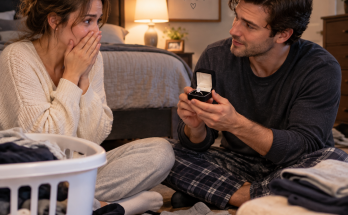
David waited almost another year before asking.
By then his lease had renewed once.
Then again.
He had a key to my apartment.
I had one to his.
Neither key had acquired symbolic weight because neither had been taken under false pretenses.
He kept clothes at my place.
Not boxes.
A drawer.
Two shirts in the closet.
Running shoes near the door.
I kept toiletries at his.
We had created overlap without pretending overlap required merger.
Then one Saturday morning, we were eating breakfast in my kitchen when he said:
“My lease renewal is coming up again.”
I looked over my coffee.
“Dangerous sentence.”
“I know.”
He smiled.
“So I want to separate two questions.”
I waited.
“First: do I want to renew my apartment?”
“Okay.”
“Second: do we want to live together?”
My pulse changed.
Not panic.
Attention.
He continued.
“I don’t want the lease deadline to answer the second question for us.”
That sentence alone made me love him a little more.
“What do you want?”
He looked at me.
“I want to live with you.”
Simple.
No speech about wasted rent.
No:
We practically live together anyway.
No:
If you loved me.
No financial optimization.
Just desire.
“Here?”
“Maybe.”
“What does maybe mean?”
“It means I’m not assuming your apartment becomes ours because I ask.”
I put down my cup.
He had thought about this.
“Options?”
“We could live here. Find somewhere together. Keep separate places.”
“All acceptable?”
“Yes.”
“If I say I want separate places?”
“I renew.”
“And us?”
“We keep dating.”
I stared at him.
He laughed softly.
“You’re testing the exit.”
“Yes.”
“Exit works.”
That was the answer beneath the answer.
A yes only feels free when no survives.
I looked around the kitchen.
The apartment no longer felt fragile.
Jason’s history was not sitting at the table with us.
Eleanor’s boxes were not outside.
Mom’s legal papers were not hidden in a drawer waiting to protect me.
This was simply a housing conversation.
I realized I wanted to keep it that way.
“I don’t want to move.”
“Okay.”
“I also don’t want you to give up your place yet.”
David nodded.
“Okay.”
“But I do want to talk about living together eventually.”
“Okay.”
I narrowed my eyes.
“You are suspiciously agreeable.”
“What would you prefer?”
“Some mild conflict for realism.”
He reached for toast.
“I hate your dining chairs.”
I gasped.
“Get out.”
“Excellent. Relationship restored.”
We laughed.
Then I became serious.
“I need something.”
“Tell me.”
“If we live here someday, the apartment stays legally mine.”
“Yes.”
Immediate.
No hesitation.
“You didn’t even think.”
“I have thought.”
“What if you contribute to expenses?”
“We document it.”
“What if we renovate?”
“We document it.”
“What if we marry?”
He paused.
Not because he objected.
Because that word deserved time.
“If we marry, we talk to lawyers before anything changes.”
My throat tightened.
Plural.
Lawyers.
Not one family attorney guiding everyone.
Independent advice.
“Your lawyer too.”
“Yes.”
“And mine.”
“Yes.”
“Prenup?”
“If that’s what we decide.”
I smiled.
“You really know how to seduce an emotionally recovered woman.”
“I’m an architect. Documentation is foreplay.”
I nearly spit out my coffee.
The conversation lasted two hours.
Not because we were in crisis.
Because important decisions deserved time.
We discussed money.
Income.
Debt.
His child’s future needs.
My parents.
His mother.
Household expenses.
Privacy.
Work space.
Guests.
Keys.
Even plants.
“No permanent family plant access,” David said.
“Nonnegotiable.”
By lunch, nothing was decided.
That felt excellent.
He went home.
I stayed.
No countdown.
No emotional hangover.
The next week I discussed it with my therapist.
“What do you want?”
“I think eventually I want him here.”
“Eventually?”
“Yes.”
“What needs to happen first?”
“I want us to make the agreement while neither of us needs it.”
She smiled.
“That sounds wise.”
I met Laura for coffee.
Not because the relationship was in trouble.
Because it wasn’t.
That was exactly when legal planning should happen.
“I’m considering cohabitation.”
Laura smiled.
“Congratulations.”
“Don’t get excited.”
“I’m a lawyer. I’m incapable.”
“I want to understand how to keep the apartment separate.”
She explained.
Written cohabitation agreement.
Expense treatment.
Improvements.
No accidental equity claims.
Property boundaries.
Potential future prenup if marriage entered the conversation.
None of it sounded romantic.
Good.
Romance did not need to carry legal infrastructure.
“Would you represent both of us?”
“No.”
I smiled.
“Correct answer.”
David found his own attorney.
We exchanged financial disclosures.
Voluntarily.
Not because a lender required them.
Not because either of us suspected the other.
Because informed decisions require information.
When David sent his documents, I almost laughed.
“What?”
We were sitting at my dining table.
“You gave me everything.”
“That was the assignment.”
“Bank statements.”
“Yes.”
“Retirement.”
“Yes.”
“Student loans.”
“Still there, tragically.”
“No secret nine-million-dollar bridge facility?”
“Not unless my accountant has been extremely creative.”
I smiled.
He did not ask to see my face as proof I trusted him.
He simply provided records.
I provided mine.
Then each attorney reviewed the agreement.
I changed two provisions.
David changed one.
Nobody called the changes insulting.
Nobody said love should make contracts unnecessary.
That phrase had become one of my least favorite ideas.
Trust is not the absence of clarity.
Sometimes clarity is how trust protects itself.
Six months after the first breakfast conversation, David moved in.
Not because his lease expired that day.
It had another month.
We chose a Saturday.
Deliberately.
He hired movers.
I knew exactly what was arriving.
No surprise boxes.
No mother.
No hidden plan.
Claire came over in the morning carrying another plant.
“No.”
She looked offended.
“This is a housewarming gift.”
“You have turned my apartment into a greenhouse.”
“It’s symbolic.”
“That makes it worse.”
David accepted the plant.
Traitor.
Mom arrived at noon.
By invitation.
She stood in the living room looking at boxes.
I watched her face.
“What?”
“Nothing.”
“You’re thinking something.”
“I’m thinking this looks different.”
We both knew what she meant.
The wedding-night plan.
Eleanor’s boxes.
Unauthorized occupancy.
A fact meant to precede permission.
These boxes were labeled.
Discussed.
Wanted.
“Yes.”
Mom smiled.
“Very different.”
Then she asked David:
“Where do you want the books?”
He looked at me.
I laughed.
“Ask him. They’re his.”
Mom blinked.
Then:
“Where do you want the books?”
David pointed toward the guest room.
Mom carried them there.
Tiny correction.
Immediate.
No drama.
By evening, most boxes were unpacked.
David’s furniture did not all fit.
We sold some.
Kept some at storage temporarily.
He hated my dining chairs but agreed they stayed until we chose replacements together.
Compromise.
Not capitulation.
When everyone left, the apartment felt different.
More occupied.
I walked through the rooms.
His coat by the door.
His books.
His shoes.
A framed photograph of his daughter.
Coffee beans I considered inferior.
Nothing felt like invasion.
David stood in the bedroom.
“You okay?”
“Yes.”
“Sure?”
I thought before answering.
“Yes.”
That mattered.
Not automatic reassurance.
An actual check.
He came closer.
“Want me to unpack the rest tomorrow?”
“Yes.”
“Want space tonight?”
“No.”
He smiled.
“Okay.”
We slept.
At three in the morning, I woke suddenly.
For a second I did not know why.
Then I heard a box shift in the living room.
Probably settling cardboard.
My heart raced.
Old memory.
Boxes entering my home.
I sat up.
David woke.
“What?”
“Nothing.”
He turned on the lamp.
“Sophia.”
“I’m okay.”
He waited.
I exhaled.
“The boxes.”
He understood.
Not perfectly.
Enough.
“Want me to move them?”
“No.”
“Want me to sit with you?”
“Yes.”
So we sat.
No speech.
No promise that he would never hurt me.
Nobody can honestly promise that.
Eventually my pulse slowed.
I looked at him.
“This is embarrassing.”
“No.”
“It’s been years.”
“So?”
“I thought I was past it.”
He rubbed his eyes.
“You are past it.”
“Apparently not.”
“You’re sitting beside boxes you chose to bring into your house.”
I looked at him.
“That seems pretty past it to me.”
I laughed softly.
Maybe he was right.
Healing did not mean old alarms never sounded.
It meant I could inspect the room and recognize the difference.
These boxes were supposed to be here.
I had invited them.
At breakfast the next morning, we unpacked the last one.
Inside was a framed photograph of David and his daughter.
He placed it on the bookshelf.
The exact shelf where my engagement photograph once stood.
I noticed.
He did not.
For a moment, I considered telling him.
Then decided not to.
Not every coincidence required interpretation.
I moved the photograph slightly because it looked better beside the lamp.
Design choice.
Nothing more.
Months passed.
Living together was not a test we had to pass.
Sometimes it was wonderful.
Sometimes David left wet towels where I hated them.
Sometimes I worked too late and became irritable.
We argued about groceries.
Noise.
His daughter’s weekend schedule.
Whether the guest room could become a partial office.
Normal conflict.
The first time we had a serious argument, I waited for the manipulation.
It did not come.
David wanted his daughter to have a permanent room.
I worried about losing my workspace.
We disagreed.
He became frustrated.
So did I.
Then he said:
“Let’s stop tonight.”
My body tensed.
Stop meant what?
Punishment?
Withdrawal?
Instead:
“We’re tired. We can continue tomorrow.”
And we did.
No silent treatment.
No emergency.
No argument transformed into proof I did not love him.
We eventually redesigned the guest room with a Murphy bed and separate storage for his daughter.
She loved it.
I kept my desk.
Nobody lost.
That should not have felt revolutionary.
It did.
One evening, about a year after David moved in, we were cooking when he said:
“I have another dangerous question.”
I looked at him.
“What?”
“Do you ever want to get married again?”
The knife in my hand stopped.
Not:
Will you marry me?
Do you ever want.
A question about possibility.
I put the knife down.
“I don’t know.”
“Okay.”
“You?”
“Yes.”
I looked at him.
“That doesn’t scare you?”
“What?”
“That I don’t know.”
“No.”
“Why?”
“Because you don’t owe me the answer I want.”
There it was again.
The difference.
He returned to chopping vegetables.
No mood change.
No wounded silence.
No deadline.
I watched him.
Then I realized something.
Years earlier, if someone asked whether I could ever marry again, my answer would have been about Jason.
Because Jason lied.
Because Jason used marriage.
Because Jason turned vows into financial access.
Now my uncertainty had nothing to do with him.
It was mine.
Maybe I wanted marriage.
Maybe not.
Maybe I would decide later.
The important thing was that Jason no longer occupied the question.
I picked up the knife.
“Ask me again someday.”
David smiled.
“Someday.”
Not later as a promise.
Later as time.
That night, after he went to bed, I walked through the apartment alone.
Shared now.
Still mine.
His presence did not diminish that.
My autonomy had not required permanent solitude.
That was perhaps the last fear I needed to lose.
I stood at the study doorway.
Thomas’s sentence remained framed above my desk.
Truth survives when people compare notes.
I had once thought the sentence described how we exposed the scheme.
Now I saw another meaning.
Truth inside a relationship also survives comparison.
What I think.
What you think.
What the documents say.
What we agreed.
What changed.
Nothing important should depend on one person controlling the only version.
I turned off the light.
In the bedroom, David was already asleep.
His phone lay on his side table.
Mine on mine.
Two people.
Two histories.
Two sets of keys.
A shared bed.
No erased boundaries.
I climbed in beside him.
For years, I thought the opposite of betrayal was certainty.
It wasn’t.
It was permission to remain separate enough to choose each other again.
Tomorrow.
And tomorrow.
Without collateral.
Click here to continue reading: PART 49: When David Finally Proposed, I Asked for Twenty-Four Hours—and His Reaction Gave Me the Answer I Had Been Waiting Years to Hear
Two Weeks Before My Wedding, My Mother Demanded My Apartment Deed and Refused to Tell Me What She Knew
Part 48 of 50