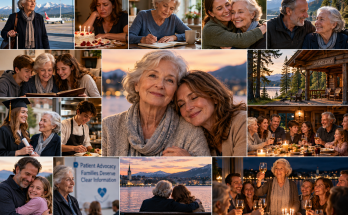
I turned eighty-five in Zurich.
No surprise party.
I had forbidden one.
My family ignored me selectively.
There were still balloons.
Emma claimed balloons did not constitute a party.
Journalists apparently abuse language professionally.
Everyone came.
Not all at once.
That was my requirement.
I no longer enjoyed twelve people inhabiting my apartment simultaneously.
Age had given me clarity and lower tolerance for noise.
Rebecca arrived first with Marcus.
They had been married nearly nine years.
Still together.
Still arguing about kitchen cabinets.
Still maintaining separate personal accounts alongside shared household finances.
That had been Marcus's idea.
Rebecca's too.
Not because they distrusted each other.
Because they understood clarity.
Emma arrived from Washington, where she worked as an investigative health reporter.
Of course.
Apparently family history became a career.
She had written about patient safety, medical transparency and the consequences of institutional silence.
Never our family's story directly.
She did not need to.
Lucas opened a restaurant with two partners.
Small.
Always crowded.
He named one dessert "Grandma's Strawberry Disaster."
I threatened legal action.
He laughed.
David and Claire came too.
David's hair had gone mostly gray.
Claire had become family through repetition.
No ceremony.
No replacement.
She showed up.
Year after year.
That was often enough.
Ethan arrived with Lena.
Caroline was seventeen.
Tall.
Opinionated.
Still loud.
She had no interest in architecture.
Ethan considered this betrayal.
Michael had died two years earlier.
Peacefully.
Ethan grieved him as his father.
No qualification.
That mattered.
Daniel did not travel.
His health had declined.
We called him from Vermont.
The cabin remained.
He planned to leave it jointly to Rebecca and Ethan.
Not because blood required it.
Because he wanted to.
I told him that sounded suspiciously symbolic.
He told me to shut up.
At eighty-five, apparently etiquette becomes optional.
Ingrid had died the previous winter.
That absence hurt differently from earlier grief.
No secret.
No unfinished confession.
Just loss.
Clean, if grief can ever be clean.
I missed her every Thursday.
Still ordered coffee for two occasionally by mistake.
Then laughed.
Then cried.
Then drank both.
Life.
My husband had been dead for more than twenty years.
His memory no longer arrived every morning.
That would once have frightened me.
Now I understood.
He had hoped to become one part of my day.
Eventually, he became one part of my week.
Sometimes less.
Then a song.
A smell.
A phrase.
An ordinary Tuesday.
Love remained without requiring constant attention.
That was not forgetting.
That was integration.
My eighty-fifth birthday dinner happened at a restaurant overlooking the lake.
Not cheap.
I paid for myself.
Everyone else paid for themselves.
Rebecca objected.
I told her I had trained for twenty years to become this irritating.
She surrendered.
There was chocolate cake.
Strawberries.
Naturally.
No one mentioned the original cake.
We didn't need to.
The memory had lost its sharp edges.
It belonged to history now.
Not danger.
After dinner, Rebecca and I walked slowly along the water.
I used a cane.
She pretended not to walk at my speed.
Children never stop protecting parents from dignity.
"Cold?" she asked.
"No."
"You're lying."
"A little."
She wrapped my scarf tighter.
I allowed it.
Receiving help no longer frightened me.
That was another surprise of age.
I had spent so much of my life fearing dependence after what happened with Rebecca that I once imagined independence as the only safe state.
But healthy relationships were not independence.
They were chosen interdependence.
Giving without control.
Receiving without surrender.
Rebecca had learned that.
So had I.
We stopped at a bench.
"Sit."
"Bossy."
"Old."
"Rude."
We sat.
The lake was dark.
Lights reflected across the water.
For a while we said nothing.
Silence had become safe between us.
That might have been the greatest change of all.
Then Rebecca asked:
"Do you ever think about that day?"
I knew which one.
"Sometimes."
"The cake?"
"Yes."
"My house?"
"Yes."
"What I said?"
"Yes."
She looked down.
"I still hate myself for it sometimes."
I turned.
"No."
She looked at me.
"Don't do that."
"What?"
"Turn remorse into identity."
She swallowed.
"I said it."
"Yes."
"I meant to hurt you."
"Yes."
"I knew where to aim."
"Yes."
Her eyes filled.
"But you are not one sentence."
She looked toward the water.
"Neither was Dad."
"No."
"Neither were you."
"No."
That was the lesson our family had taken decades to learn.
People are not their worst sentence.
Not their best either.
They are patterns.
Choices.
Repairs.
Failures.
The courage to tell truth after lying.
The discipline to keep a boundary after anger fades.
The willingness to live differently when apology becomes insufficient.
Rebecca took my hand.
"I used to think your leaving was the worst thing that ever happened to me."
I smiled faintly.
"What do you think now?"
"Still top ten."
I laughed.
"Fair."
Then she became serious.
"It forced me to see that I had built my life around avoiding consequences."
I waited.
"And I blamed you because you made avoidance possible."
Also true.
"I hated you for being the person I called every time I needed rescue."
My throat tightened.
"And I hated myself every time I called."
She sighed.
"I think that was why the birthday happened."
I nodded.
We had understood that years ago.
Still, some truths deepen with time.
"I wanted you gone so I wouldn't have to see myself in your eyes."
There it was.
Not hatred of me.
Hatred of reflection.
"And then I actually left."
Rebecca smiled painfully.
"Yes."
"Terrible planning."
"Extremely."
We laughed.
Then she looked at me.
"What was it like that first night?"
I thought of the yellow legal pad.
Statements.
Receipts.
Calculator.
$467,000.
The cake in the trash.
My shaking hands.
"Quiet."
"Did you hate me?"
"No."
"Really?"
"I wanted to."
That surprised her.
"Hate would have been easier."
"What did you feel?"
"Used."
She closed her eyes.
"Sorry."
"I know."
"Anything else?"
"Humiliated."
Her eyes opened.
"Why humiliated?"
"Because I realized how much of my life I had organized around being useful to you."
I looked at my hands.
Older now.
Veins raised beneath thin skin.
Hands that had delivered care for decades.
Held patients.
Held my husband.
Held Rebecca.
Signed checks.
Closed accounts.
Bought plane tickets.
Learned to receive.
"I thought sacrifice automatically created closeness."
Rebecca's face softened.
"It doesn't."
"No."
"Sometimes it creates debt."
"Yes."
"Sometimes resentment."
"Yes."
"And sometimes love."
"Yes."
All of it.
No simple equation.
We sat quietly.
Then Rebecca smiled.
"You know what the strangest part is?"
"What?"
"You gave me exactly what I asked for."
I frowned.
"What do you mean?"
"I asked for you to die."
My body tightened slightly despite the decades.
She continued.
"And the version of you I knew did."
I stared.
Rebecca's eyes filled.
"The woman who would drop everything whenever I called."
Yes.
"The woman who thought saying no was selfish."
Yes.
"The woman who saved everyone else before deciding whether she wanted anything."
My throat closed.
"She disappeared."
Rebecca squeezed my hand.
"And I hated it."
I laughed through tears.
"You were very vocal."
"I was."
Then she smiled.
"But she needed to go."
That was more complicated.
"I don't hate who I was."
"I don't either."
"She loved you."
"I know."
"She wasn't weak."
"I know."
"She just didn't know when love had crossed into erasing herself."
Rebecca nodded.
"That's what I mean."
The woman I had been did not deserve contempt.
She deserved gratitude.
She carried me to the moment when I could choose differently.
I thought of my husband's recording.
Please live longer than my mistakes.
I had.
Years beyond them.
Not perfectly.
But fully enough.
"Your father wanted me to come here."
"Switzerland."
"Yes."
"You would've hated him arranging it."
"Absolutely."
Rebecca laughed.
"He knew that."
"Eventually."
I looked over the lake.
"He wanted to give me permission to live."
Rebecca became quiet.
"Did you need it?"
"At first."
"And later?"
"No."
I smiled.
"Eventually I gave it to myself."
That was the real shift.
Not leaving Rebecca.
Not closing the account.
Not changing the will.
Not flying to Zurich.
Those were actions.
The deeper change was refusing to outsource permission for my own life.
No daughter.
No husband.
No lawyer.
No friend.
No grief.
I could choose.
Rebecca rested her head against my shoulder.
"Do you regret not leaving me anything in the will?"
Direct as ever.
I laughed.
"Still checking?"
"No."
"Then why ask?"
"Curious."
I considered.
My estate plan had evolved slightly over the years.
Emma and Lucas's trust remained.
Some money would go to Samuel's patient advocacy program.
Some charities.
A modest personal item collection to Rebecca.
Not a financial inheritance large enough to restart the old dynamic.
She knew.
"Do you want more?"
"No."
Immediate.
I believed her.
"Then no."
Rebecca smiled.
"Good."
"Why good?"
"Because changing it for me would make the whole thing feel unfinished."
Interesting.
"In what way?"
"Like money still had to prove we were okay."
Exactly.
We did not need that.
She had already received something more difficult.
A relationship with me as a person.
Not a resource.
And I had received something too.
A daughter who stayed when usefulness disappeared.
That mattered more than inheritance.
We walked home slowly.
At my apartment, everyone had returned.
Apparently my request for quiet had been ignored after nine.
Lucas had brought food.
Emma was arguing with Ethan.
Marcus was washing glasses.
Claire was helping Caroline repair a broken bracelet.
David had fallen asleep in a chair.
Rebecca looked around.
"Your house is full."
"For tonight."
"Want us gone?"
"Eventually."
She laughed.
I stood near the doorway.
Years earlier, a crowded family room might have made me feel successful because everyone needed me at the center.
Now no one did.
That was the miracle.
They could feed themselves.
Manage money.
Love.
Separate.
Marry.
Fail.
Repair.
Grieve.
Choose.
I was not the structural beam holding the building upright.
I was a person in the room.
Enough.
Emma noticed me.
"Grandma, speech."
"No."
"Birthday speech."
"Absolutely not."
"Five sentences."
"No."
Everyone started chanting.
Traitors.
I lifted my glass.
"Fine."
Silence.
They waited.
I looked around.
At Rebecca.
At Marcus.
Emma.
Lucas.
David.
Claire.
Ethan.
Lena.
Caroline.
People whose lives had been changed by secrets, choices, money, grief and truth.
I had no wisdom grand enough for all of it.
So I said:
"Tell the truth sooner."
Emma counted.
"One."
"Let people make their own choices."
"Two."
"Help without making yourself necessary."
"Three."
"Say no without turning it into punishment."
"Four."
I looked at Rebecca.
She already knew the last one.
"And live before someone has to remind you."
Silence.
No one counted five.
Rebecca started crying.
I pointed.
"No birthday crying."
Everyone laughed.
Then glasses lifted.
No toast to survival.
No toast to forgiveness.
Just noise.
Food.
Ordinary life.
Much later, after everyone finally left or slept, I stood alone on the balcony.
Cold air.
Dark lake.
The city quiet below.
I thought about the morning years ago when I first arrived here.
Frightened.
Angry.
Two suitcases.
No idea whether I was escaping or beginning.
I had believed my daughter's cruel sentence destroyed my life.
It did destroy something.
The structure I had mistaken for love.
The belief that motherhood required disappearance.
The belief that being needed was the same as being valued.
The belief that sacrifice purchased security.
Those things died.
I was grateful.
Not to Rebecca for hurting me.
Pain does not need gratitude to become useful.
I was grateful to myself for what I did afterward.
I left.
I learned.
I returned differently.
I listened.
I set boundaries.
I forgave without forgetting.
I received help.
I gave without buying closeness.
I allowed unfinished things to remain unfinished.
I lived.
My phone buzzed.
A message from Rebecca, though she was sleeping twenty feet away.
I opened it.
Happy birthday, Mom.
Then:
Best gift you ever gave me was staying alive long enough for me to know you.
My eyes filled.
I typed:
Best gift I gave myself too.
Then I turned off the phone.
Inside, my husband's photograph stood beside his letter.
Please live.
Beside it was Rebecca's old watch.
TIME IS NOT A DEBT.
Two sentences.
Two lives.
Two people who had loved me imperfectly.
I no longer needed either sentence to tell me what to do.
I stepped back inside.
Closed the balcony door.
Turned off the lights.
And went to bed in the life I had chosen.
The End
Read more original stories on Feel Every Story.
I Brought My Daughter Her Favorite Birthday Cake, and She Gave Me One Sentence I Could Never Unhear
Part 35 of 35