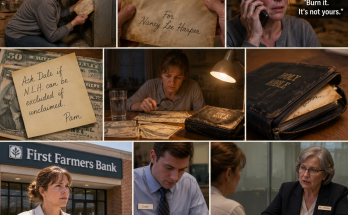
The blue box stayed under the loose floorboard for most of the summer.
Kaylee checked it occasionally.
Not obsessively.
Enough to know it remained where she left it.
Claire’s eighth-birthday letter.
Photographs.
The bracelet.
A few small keepsakes.
Her notebook.
The pink sneakers were under the opposite side of the board.
Two histories.
One she wanted close.
One she did not want erased.
In August, a thunderstorm knocked out power for forty minutes.
Greg found flashlights.
Kaylee found candles.
He refused to light them because Winston had already knocked over a lamp that week.
They compromised with battery lanterns.
The yellow laundry room looked strange in dim light.
Kaylee stood in the doorway.
“You okay?” Greg asked.
“Yes.”
Thunder shook the windows.
She flinched.
Then laughed at herself.
“Loud.”
“Very.”
They sat in the living room.
Without television or Wi-Fi, conversation eventually became unavoidable.
Kaylee asked Greg what he remembered about the night Claire died.
He did not answer immediately.
“You really want to know?”
“Yes.”
“It’s sad.”
“I know.”
“You can change your mind.”
“Dad.”
“Okay.”
He told her.
Not every medical detail.
Enough.
Claire had been sleeping most of the day.
Evelyn was there.
Judith came earlier.
Marianne brought food no one ate.
Kaylee was three and angry that people kept taking her toys out of the bedroom.
Near evening, Claire woke.
She asked to see Kaylee.
Greg brought her in.
Toddler Kaylee climbed into bed.
Claire was too weak to lift her properly, so Greg helped.
“She sang to you.”
“What song?”
He named it.
Kaylee frowned.
“I don’t remember.”
“You were three.”
“Did she know?”
“That she was dying?”
“Yes.”
Greg nodded.
“I think so.”
“Was she scared?”
“Yes.”
That answer surprised her.
“Adults get scared?”
“Constantly.”
“You act like you don’t.”
“Bad habit.”
The power returned.
Lights snapped on.
Neither moved.
Kaylee asked:
“Did Mom ever lie to me?”
Greg smiled sadly.
“Probably.”
“About what?”
“She once told you the grocery store ran out of cookies.”
Kaylee looked offended.
“That’s terrible.”
“She was desperate.”
“Anything big?”
Greg thought.
“She tried to protect you from things you were too young to understand.”
“Is that lying?”
“Sometimes.”
“Was that good?”
“Sometimes. Sometimes not.”
Kaylee stared at the floor.
Then:
“I lied a lot with Tasha.”
Greg’s face changed.
“I know.”
“I said I fell.”
“Yes.”
“I said I wasn’t hungry.”
“Yes.”
“I said stuff didn’t hurt.”
“Yes.”
“Was I bad?”
“No.”
The answer came too quickly.
Kaylee narrowed her eyes.
“You didn’t think.”
“I don’t need to.”
“Dana says think.”
Greg corrected himself.
“Fine.”
He took a breath.
“You lied because you believed telling the truth would make you less safe.”
Kaylee watched him.
“That’s different from lying to get out of cleaning your room.”
“Which I also do.”
“I’m aware.”
She smiled faintly.
Then she went upstairs.
Ten minutes later, she returned with the blue box.
Greg stopped.
“You want me to leave?”
“No.”
She sat on the floor.
Opened it.
Took out the notebook.
The cover was bent.
Several pages were wrinkled.
Some entries were written in pencil.
Others in crayon.
A few only had marks.
No words.
Kaylee turned the first page.
“I don’t remember writing this.”
Greg remained silent.
The earliest entries were simple.
Bad day. No TV.
Bad day. Stand.
Dad gone.
T ate my cookie.
One entry had a crude drawing of feet over dots.
Rice.
Another page contained only tally marks.
“What are those?” Greg asked.
Kaylee stared.
“Dryer.”
Each line represented a dryer cycle.
Greg went pale.
Kaylee noticed.
“Face.”
He looked away.
She turned another page.
Dad called. T nice after.
Then:
Dad home. Good.
Then:
Dad leaves tomorrow.
Underneath, written much larger:
NO.
Kaylee touched the word.
“I remember that.”
Greg swallowed.
“What?”
“I hid your work boots.”
His eyebrows rose.
“You did?”
“You thought Winston moved one.”
Greg laughed painfully.
“I blamed the dog.”
“I hid it under guest bed.”
“Why?”
“So you couldn’t go.”
He stared at her.
“You were seven.”
“Yes.”
“I just thought you hated my job.”
“I did.”
“Because of Tasha.”
Kaylee nodded.
Another missed signal.
But this time Greg did not say he should have known.
He simply listened.
A later page read:
Grandma says I can call. T says no.
Another:
Aunt M says tell Dad. I can’t.
Another:
Beth says feelings get big.
Then:
Mrs F asked if home okay.
Below that:
Don’t tell.
Kaylee read the words slowly.
“I wrote that to myself?”
“Looks like.”
“Why?”
Greg did not answer.
She did.
“So I wouldn’t forget.”
The notebook was not only evidence of what happened.
It was evidence of how she survived remembering it.
Some entries contradicted others.
One date said rice.
The next date said mat.
Another described both.
A meal she thought happened Tuesday may have happened Wednesday.
A punishment she remembered lasting three dryer cycles was recorded as two.
Those inconsistencies had terrified her when Tasha copied the notebook and marked “contradictions.”
Now Kaylee saw them herself.
She frowned.
“I got stuff wrong.”
Greg leaned forward.
“What?”
“Dates.”
“Maybe.”
“Tasha said if I got things wrong, nobody would believe anything.”
Greg’s jaw tightened.
“She was wrong.”
“But I did.”
“Yes.”
Kaylee stared.
“You said yes.”
“You asked if some details may be wrong.”
“But then how do people know?”
Greg looked uncertain.
This was bigger than a fatherly reassurance.
He called Dana.
Not because it was an emergency.
Because Kaylee asked.
Dana came over the next day.
She read only the pages Kaylee chose to show.
Then Kaylee pointed to contradictions.
“See?”
Dana nodded.
“Yes.”
“So how did you know?”
“Because memory doesn’t work like a security camera.”
“But the camera was there.”
“For some things.”
“What if there wasn’t?”
Dana sat beside her.
“We look at patterns. Context. Medical evidence. What you said at different times. What other people observed. Records. Whether someone influenced you. Whether parts of your account stayed consistent even when small details changed.”
Kaylee frowned.
“So I can be wrong and still tell truth?”
“Yes.”
That seemed to bother her.
“How?”
Dana thought.
“If you tell me it rained last Tuesday and later we learn it rained Wednesday, you were wrong about Tuesday. That doesn’t prove you invented the rain.”
Kaylee considered.
“That’s obvious.”
“Yes.”
“Then why did adults act like one wrong thing means lying?”
“Sometimes people misunderstand memory. Sometimes they are looking for reasons not to believe. Sometimes legal questions make details important.”
“Tasha did it on purpose.”
“Yes.”
That answer mattered.
Tasha had marked inconsistencies not because they disproved Kaylee.
Because she knew small mistakes could frighten a child into silence.
Kaylee turned another page.
Near the middle was an entry nobody had discussed.
Mom picture gone.
Asked T.
She said I moved it.
I didn’t.
Underneath:
Maybe I did?
Kaylee stared at the question mark.
“I thought I was forgetting.”
Greg’s eyes filled.
Tasha had not only contradicted her.
She had taught her to distrust her own memory.
Another page:
Pantry was open.
T says no.
I saw it.
Maybe dream.
Kaylee looked up.
“Was it open?”
Greg did not know.
Dana answered carefully.
“We can’t verify every memory.”
Kaylee stared at the page.
“That sucks.”
“Yes.”
“But some things we can?”
“Yes.”
“Like shoes.”
“Yes.”
“Rice.”
“Yes.”
“Mat.”
“Yes.”
“Food.”
“Yes.”
“Camera.”
“Yes.”
“Letters.”
“Yes.”
“Dad not knowing everything.”
“Yes.”
Kaylee nodded.
She did not need every page proven.
She needed enough anchors to know she had not imagined her own life.
Near the end of the notebook was an entry from the week before the sleepover.
Heel bad.
Keep shoes.
Sleepover Friday.
Don’t tell Mia.
Underneath, written darker:
Maybe Mrs H.
I stopped breathing.
Kaylee noticed.
“You?”
“It says maybe Mrs H.”
“You wrote that before you came.”
She stared.
“I don’t remember.”
“You were thinking about telling me.”
“Maybe.”
That word had changed meaning.
Not adult evasion.
Possibility.
Kaylee read the next line.
If she asks.
Then another.
If blood.
I felt sick.
The blood had not been random in her planning.
Some part of Kaylee understood the injury might become impossible to hide.
She may not have intended disclosure.
But she had imagined a moment where someone saw enough to ask.
“You were waiting?”
“I don’t know.”
“That’s okay.”
She looked at me.
“You asked.”
“Yes.”
“I said no.”
“Yes.”
“You kept asking.”
“Yes.”
“You stopped when I got scared.”
“Eventually.”
Kaylee nodded.
Then she closed the notebook.
“That’s enough.”
No one argued.
She placed it back in the blue box.
Then changed her mind.
She removed one page.
The one that said:
Maybe Mrs H.
“What are you doing?”
“Keeping this out.”
“Why?”
She shrugged.
“So I remember I tried.”
That distinction mattered.
For months, she had talked about the first disclosure as something that happened because blood became visible.
The notebook showed more.
She had been searching for a crack.
Grandma.
Marianne.
Mrs. Fox.
A teacher.
Me.
She had not failed to tell.
She had tried repeatedly under conditions designed to make telling feel dangerous.
That evening, Greg took the notebook question into therapy for himself.
He had started attending separately.
Not court-ordered anymore.
His choice.
He told me later:
“I keep wanting to identify the one moment I could have fixed everything.”
“There probably wasn’t one.”
“There were dozens.”
“Yes.”
“That’s worse.”
“Maybe.”
He laughed.
“You’re doing it now.”
“What?”
“Maybe.”
I smiled.
He became serious.
“If I make one moment the failure, I can imagine changing it and saving her.”
“That’s easier than accepting a pattern.”
“Yes.”
“And your part in the pattern.”
“Yes.”
He looked toward the yellow laundry room.
“I didn’t cause what Tasha did.”
“No.”
“I did make it easier to hide.”
“Sometimes.”
He nodded.
That was the version he could live with.
Neither total innocence nor total blame.
Responsibility without claiming ownership of someone else’s cruelty.
By late August, the notebook returned beneath the floorboard.
The single page stayed out.
Kaylee put it in the frame behind Claire’s birthday-letter copy.
Not visible from the front.
But there.
A reminder not only of what happened.
Of the fact that before anyone else understood, she had already been trying to find a way toward help.
Click here to continue reading: PART 40: On the First Anniversary of the Sleepover, Kaylee Chose What to Do With the Old Pink Sneakers and Who Should Witness It
The Sleepover Began Normally Until Kaylee Wouldn’t Take Off the Pink Sneakers She Had Worn Inside All Evening
Part 39 of 44