I read Helen’s email three times before I answered.
Not because I did not understand the question.
Because I understood it too well.
Did I intend to involve the police?
The idea had never fully formed in my mind.
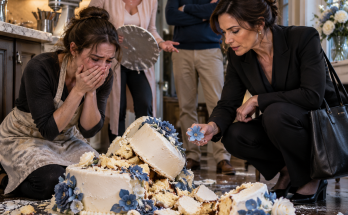
That morning in the kitchen had felt like family conflict wrapped around business damage. Even after Vanessa saw what happened, even after Dad admitted Natalie had acted deliberately, I had focused on recovering the order.
Repair the cake.
Deliver it.
Protect the client.
Move forward.
That had always been my instinct.
Fix first.
Feel later.
But Helen’s question made me realize something uncomfortable.
I had spent years treating Natalie’s choices as private simply because they happened inside our house.
That did not automatically make them harmless.
I opened a reply.
Then deleted it.
Opened another.
Deleted that too.
Finally, I called Vanessa.
She answered quickly.
“You saw Helen’s email?”
“I did.”
“Did you tell her anything?”
“No.”
“Then how does she know?”
“Natalie.”
I stood beside my bedroom window.
Outside, rain had started tapping against the glass.
“Why would Natalie tell her?”
“Probably to control the story before you could.”
That sounded exactly right.
Vanessa continued, “Helen asked me one question this afternoon.”
“What?”
“Whether the cake damage was accidental.”
My stomach tightened.
“What did you say?”
“I told her I did not witness the moment of impact.”
That was careful.
“And?”
“I told her what I did witness afterward.”
I closed my eyes.
Natalie saying it was an accident.
Me saying I watched her push it.
Dad trying to distribute blame.
The wreckage.
My hands rebuilding.
“What do you think I should do?”
Vanessa paused.
“I’m not your lawyer.”
“I know.”
“And I don’t think you should make a legal decision based on what keeps Helen comfortable as a client.”
That was not the answer I wanted.
It was the one I needed.
“I’m scared reporting it will make everything worse.”
“For who?”
I did not answer.
Vanessa let the silence stretch.
Then she said, “That wasn’t rhetorical.”
“For everyone.”
“Claire.”
I pressed my fingers against the window frame.
“For Dad. Brooke. The wedding.”
“And you?”
I said nothing.
Vanessa exhaled quietly.
“You don’t need to decide tonight whether to pursue charges.”
“I thought reporting meant doing exactly that.”
“Not necessarily. But documenting what happened while memories are fresh might matter later.”
I turned from the window.
“Documenting.”
“Photos. Messages. invoices. Who witnessed what. Dates. Times.”
Of course.
It was embarrassingly obvious once she said it.
My work already ran on records.
Contracts.
Invoices.
Photos.
Confirmation emails.
I had simply never applied that discipline to my family.
“Thank you.”
“Talk to someone qualified before making decisions.”
“I will.”
“And Claire?”
“Yes?”
“Do not delete anything.”
I looked toward the photographs of the destroyed cake in my phone.
“I won’t.”
After we hung up, I answered Helen.
I kept it simple.
I told her I had not made a decision about legal action. I said I was documenting the incident properly and would handle it through appropriate channels if necessary. I reassured her that her anniversary event would remain separate from the family matter.
She responded within fifteen minutes.
Understood. That is all I needed to know.
Then she sent the deposit.
I stared at the confirmation.
The money mattered.
But not as much as the fact that she had not demanded silence in exchange for hiring me.
The next morning, I created a folder.
Incident — Vanessa Cole Anniversary Cake.
The title looked absurdly formal.
I needed that.
I added the original invoice.
Timestamped photographs of the completed cake.
Pictures of the damaged tiers.
Vanessa’s messages.
The revised delivery documentation.
My notes from immediately afterward.
Then I wrote a timeline.
7:23 a.m. — returned to kitchen and found Natalie beside cake.
Approx. 7:24 — discovered broken sugar rose.
Approx. 7:50 — heard Natalie and Dad discussing Brooke’s cake.
Approx. 7:53 — confronted Natalie regarding false promise to Brooke.
Approx. 7:55 — witnessed Natalie push worktable.
I stopped there.
My hands felt cold.
Writing it in neutral language made the event uglier.
Family arguments depended on blur.
Records did not.
At ten, Dad knocked on my bedroom door.
“Can I come in?”
“Yes.”
He entered.
His eyes landed on the open folder beside my laptop.
“What are you doing?”
“Documenting what happened.”
He went still.
“Why?”
I looked at him.
“Because I should have done it immediately.”
“Are you going to the police?”
“I don’t know.”
His face tightened.
I recognized the fear.
Not fear for me.
Fear of consequences.
I hated that I recognized it so easily.
“Dad.”
“I’m not asking you not to.”
“You were about to.”
He sat on the edge of the chair.
“I was going to ask what you wanted to happen.”
“I want Natalie to understand she cannot destroy my work when she’s angry.”
“She understands.”
I stared at him.
“Does she?”
His mouth closed.
“Because she canceled Brooke’s venue afterward.”
“That was Brooke’s situation.”
“No.”
I shook my head.
“It’s the same behavior.”
Dad looked tired.
“She loses control, so she punishes people.”
He rubbed his forehead.
“She’s angry.”
“So am I.”
“I know.”
“But I didn’t destroy anything.”
He looked at me.
That landed.
I continued.
“I’m not trying to ruin her life.”
“I know.”
“I’m trying to stop treating every serious thing she does like an emotional misunderstanding.”
Dad nodded slowly.
“I should write a statement.”
I blinked.
“What?”
“I saw what happened after the cake fell.”
“You didn’t see her push it.”
“No.”
His voice became quieter.
“But I heard what she said afterward.”
I remembered.
Maybe if you weren’t so obsessed with money, none of this would have happened.
I sat back.
“Would you write exactly what you remember?”
“Yes.”
“No cleaning it up.”
“I know.”
“No trying to make everyone look better.”
“I know.”
He looked toward the folder.
“I’ve done enough of that.”
That afternoon, I met with a local attorney named Rachel Kim.
I had worked with her once before to review a client contract, but this meeting felt entirely different.
Her office was small and calm.
She listened while I explained.
She asked almost no emotional questions.
Only factual ones.
Who owned the cake?
Who paid for it?
Was it fully completed?
Did I witness the act?
Were there photographs?
Any video?
Witnesses?
Admissions?
I answered.
Rachel took notes.
When I finished, she said, “You have several options.”
I waited.
“You can do nothing beyond documenting it.”
I nodded.
“You can demand reimbursement in writing.”
“From Natalie?”
“Yes.”
“Even though I completed the order?”
“You still had additional labor and replacement costs, and depending on how the property is characterized, there may be other issues.”
I listened carefully.
“You could also make a police report.”
My stomach tightened.
“Would that automatically mean charges?”
“No. Reporting creates a record. What happens after that depends on the facts, local law, and how authorities evaluate them.”
“What would you do?”
She gave me a slight smile.
“I don’t make that decision for clients.”
Of course.
“What would you recommend I think about?”
“That was the better question.”
She folded her hands.
“Think about whether your goal is compensation, documentation, deterrence, separation, or punishment. Those are not the same objective.”
I looked down.
“Deterrence.”
“Then start there.”
“How?”
“A formal demand letter may be enough.”
I almost laughed.
“Natalie will hate that.”
“That is not a legal factor.”
That sentence was so clean I wrote it down.
We discussed documenting any future contact, keeping business assets secure, and separating my commercial operations from the house as quickly as possible.
When I left, I felt less frightened.
Not because the situation was simpler.
Because it had categories.
Facts.
Options.
Decisions.
That evening, Rachel emailed a draft demand letter.
It stated that Natalie had intentionally damaged client property used in my business and that I was seeking reimbursement for documented losses associated with repair, replacement materials, and emergency labor.
The amount was less than $4,650.
That surprised me.
But Rachel explained that since I had ultimately fulfilled the order, I should claim losses I could support rather than use the full retail value as a symbolic number.
That mattered.
This was not revenge.
It was accounting.
I sent Rachel the receipts.
Extra butter.
Sponge.
Flowers.
Labor.
Replacement supplies.
Emergency transportation adjustments.
By the next afternoon, we had a final figure.
$1,187.40.
It looked small beside the original cake price.
Yet sending that demand felt bigger than asking for $4,650.
Because I was no longer speaking as Natalie’s stepdaughter.
I was speaking as a business owner.
Rachel sent the letter.
Natalie received it by email and certified mail.
She called me less than twenty minutes later.
I did not answer.
Then she texted.
Are you serious?
Another message.
You hired a lawyer against your own family?
Then:
This is disgusting.
I saved screenshots.
No reply.
Another message arrived.
Your mother would be ashamed.
My hands started shaking.
I read Mom’s note.
Generosity meant choosing.
Not being guilted.
Not being frightened.
I took a screenshot.
Saved it.
No reply.
Dad came upstairs half an hour later.
“She got the letter.”
“I know.”
“She’s furious.”
“I know.”
“She wants me to ask you to withdraw it.”
I looked at him.
“Are you going to?”
“No.”
That answer came immediately.
Something in my chest loosened.
Dad sat across from me.
“She says you’re trying to humiliate her.”
“I’m asking for reimbursement.”
“I told her that.”
“What did she say?”
“That you never would have done this before.”
I almost smiled.
“She’s right.”
Dad looked at me.
Neither of us said what that meant.
Before, fear had been enough.
Before, family guilt had been enough.
Before, one hard look from Natalie would have pushed me into apologizing for the damage she caused.
Not anymore.
Three days passed.
Then Rachel forwarded Natalie’s response.
Natalie denied deliberately damaging the cake.
She called it an accident.
She refused payment.
But attached beneath her response was something Rachel highlighted.
A sentence.
I only touched the table because Claire was being cruel about Brooke’s wedding.
I read it twice.
Then again.
Rachel called.
“She may believe that helps her.”
“It doesn’t?”
“It establishes contact with the table and motive context.”
I sat very still.
“So what now?”
“That depends on your goal.”
Deterrence.
Documentation.
Separation.
I looked across the room at my storefront keys.
“File the report.”
Rachel paused.
“You’re sure?”
“Yes.”
The word came quietly.
But it did not shake.
That afternoon, I walked into the police station with a folder under my arm.
For years, Natalie had relied on the fact that everything in our family disappeared into conversation.
Argument.
Apology.
Silence.
Repeat.
This time, it would become a record.
Click here to continue reading: PART 10: Filing the Report Changed Nothing Overnight, Until Natalie Discovered a Written Record Could Not Be Rewritten Like a Family Argument
The Morning My Stepmother Asked for One More Favor, I Finally Told Her What My Work Was Worth
Part 9 of 44