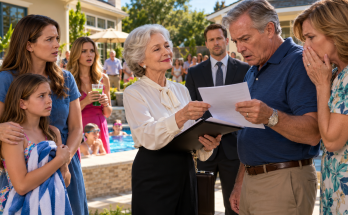
Claire found the envelope while clearing Arthur’s apartment.
Arthur died at eighty-two.
Not in prison.
Not in hiding.
At a hospital after a stroke, with Claire and Rebecca beside him.
He remained conscious long enough to complain about the food.
Sophie considered that consistent character development.
Arthur had lived quietly after prison.
Too quietly, Claire sometimes thought.
He refused most invitations to speak publicly about NorthStar.
When universities asked him to discuss whistleblowing, he declined.
“I was not a whistleblower,” he once told Sophie. “I was a man who kept evidence too long because I wanted control over how the truth arrived.”
She respected that.
He did testify in regulatory hearings when subpoenaed.
He answered.
Then went home.
His apartment contained fewer secrets than Claire expected.
Books.
Chess sets.
Stacks of ordinary correspondence.
Sophie’s letters from college.
Photographs.
A terrible knitted scarf Maya once gave him as a joke.
Then Claire opened a fireproof box.
Inside were legal documents.
Miriam’s old wedding ring.
Arthur’s government-clearance badge.
And one sealed envelope.
TO SOPHIE, IF SHE IS AN ADULT AND WANTS IT.
Miriam’s handwriting.
Claire froze.
Rebecca was across the room.
“What?”
Claire held it up.
Rebecca closed her eyes.
“Of course.”
Neither opened it.
Good.
Claire called Sophie.
She was thirty-seven now, in the middle of preparing for an appellate argument involving a genomic-data company that claimed users had permanently licensed reproductive-health information through a click-through agreement.
She answered distractedly.
“What exploded?”
“Nothing.”
“Good. Strong opening.”
Claire explained.
Silence.
“Another letter?”
“Yes.”
“From Grandma Miriam?”
“Yes.”
“Opened?”
“No.”
Sophie leaned back.
“Where did Dad—Grandpa Arthur—get it?”
“Unknown.”
“Anything written outside?”
Claire read the line.
Sophie laughed.
“She learned.”
“Yes.”
The envelope did not say OPEN.
It said IF SHE WANTS IT.
Sophie hated that this made refusing harder.
She told Claire to lock it back up.
“For how long?”
“I don't know.”
Claire laughed.
“Okay.”
Months passed.
Sophie won the appeal.
The court rejected the company's broad interpretation of consent and required renewed authorization for certain secondary uses of sensitive genomic data.
Reporters called it an important ruling.
Sophie said the decision was narrower than headlines suggested.
Daniel accused her of becoming boring professionally.
She considered that praise.
The unopened letter remained with Claire.
Sophie occasionally thought about it.
Miriam had already said enough.
The famous letter.
The notebooks.
The warnings.
The mistakes.
The embryos.
The blue archive.
What else could one dead scientist possibly need to explain?
Then Rebecca called.
“You know I want to read it.”
“Obviously.”
“I haven't.”
“Good.”
“I deserve recognition.”
“Do you?”
“Yes.”
Sophie smiled.
“Fine. Recognition.”
Rebecca became serious.
“Do you think you're afraid it changes how you see her?”
“Yes.”
“Me too.”
That surprised Sophie.
Miriam had become more complicated with every recovered file.
Early ambition.
Self-experimentation.
Embryo research.
Ethical failures.
Later restraint.
Warnings.
Temporary treatments.
The mother who tried to protect daughters through secrecy and harmed them with it.
Another letter could not restore simplicity.
It could only disturb whatever balance remained.
Sophie finally asked Claire to bring the envelope to her apartment.
Claire arrived with Daniel.
“Why is he here?”
Daniel looked offended.
“I am emotional support.”
“You're nosy.”
“Also.”
They ate dinner first.
No one mentioned the letter.
After dessert Claire placed it on the table.
Old paper.
Miriam's handwriting.
Sophie looked at it.
Then at Claire.
“Would you read it?”
“If you want.”
“To yourself first?”
“No.”
“Why?”
“Because she addressed it to you.”
Sophie appreciated that.
Rebecca joined by video.
She promised not to talk unless invited.
Nobody believed her.
Sophie broke the seal.
Inside were four pages.
The first line:
Sophie—
If you are reading this, then you became old enough to choose whether I was worth hearing from.
Sophie stopped.
“Strong start.”
Rebecca covered her mouth.
Sophie continued.
Miriam explained that she had written the letter during her final hospitalization.
She did not know whether Sophie would survive infancy.
She did not know whether Samuel’s intervention had already happened.
Arthur was still trying to track the network.
Miriam feared the worst.
She wrote:
I have spent years trying to determine which of my decisions were mistakes because the outcome was poor and which were mistakes regardless of outcome. The second category is harder.
Sophie read more slowly.
Miriam admitted creating research embryos.
Believing exceptional disease risk justified exceptional experimentation.
Allowing Ward to extend boundaries she should have stopped earlier.
Treating her own body as though self-consent made every downstream consequence acceptable.
Helping create scientific systems others later weaponized.
She did not excuse herself by saying she eventually changed.
Then she wrote:
Learning later does not make earlier harm disappear. It only gives the learner a chance not to repeat it.
Claire cried quietly.
Sophie continued.
Miriam described Sophie as a possibility, not someone she knew.
She knew Claire was pregnant.
She knew the genetic combination might interest Samuel.
She did not know whether the baby was a girl.
Did not know her name.
Then:
If you are alive when you read this, I hope no one has convinced you that survival creates a debt.
Sophie stopped.
The room became still.
Miriam continued.
You do not owe science your blood because science harmed you. You do not owe future patients your cells because your body became unusual. You do not owe your family forgiveness because they were afraid. You do not owe me admiration because I learned too late.
Sophie wiped her eyes.
Daniel looked down.
Rebecca was openly crying on screen.
The next paragraph was shorter.
If you choose to help others, let it be generosity rather than repayment.
Sophie thought of K-17-T.
The final study.
One last use.
Then destruction.
She laughed through tears.
“What?”
Claire asked.
“She would've approved.”
Rebecca smiled.
“Probably.”
Sophie continued.
Miriam wrote about Claire.
Your mother will blame herself if harm reaches you through anything I helped begin. Tell her I knew what I was doing long before she did, and responsibility does not travel backward simply because love wishes it could.
Claire covered her face.
“Rude.”
Sophie smiled.
“She knew you.”
The final page addressed choice.
Miriam wrote:
There will always be people who believe the stakes are too high to wait for permission. Sometimes the stakes will truly be high. Sometimes delay will cost lives. Consent does not make those tragedies disappear. It only recognizes that preventing one tragedy by commandeering another person's body creates a second tragedy.
Sophie paused.
Then the last paragraph.
I hope you live a life in which the most important things about you have nothing to do with my work.
No instruction.
No hidden location.
No medical warning.
No final code.
Just:
If you never forgive any of us, that is yours. If you do, let that be yours too.
Miriam Morgan.
Sophie finished.
Nobody spoke.
Then Daniel said, “No secret basement coordinates?”
Sophie laughed so hard she cried harder.
“Thank God.”
Claire took the letter only after Sophie handed it to her.
She read the section about responsibility.
Twice.
Sophie watched.
“Mom.”
Claire looked up.
“You heard her.”
“I know.”
“Did you?”
Claire nodded slowly.
“I’m trying.”
Same phrase Samuel once wrote.
Different context.
Still human.
Rebecca asked whether Sophie wanted the letter donated to the public archive that now housed redacted NorthStar materials.
“No.”
Immediate.
“Family archive?”
“No.”
“Where?”
“My apartment.”
Rebecca nodded.
“Okay.”
The letter went into Sophie's desk drawer beside ordinary documents.
Lease.
Insurance.
Passport copies.
Nothing ceremonial.
She liked that.
Several years later the appellate case Sophie had won became part of new federal legislation governing secondary genomic-data use.
Not solely because of her case.
Advocates, researchers, families, lawmakers, institutions.
Slow systems moving.
Compromise.
Imperfection.
The law required clearer consent for certain high-risk secondary uses and stronger withdrawal mechanisms.
Commentators wanted Sophie to become the face of it.
She refused.
A journalist asked why.
“Because good law should not depend on one person having the most dramatic story.”
The quote became famous anyway.
Sophie found that irritating.
At forty-one, she became director of the legal center where she started.
Claire asked whether this meant she was important now.
“No.”
“Salary says otherwise?”
Sophie refused to answer.
Daniel retired.
Eric moved closer after a minor heart problem reminded everyone that age had been happening while they were busy looking backward.
Maya’s pediatric clinics became a small network.
Lucas started a company making low-cost rehabilitation devices and included patient representatives on design teams because Rebecca had apparently infected everyone with governance.
Emily became head nurse on a pediatric oncology floor.
Caleb taught astronomy workshops.
Sarah became a high-school science teacher.
Lydia, after completing her sentence and professional restrictions, never returned to human genetic research.
She worked in laboratory quality systems.
Quietly.
Amelia joined a university ethics program and became one of Rebecca’s most irritating critics.
Rebecca considered that useful.
Ward died.
Evelyn Cross died.
Nathan lived long enough to learn the temporary regulatory therapy based partly on Miriam's work had helped patients.
He never claimed credit.
Good.
Margaret and Emily rebuilt something resembling a relationship.
Not the one either imagined.
Real enough.
The frozen embryo M-H 02 remained unresolved for decades.
Eventually, after extensive legal proceedings and independent review of Miriam’s documented wishes, the court authorized destruction rather than research or reproductive use.
Samuel was dead.
No living person had uncontested authority to implant it.
Miriam had ultimately requested destruction.
No party sought parenthood through it.
The embryo was thawed and allowed to cease developing under approved procedure.
Sophie attended no ceremony.
She read the order.
Closed the file.
Another unfinished possibility ended without becoming anyone’s experiment.
Years later, she asked Rebecca whether that decision still bothered her.
“Yes.”
“Do you think it was wrong?”
“I don't know.”
“Good.”
Rebecca laughed.
“You've trained me terribly.”
The older Sophie became, the less she believed ethical maturity meant reaching certainty.
Sometimes it meant understanding exactly where certainty stopped.
That became the lesson she carried into courtrooms, hospitals, research boards, and family dinners.
Not everything unresolved required rescue.
Not everything preserved required use.
Not everything useful required preservation.
Not every loving intention deserved permission.
And no outcome—good or terrible—could retroactively create consent that never existed.
On Claire's seventy-fifth birthday, the family gathered at the house where Sophie once came home from treatment.
Daniel overcooked something on the grill.
Eric criticized him.
They argued exactly as they had decades earlier.
Sophie sat on the porch beside Claire.
Her mother’s hair was silver.
“What?”
Claire asked.
“Nothing.”
“You're staring.”
“Old.”
Claire hit her arm.
Sophie laughed.
Inside, Miriam’s last letter rested in Sophie’s bag.
She had brought it without planning to.
Claire noticed.
“You keep carrying that?”
“Sometimes.”
“Why?”
Sophie thought.
“Because it's one of the few things from the past that doesn't ask me to do anything.”
Claire smiled.
They sat without speaking.
From the yard came Maya’s laugh.
Lucas arguing with Caleb.
Emily telling someone not to run near the steps.
Rebecca correcting Sarah’s description of an immune pathway.
Daniel shouting that nobody appreciated grilled vegetables.
Ordinary chaos.
Claire reached for Sophie’s hand.
“You okay?”
Sophie squeezed back.
“Yes.”
Not cured of history.
Not free of every medical uncertainty.
Not untouched.
Just yes.
And that was enough.