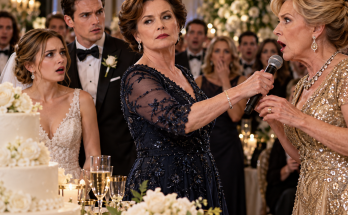
Mother pleaded guilty.
Not to everything.
The case was too large for everything.
Obstruction.
Fraudulent records.
Conspiracy related to Daniel’s illegal transfer.
Interference with Samuel Harrison’s investigation.
Participation in concealing Cross Nine.
The unauthorized reproductive procedure involving Tyler remained part of sentencing evidence even where statute limitations complicated separate charges.
Her attorney asked whether I would provide a victim-impact statement.
I said yes.
Mother asked to see me first.
I said no.
Then spent three days thinking about why.
Not because she deserved a meeting.
Because I wanted to know whether refusing was a boundary or avoidance.
Both were allowed.
But I wanted to recognize which.
On the fourth day, I called her attorney.
“One meeting.”
Secure facility.
One hour.
No physical contact unless I initiated.
No letters handed to me.
No requests about sentencing.
The attorney agreed.
Mother did too.
When she entered the visiting room, she looked smaller than I remembered.
Prison clothing did that.
So did age.
So did finally existing without secrets to manage.
She sat across from me.
“Margaret.”
“Hello.”
She did not call me Maggie.
Good.
For several seconds we said nothing.
Then she started:
“I’m sorry.”
I raised a hand.
She stopped.
“I know.”
Her face tightened.
“I don’t want a list.”
She nodded.
“No chronological confession.”
Another nod.
“I don’t need you to explain the network.”
“Okay.”
“I came because I have one question.”
She waited.
“Why couldn’t you ever let me choose?”
Mother closed her eyes.
Not Gerald.
Not Arthur.
Not William.
Not fear.
Her.
“Because I didn’t trust choice.”
That answer surprised me.
“What does that mean?”
Mother looked toward the security camera.
Then back.
“When I was young, Margaret chose Arthur’s world.”
Her sister.
My aunt.
“She told herself she chose it.”
Mother continued.
“Then I watched Arthur shape every option around her until whatever she picked served him.”
She saw manipulation become architecture.
“So I decided choices were mostly illusions.”
My throat tightened.
“That made you think you should make them for people.”
“Yes.”
There.
Mother said when she became pregnant with me, Arthur presented options.
Disappear.
Private adoption.
Money.
Marriage arrangement.
None felt free.
Then William offered another option.
Marriage.
A home.
His name.
She took it.
“Was that free?”
“I don’t know.”
At least honest.
Afterward, Mother became obsessed with eliminating uncertainty.
If she could choose the safest route before danger reached people, she believed she could prevent what happened to Margaret Bell.
“So you chose for Daniel.”
“Yes.”
“For Tyler.”
“Yes.”
“For Dad.”
“Yes.”
“For me.”
Her voice broke.
“Yes.”
I sat with it.
Mother continued.
“Every time something terrible happened, I thought the mistake was that I hadn’t controlled enough.”
That explained everything.
Not excused.
But explained.
“When Daniel was taken, I should have told you.”
“Yes.”
“I thought telling you created danger.”
“Yes.”
“When Tyler was born, I should have told you.”
“Yes.”
“I thought losing another child would destroy you.”
“You violated me instead.”
“Yes.”
No defense.
Good.
“When Samuel lived, I should have helped him go home.”
“Yes.”
“I thought his family would become targets.”
“Yes.”
“When I learned Michael was reaching Tyler—”
“You should have told me.”
“Yes.”
She started crying.
Not loudly.
“I kept thinking one more secret could stabilize everything.”
I remembered the kitchen table.
How long had I made smaller versions of the same mistake with Tyler?
Pay one more bill.
Make one more call.
Cover one more consequence.
Keep him stable.
Keep the family intact.
I understood Mother enough to feel compassion.
That scared me.
Compassion had once meant surrendering boundaries.
Not anymore.
“I understand some of it.”
She looked at me.
Hope appeared.
I hated the hope.
So I corrected it.
“That does not mean we go back.”
The hope disappeared.
Pain replaced it.
I let it.
“What does that mean?”
“I don’t know yet.”
“Can I write?”
“No.”
Her face tightened.
“Can I call?”
“No.”
“After sentencing?”
“No.”
She swallowed.
“For how long?”
“I don’t know.”
It sounded like Tyler with Michael.
Interesting.
Mother noticed too.
“You’re doing to me what Tyler did to Michael.”
“I’m setting a boundary.”
“Yes.”
She nodded.
“You’re right.”
She looked down.
“I hate it.”
“You can.”
Another lesson.
People could hate my boundary.
Still mine.
Mother asked:
“Do Daniel and Tyler know you’re here?”
“Yes.”
“What did they say?”
“Daniel said it was my choice.”
“And Tyler?”
I almost smiled.
“He said not to let you guilt me.”
Mother laughed through tears.
“That sounds like him.”
“Yes.”
She asked whether Tyler was doing well.
“Better.”
“Does he hate me?”
“I don’t know.”
“Will you tell him I’m sorry?”
“No.”
She flinched.
“Why?”
“If you want to apologize to him, that belongs between you and him if he chooses contact.”
Mother nodded slowly.
“You really changed.”
“No.”
I thought.
“I think I stopped confusing care with control.”
Her face folded.
“That was what I never learned.”
“I know.”
We sat in silence.
Then Mother asked:
“Do you still love me?”
The question felt unfair.
Not intentionally perhaps.
Still unfair.
“I’m not answering that today.”
She looked hurt.
“Why?”
“Because whatever I say, you’ll use it to decide what access you should have.”
Mother started to protest.
Then stopped.
She knew.
“You’re right.”
Good.
The meeting ended after forty-eight minutes.
I stood.
Mother remained seated.
She did not ask for a hug.
That mattered.
At the door she said:
“Margaret.”
I turned.
“Whatever sentence they give me, don’t try to fix it.”
I almost laughed.
“I wasn’t planning to.”
She smiled sadly.
“Good.”
The door closed.
I stood in the hallway and cried.
Not because I regretted the boundary.
Because boundaries could be right and still hurt.
Daniel waited outside.
Not because I asked him to.
He happened to be nearby for work and offered a ride.
I accepted.
He did not ask what Mother said until we reached the car.
“How was it?”
“Awful.”
“Useful?”
“Yes.”
“Worse.”
“Much.”
He started the car.
We drove.
At a red light he said:
“You know you don’t have to understand everybody.”
“I know.”
“You keep trying.”
“I like patterns.”
“You work in a library.”
“Exactly.”
He smiled.
Then said:
“I’m thinking about calling you Mom.”
The traffic light changed.
I did not move.
A horn sounded behind us.
Daniel laughed.
“Drive.”
I drove.
At the next light I said:
“You don’t have to.”
“I know.”
“You can call me Margaret forever.”
“I know.”
“Don’t do it because you think I need it.”
“I know.”
He looked at me.
“Can I finish?”
“Sorry.”
“I said thinking.”
“Right.”
“Not decided.”
“Okay.”
He smiled.
“You’re terrible at being casual about this.”
“Yes.”
We laughed.
He did not call me Mom that day.
Good.
The sentencing hearings began a month later.
Gerald was deemed competent.
Barely.
He took a plea to avoid a trial that would likely outlive him.
His statement contained no remorse worth repeating.
He blamed systems.
Arthur.
Margaret Bell.
Leonard.
Age.
History.
When the judge asked whether he accepted responsibility, Gerald said:
“I accept that my decisions had consequences.”
The judge replied:
“That is not the same sentence.”
I liked her immediately.
Gerald finally said yes.
Whether he meant it did not matter legally.
Michael pleaded guilty to fraud, conspiracy, unlawful surveillance, and other charges.
His kidnapping-related exposure remained disputed.
Tyler did not attend.
Good.
Claire did.
Not for Michael.
For herself.
She read a statement about being made to believe love required secrecy.
Michael cried.
Claire did not look at him afterward.
Margaret Bell fought longer.
Eventually convicted on multiple counts.
Noah declined to provide a statement.
Marian did.
Her voice shook.
She described eleven months in a psychiatric institution because Margaret wanted Rachel.
The courtroom became completely still.
Margaret Bell looked at the table.
For once, she did not interrupt.
Richard Cross died before trial.
Actually died.
Independent confirmation.
No hidden relocation.
His final statement remained sealed except for portions relevant to active investigations.
I did not request the rest.
That surprised everyone.
Even me.
Why not?
Because I no longer wanted old men to narrate my life after they left it.
Samuel Reeves survived and cooperated partially.
His testimony implicated several retired officials and two still-serving administrators.
Evan Mercer was cleared of participating in his own impersonation filings but remained under investigation for earlier sealing decisions.
Thomas Bennett pleaded guilty.
Frank Bell too.
Leonard died before his case resolved.
Another real death.
No funeral I attended.
David’s case ended differently.
Age.
Medical condition.
Evidence.
Cooperation.
He received a limited sentence with home confinement after hospitalization.
Daniel struggled with that.
“So he helped destroy your life and gets a bedroom.”
“Yes.”
“You’re okay with that?”
“No.”
“Then?”
“I don’t control sentencing.”
He looked frustrated.
I understood.
Justice rarely arrived in proportions that satisfied emotion.
He asked whether I wanted David punished more.
“Yes.”
That honesty helped.
“Do you hate him?”
“Sometimes.”
“Do you love him?”
The question surprised me.
“I love who I thought he was.”
Daniel nodded.
“Same.”
We did not speak for several minutes.
Tyler’s relationship with David remained occasional.
Medical questions.
Short conversations.
No father title.
Richard kept that.
David never asked for it.
Good.
Richard himself received probation, fines, and professional consequences tied to his obstruction plea.
He also testified extensively.
He lost friends.
Reputation.
Some people called him a hero for running onto the airfield.
Others called him a criminal for hiding Daniel.
Both labels were too simple.
He was Richard.
He did one brave thing.
He did several cowardly things.
He loved Tyler.
He lied to me.
All true.
At Mother’s sentencing, I read my statement.
I did not tell the court what punishment to give.
I described effects.
A child mourned who lived.
A second child conceived without consent.
Years of altered choices.
Relationships built on missing information.
Fear inherited by the next generation.
Then I said:
“My mother believed love gave her permission to decide what truths other people could survive.”
Mother cried.
I continued.
“I am not asking this court to decide whether she loved us. I believe she did.”
She looked at me.
“But love is not the measure of whether harm occurred.”
The room went silent.
I finished.
“When people lose the right to choose because someone claims to know what is best for them, that is not protection. It is control, even when fear and love are real.”
I sat.
Mother did not look away.
The judge sentenced her.
Years.
Fewer than some wanted.
More than Mother’s lawyer requested.
I felt nothing clean.
No triumph.
No relief.
Just consequence.
Outside the courthouse, reporters waited.
I said nothing.
Daniel walked beside me.
Then Tyler appeared across the street.
I did not know he was coming.
He had finished treatment two weeks earlier.
He lived in transitional housing.
Worked full time.
No car yet.
He crossed when the light changed.
“Hey.”
“Hey.”
“You came.”
“Yeah.”
“Why?”
He shrugged.
“Thought you might want coffee.”
I laughed.
Daniel said:
“Normal?”
Tyler looked confused.
I said:
“Long story.”
Daniel looked at him.
“Actually short by our standards.”
Tyler smiled.
Then the three of us walked away from the courthouse.
No one called me Mom.
Then, halfway down the block, Daniel said:
“Mom, which place?”
I stopped.
So did Tyler.
Daniel’s face turned red.
“I didn’t plan that.”
My eyes filled.
“I know.”
“Don’t make it weird.”
“Too late,” Tyler said.
Daniel laughed.
So did I.
Then I answered the question.
“The place on Fifth.”
We kept walking.
One word had changed.
Nothing else needed to.
Click here to continue reading: PART 44: When Tyler Asked Whether He Could Ever Be Trusted in My Home Again, I Finally Understood What Forgiveness Could and Could Not Restore
After My Son Struck Me in My Own Kitchen, I Finally Made the Call He Never Expected Me to Make
Part 43 of 47