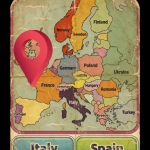
 The correct answer is Spain, a country in southwestern Europe located on the Iberian Peninsula. Its capital is Madrid, and it shares land borders with Portugal, France, and Andorra.
Let’s turn this into your detailed Facebook Reels quiz script, with geography, history, culture, and fascinating facts about Spain.
 FACEBOOK REELS QUIZ SCRIPT
Which Country Is This? Discover the Beautiful Country of Spain!
1. HOOK — Challenge Your World Geography Knowledge!
Are you ready to test your knowledge of world geography?
Europe is home to some of the most beautiful and historically important countries on Earth. From the romantic streets of Italy to the magnificent castles of France, every country has its own fascinating identity, traditions, and culture.
But today’s challenge is about identifying one particular country on the map!
Look carefully at the map of Europe. Can you recognize the country hidden among its neighboring nations?
Is it Italy, Spain, France, or Germany?
This country is famous for its beautiful Mediterranean coastline, historic cities, delicious food, passionate music, impressive architecture, and rich cultural traditions.
It is also home to one of the world’s most recognizable football cultures.
So, take a good look at the map and see whether you can identify this European country!
2. INTRODUCTION — Examine the Four Choices
Let’s take a closer look at today’s four possible answers.
A — Italy.
Italy is a beautiful country in southern Europe, famous for its ancient Roman history, Renaissance art, impressive architecture, and world-renowned cuisine.
Its capital is Rome, a city filled with historical landmarks such as the Colosseum and the Roman Forum.
Italy is also famous for pizza, pasta, fashion, and its beautiful Mediterranean coastline.
B — Spain.
Spain is located in southwestern Europe, primarily on the Iberian Peninsula.
Its capital city is Madrid, and the country is famous for its historic architecture, beautiful beaches, flamenco music and dance, football, and delicious traditional dishes such as paella.
Spain also has a rich history influenced by Roman civilization, Islamic culture, and European traditions.
C — France.
France is a major European country famous for its art, fashion, romantic cities, historical monuments, and culinary traditions.
Its capital is Paris, home to the world-famous Eiffel Tower, the Louvre Museum, and Notre-Dame Cathedral.
France is also known for its beautiful countryside, vineyards, and internationally celebrated cuisine.
D — Germany.
Germany is located in central Europe and is famous for its engineering, automobile industry, historic cities, castles, and cultural traditions.
Its capital is Berlin, a city known for its important role in European history.
Germany is also famous for its contributions to science, technology, classical music, and manufacturing.
All four countries are important parts of European history and culture, but only one is the correct answer to today’s geography challenge.
3. SUSPENSE — Can You Find the Country on the Map?
Here’s a helpful geographical clue!
The country we’re looking for is located in southwestern Europe.
It occupies most of the Iberian Peninsula and shares this peninsula with another European country called Portugal.
To its northeast, it borders France and the small country of Andorra.
It also has coastlines along the Mediterranean Sea and the Atlantic Ocean.
Another interesting clue is that this country includes beautiful islands, including the Balearic Islands in the Mediterranean and the Canary Islands in the Atlantic Ocean.
Its capital city is one of Europe’s most important cultural, political, and economic centers.
And here’s one more clue!
This country is famous for flamenco, traditional festivals, historic palaces, and some of the world’s most celebrated football clubs.
Can you recognize it now?
Is it Italy, Spain, France, or Germany?
Look carefully at the map and think about the country’s location in southwestern Europe.
4. ENGAGEMENT — Make Your Final Choice!
It’s time to make your final decision!
Look at the four answers again:
A — Italy
B — Spain
C — France
D — Germany
Which country do you believe is highlighted by today’s geography challenge?
Write your answer in the comments!
If you enjoy learning about countries, capitals, famous landmarks, and world geography, share this quiz with your friends and family.
Let’s see how many people can identify this beautiful European country correctly!
Get ready, because we’re about to reveal the answer and discover some fascinating facts about its history, geography, and culture!
5. ANSWER REVEAL — The Correct Answer Is Spain!
The correct answer is B — Spain!
Congratulations to everyone who selected Spain!
Spain is one of the most fascinating countries in Europe. Officially known as the Kingdom of Spain, it is located in southwestern Europe and occupies most of the Iberian Peninsula.
Its geographical position makes it particularly interesting because it connects different parts of Europe while also maintaining strong historical and cultural connections with the Mediterranean region and the Atlantic world.
But there’s much more to Spain than its location on a map.
Let’s discover what makes this country so special!
First, let’s explore Spain’s geography.
Spain shares its main land borders with Portugal to the west and France and Andorra to the northeast.
It also borders Gibraltar, a British Overseas Territory, along its southern coast.
Spain has coastlines along both the Mediterranean Sea and the Atlantic Ocean.
Its territory includes mainland Spain, the Balearic Islands, the Canary Islands, and the autonomous cities of Ceuta and Melilla in North Africa.
The Balearic Islands include popular destinations such as Mallorca, Menorca, and Ibiza.
The Canary Islands, located off the northwest coast of Africa, are famous for their volcanic landscapes, warm climate, and beautiful beaches.
This variety of geographical environments makes Spain one of Europe’s most attractive destinations for travelers.
Second, let’s talk about Madrid, the capital city.
Madrid is located in central Spain and serves as the country’s political, economic, and cultural center.
It is famous for its beautiful architecture, lively public squares, museums, restaurants, and vibrant nightlife.
One of its most important attractions is the Royal Palace of Madrid, an impressive historic building associated with the Spanish monarchy.
Another famous destination is the Prado Museum, which houses an extraordinary collection of European paintings.
Madrid is also home to Real Madrid, one of the most famous and successful football clubs in the world.
Visitors can enjoy historic neighborhoods, beautiful parks, traditional markets, and countless cultural attractions throughout the city.
Third, Spain has an extraordinary history.
Spain’s history stretches back thousands of years and includes many different civilizations.
The Romans conquered much of the Iberian Peninsula and developed important cities, roads, bridges, and infrastructure.
Roman influence helped shape the region’s language, legal traditions, architecture, and culture.
Later, during the early eighth century, Muslim forces entered the Iberian Peninsula, beginning a long period of Islamic political and cultural influence in parts of the region.
The period of Al-Andalus left an extraordinary architectural and cultural legacy.
One of the most famous examples is the Alhambra in Granada, a magnificent palace and fortress complex known for its beautiful courtyards, decorative details, gardens, and Islamic architecture.
During the medieval period, several Christian kingdoms gradually expanded their territories.
In 1492, the Catholic Monarchs, Ferdinand II of Aragon and Isabella I of Castile, captured Granada, bringing the last Muslim-ruled kingdom on the Iberian Peninsula under Christian rule.
That same year, Christopher Columbus began his famous voyage across the Atlantic under the sponsorship of the Spanish Crown.
These developments helped establish Spain as one of the major European powers during the following centuries.
Fourth, Spain became an important global power.
During the sixteenth and seventeenth centuries, Spain established a vast overseas empire.
Spanish explorers, soldiers, missionaries, and settlers traveled across the Americas and other parts of the world.
Spanish became widely spoken across large areas of the Americas, creating a lasting linguistic and cultural connection between Spain and many countries in Latin America.
Today, Spanish is one of the most widely spoken languages in the world.
Although Spain’s overseas empire eventually declined, its historical influence remains visible in language, architecture, religion, food, and cultural traditions across many regions.
Fifth, Spain has a rich and diverse culture.
One of the country’s most famous cultural traditions is flamenco.
Flamenco is a passionate art form associated particularly with Andalusia in southern Spain.
It combines singing, guitar music, rhythmic handclapping, and expressive dance.
Its powerful emotions and distinctive musical style have made it famous around the world.
Spain is also known for its festivals.
One of the most famous is La Tomatina, held in the town of Buñol, where participants take part in a huge tomato-throwing celebration.
Another famous event is the Running of the Bulls in Pamplona, which takes place during the San Fermín festival.
Spain also celebrates Semana Santa, or Holy Week, with elaborate religious processions in many cities.
These celebrations demonstrate the country’s regional diversity and strong cultural traditions.
Sixth, let’s talk about Spanish food!
Spanish cuisine is famous for its variety, fresh ingredients, and regional specialties.
One of its best-known dishes is paella, traditionally associated with the Valencia region.
Paella is a rice-based dish that can include seafood, chicken, vegetables, and different seasonings depending on the recipe.
Another popular Spanish food is tapas.
Tapas are small dishes or snacks that people often enjoy while socializing with friends and family.
Some examples include patatas bravas, olives, Spanish tortilla, and croquettes.
Spain is also famous for jamón ibérico, a highly valued cured ham produced from Iberian pigs.
Food is an important part of Spanish social life, and meals often provide an opportunity for families and friends to spend time together.
Seventh, Spain is famous for football!
Football is one of the most popular sports in the country.
Spanish clubs have achieved enormous international success, and millions of supporters follow their favorite teams.
Two of the most famous clubs are Real Madrid and FC Barcelona.
Their rivalry is commonly known as El Clásico, one of the most watched football matchups in the world.
The Spanish national team has also enjoyed remarkable success.
Spain won the FIFA World Cup in 2010, defeating the Netherlands in the final in South Africa.
The national team also won the UEFA European Championship in 1964, 2008, 2012, and 2024.
These achievements helped establish Spain as one of the most respected football nations in international competition.
Eighth, Spain is home to extraordinary architecture and landmarks.
One of the most recognizable landmarks is the Sagrada Família in Barcelona.
This extraordinary basilica was designed by the famous Catalan architect Antoni Gaudí.
Its unusual towers, detailed decorations, and impressive architectural design make it one of the most recognizable buildings in Europe.
Another famous destination is the Alhambra in Granada.
Visitors also travel to Seville to see its historic cathedral and the beautiful Royal Alcázar.
In Madrid, the Royal Palace and Prado Museum attract millions of visitors.
From historic castles to magnificent cathedrals, Spain offers an incredible variety of cultural and architectural treasures.
Finally, let’s discover some important facts about modern Spain.
Spain is a constitutional monarchy with a parliamentary system of government.
The country is divided into 17 autonomous communities and two autonomous cities.
Spanish, also known as Castilian, is the official language of the state. Several other languages, including Catalan, Galician, and Basque, also have official status in particular autonomous communities.
Spain became a member of the European Communities, now the European Union, in 1986.
Its economy includes important industries such as tourism, manufacturing, agriculture, renewable energy, and services.
The country attracts visitors from around the world who come to experience its beaches, historic cities, food, art, and cultural festivals.
From the streets of Madrid to the beaches of Barcelona, from the historic monuments of Andalusia to the beautiful islands of the Mediterranean, Spain offers something remarkable for almost every traveler.
And that is why Spain is such an interesting country to discover!
6. ENDING — How Much Do You Know About Spain?
So, now you know!
The correct answer is Spain!
Located in southwestern Europe, Spain is a country with an extraordinary combination of history, culture, architecture, natural beauty, and modern achievements.
From the ancient Roman influence and the legacy of Al-Andalus to flamenco, paella, world-famous football clubs, and magnificent historic landmarks, Spain has contributed so much to European and global culture.
Now it’s your turn!
Have you ever visited Spain?
Which Spanish city would you most like to explore: Madrid, Barcelona, Seville, Valencia, or Granada?
And what interests you most about Spain: its history, food, beaches, architecture, or football?
Share your answer in the comments, challenge your friends with this geography quiz, and follow USA Brain Challenge for more fascinating countries, world landmarks, and exciting knowledge challenges.
Keep exploring the world, keep learning something new, and keep challenging your brain!
Quick fact-check
-
Spain is located in southwestern Europe, occupying most of the Iberian Peninsula.
-
Its capital is Madrid.
-
Spain has 17 autonomous communities and two autonomous cities.
-
Spain joined the European Communities in 1986.
-
Spain won the FIFA World Cup in 2010 and the UEFA European Championship in 1964, 2008, 2012, and 2024.
Small image note: The map shows Spain’s geographical region on the Iberian Peninsula, beside Portugal and below France. The country itself is not clearly labeled, so the answer depends on recognizing its location.
 Who Sang the Popular Song “Runaround Sue” in 1961?