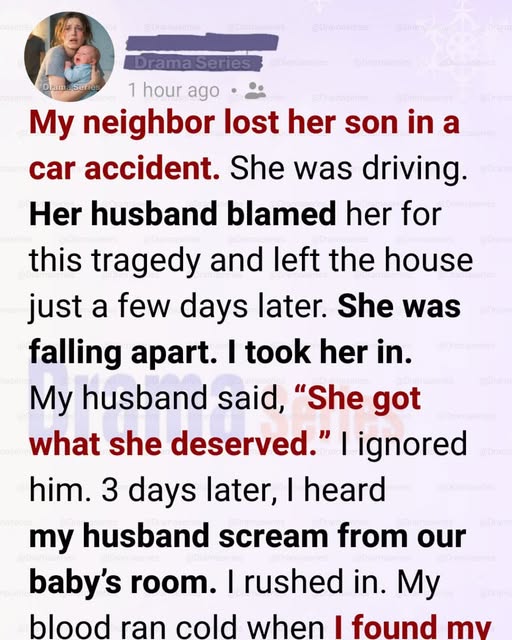
The night we lost our neighbor’s son, the whole street seemed to fall silent.
His name was Lucas. He was seven years old, the kind of boy who rode his bike in circles on the sidewalk and waved at every car that passed. Just three days before the accident, he had proudly shown me the missing tooth in his smile while my own baby giggled from the stroller.
Then one rainy evening, everything changed.
Lucas’s mother, Emily, had been driving him home from soccer practice when another car ran a red light. The crash happened just two blocks from our neighborhood. By the time the ambulance arrived, it was already too late.
At the funeral, Emily looked like a ghost of herself. Her eyes were empty, her shoulders collapsed inward as if she were trying to disappear. Her husband, Mark, barely stood beside her. He didn’t hold her hand. He didn’t look at her.
Three days later, he packed a suitcase and left.

Word spread quickly: he blamed Emily for the accident.
“You k:illed our son,” he’d reportedly shouted before slamming the door behind him.
I watched her house grow darker every evening. Curtains stayed closed. No lights. No sounds. No movement.
I knew what loneliness could do to a grieving person. And I couldn’t just sit there and pretend I didn’t see it.
So one afternoon, I knocked on her door.
When she opened it, she looked thinner already, her hair unwashed, her face pale and hollow.
“Emily,” I said softly. “You shouldn’t be alone right now. Come stay with us.”
She stared at me like she didn’t quite understand the words. Then tears spilled down her cheeks.
My husband was not happy about it.
When I told him she would be staying in our guest room for a while, he frowned.
“She got what she deserved,” he muttered under his breath.
I felt anger rise in my chest.
“She lost her child,” I said sharply.
But he just shrugged and walked away.
I tried to ignore him.
For the next few days, Emily barely spoke. She moved through the house quietly, like someone afraid of taking up space. Sometimes I’d find her sitting by the window, staring outside for hours.
But one thing I noticed: whenever our baby cried, her head would lift instantly.
Three nights later, something happened that I will never forget.
My husband and I were downstairs in the kitchen when we suddenly heard him scream from upstairs.
“WHAT ARE YOU DOING?!”
The sound of panic in his voice made my heart leap into my throat.
I ran up the stairs two at a time.

When I burst into the nursery, my blood ran cold.
Emily was holding our baby.
For half a second, I couldn’t breathe.
Then I saw our son’s face — red, gasping for air.
“He was choking,” she cried, her voice shaking.
Later she told us she had heard strange gasping sounds through the wall while she was lying awake. Something about it had triggered an instinct in her. She rushed into the room without even thinking.
By the time I arrived, she had already turned our baby gently onto his side and cleared the obstruction from his airway.
Now she was trembling, clutching him against her chest like he was the most fragile thing in the world.
Tears streamed down her face.
“I heard him struggling,” she whispered. “I couldn’t ignore it.”
Our baby let out a loud cry — the most beautiful sound I had ever heard.
He was breathing.
Alive.
Click Here to continuous Read Full Ending Story👉 Part2: She Couldn’t Save Her Own Son… But She Saved Mine
She Couldn’t Save Her Own Son… But She Saved Mine
Part 1 of 2