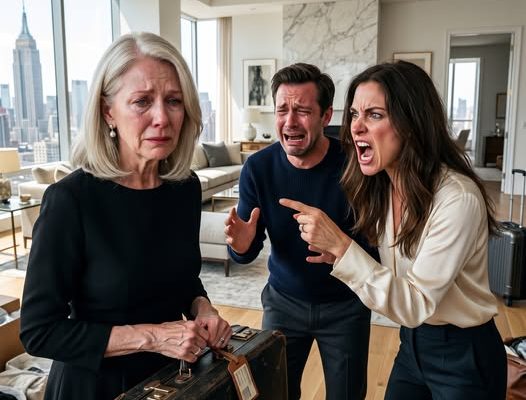
After my husband passed away, I kept the $28 million inheritance and the penthouse in New York City a secret. That same week, my daughter-in-law yelled, “Now that he’s gone, cry, pack your things, and go live on the streets.” I simply replied, “Okay.” Then I decided to do something that…
After my husband passed away, I kept the $28 million inheritance and the penthouse in New York City a secret. That same week, my daughter-in-law yelled, “Now that he’s gone, cry, pack your things, and go live on the streets.” I simply replied, “Okay.” Then I decided to do something that…
After my husband passed away, I kept the $28 million inheritance and the penthouse in New York City a secret.
That same week, my daughter-in-law stood in my living room, looked me dead in the eye, and said, “Now that he’s gone, cry, pack your things, and go live on the streets.”
I said, “Okay.”
That was all.
No tears. No argument. No plea. No dramatic speech worthy of the kind of woman Vanessa believed she was dealing with. Just one word, spoken flatly, while my fingers tightened around the small brass key in my coat pocket, the one Daniel had pressed into my palm 3 weeks before he died, when his hands were already thin and cold and his voice had become the frail, urgent voice of a man who knew time was nearly done with him.
“Keep this safe, Maggie,” he had whispered. “Don’t tell anyone.”
I hadn’t.
And standing there in my own living room, with my son’s wife ordering me into homelessness 5 days after we buried my husband, I decided I still wouldn’t.
Vanessa blinked when I didn’t fight back. She had expected rage. She had wanted tears. She wanted me to scream and beg and thrash around so she could later tell anyone who asked that I had become unstable after Daniel’s death, that she and Robert had only done what was necessary, that generosity had limits when grief became inconvenient.
Robert stood behind her with his hands shoved into his pockets, staring at the floor like a schoolboy waiting to be dismissed by the principal. My son was 42 years old. I had carried him in my body, fed him from my own hands, worked double shifts to keep him clothed and educated, sold my mother’s jewelry to make sure he never had to leave college because of money. And there he stood, unable or unwilling to look at me while his wife informed me I no longer belonged in the house where I had lived for 40 years.
“Did you hear me?” Vanessa demanded, her voice climbing.
I heard her.
I also saw the black Louboutins on her feet, the ones with the red soles. I knew exactly how much they cost because 2 months earlier, while helping Daniel organize the papers in his study, I had seen the credit card statement and the charge circled in his handwriting, as if he too had been trying to teach himself what kind of woman his son had brought into our lives. $1,200 for shoes. More than I had earned in a month at Saint Vincent’s Hospital back when I was still working night shifts and driving home at dawn with my feet swollen and my hair pinned up under a scarf because I never had enough time to do it properly before going back again.
“I heard you,” I said.
The funeral had been that morning.
March in White Plains has a coldness that does not merely sit on the skin. It enters the bones and waits there. I had stood beside Daniel’s grave in my old navy wool coat—the one I bought in 1998 after a Christmas bonus and wore every winter afterward because coats, like marriages, should last if you choose carefully—and watched strangers lower him into the ground as if 40 years could be translated cleanly into a casket and a few handfuls of dirt.
Forty years.
Forty years of waking up at 4:30 to make his coffee before my shift.
Forty years of packing his lunches.
Forty years of hospital waiting rooms when his mother had her strokes.
Forty years of managing his father’s Alzheimer’s one brutal season at a time.
Forty years of raising Robert while Daniel built his career.
Forty years of doing the invisible labor that makes another person’s stability look natural.
No one mentioned any of that at the service.
Vanessa had hired a professional eulogist because, as she put it, “We need someone who can speak properly, not just ramble about old stories.” The man spoke for 12 minutes about Daniel’s business acumen. He mispronounced his name twice. Daniel Jacob Hayes, not Haze. Hayes. I did not correct him. There are humiliations that feel too tired to interrupt in real time.
Now we were back at 847 Maple Avenue, in the Victorian house I had scrubbed, painted, polished, and maintained for 4 decades, and Vanessa was already rearranging the future.
“This house needs to be sold,” she announced to the room as if the room belonged to her.
My sister Linda sat on the couch and nodded along. Linda Schultz, 65 years old, freshly arrived from Ohio, not to comfort me but to position herself for whatever scraps she imagined might fall once the estate was cut apart. We had not been close since 1987, when I married Daniel and she married a car salesman who left her 3 years later. She had been bitter ever since, though she preferred to call it realism.
“The market’s good right now,” Linda said. “You could get $890,000, maybe more.”
Vanessa kept pacing in front of the fireplace. She had already taken down our wedding photo and replaced it with some oversized abstract thing from a gallery in SoHo that looked like spilled wine on sadness.
“Daniel left everything to Robert,” she said. “The will is very clear. And since Robert and I are building our future, we need liquidity. You understand?”
I understood plenty.
I understood that she had been planning this since the day Robert brought her home 8 years earlier wearing that bright hungry smile she reserved for homes better furnished than her own. I understood that my son, who I had put through college with overtime and sacrifice, had allowed her to turn him into a soft, apologetic accomplice to his own mother’s erasure. I understood that Daniel had tried to warn me in small, careful ways over the past year and that I, in my own foolish trust, had not listened closely enough.
Six months before his death, over breakfast, while the toast burned because he was distracted and never did pay enough attention to bread, Daniel said quietly, “Maggie, if something happens to me, don’t trust the paperwork. Wait for Mr. Brennan.”
Donald Brennan was his estate attorney. I hadn’t heard from him after the funeral. Vanessa had informed me that he was unavailable and that a junior associate had “handled everything.”
“Where will I go?” I asked.
My voice sounded flat even to me. Not because I wasn’t devastated. Because grief had become too large to fit into panic. When your whole life is being stripped around you while you are still trying to absorb that your husband is in the ground, you stop sounding like yourself.
Vanessa shrugged.
“That’s not really our problem, is it? You’re 68. You must have savings, Social Security. Robert and I have our own family to think about.”
They had no children.
Vanessa had been “trying” for 7 years, which mostly seemed to involve spa weekends, moon-cycle apps, and a theatrical refusal to see an actual fertility specialist because, in her words, “The universe provides when the time is right.” She spoke of motherhood the way some women speak of handbags—something expected eventually, mostly as proof of deserving it.
Robert finally lifted his head.
“Mom, don’t—”
Vanessa’s hand shot out and clamped around his forearm. Her nails were painted burgundy. I remembered those same nails tapping impatiently on the Christmas table while I carved the organic turkey she insisted on and then criticized for being dry.
“Your mother is a grown woman,” Vanessa said. “She’ll figure it out. We’ve been more than generous letting her stay this long after the funeral.”
Five days.
She called 5 days generosity.
Linda stood and gave me a smile so tight it was practically a threat.
“Margaret, you’ve always been so independent. I’m sure you have a plan.”
I looked at my sister and thought how strange it was that some people spend a lifetime waiting for your weakness to finally prove the story they’ve been telling themselves about you. Linda always hated that I built a life she couldn’t sneer at directly. So now she had come for the collapse.
“I’ll need a few hours to pack,” I said.
“Of course,” Vanessa replied brightly. “Take your time. We’ll be out until 6. Robert has a meeting with the estate planner.”
The estate planner.
I almost smiled at that, though not from amusement.
They left 2 minutes later. I heard the front door shut, then the electronic chirp of the Audi unlocking in the driveway. Leased, $680 a month. I knew because Robert had borrowed $2,000 from me the previous November when he came up short, and I had given it to him from my savings without a lecture because he was my son and mothers commit that particular sin more often than anyone admits.
When the house went quiet, the silence felt obscene.
I stood in the center of the living room and looked around.
The couch I had reupholstered myself in 2004.
The coffee table Daniel built in the garage and sanded for weeks.
The curtains I sewed by hand in 1989 to match wallpaper I no longer liked but kept because Daniel said the room looked warm in them.
The china cabinet with yellow Post-its Vanessa had already stuck to the glass: sell, donate, trash.
My wedding china sat in a box near the front hall, marked donate.
I went upstairs slowly, holding the banister because my knees hurt and because touching the wood helped anchor me to the fact that I was still in my own house, if only for a few more hours.
In the bedroom, the bed was made because I had made it that morning by force of habit before the funeral. That might have been the saddest part. Habit continuing while life did not.
Daniel’s closet was empty.
Gone.
The suits I had taken to the cleaners.
The ties I straightened every Sunday before church.
The shirts I ironed while watching the evening news.
Gone.
Donated or boxed or hauled away before his body was even cold.
I opened my own closet. Vanessa had been in there too. Three of my dresses were missing. The good ones. The blue Talbots dress I wore to Robert’s wedding. The one I saved 2 months to buy for Daniel’s retirement dinner. The cream one I had thought I might wear again one day if life ever handed me another reason to stand in soft light.
On the bed sat a neat stack of papers.
The letterhead read Whitmore and Associates, Attorneys at Law. Not Mr. Brennan’s firm.
A Post-it note on top, in Vanessa’s looping handwriting: Sign here, here, and here.
Voluntary transfer of property to Robert J. Hayes.
Witnessed by Linda Schultz.
Voluntary.
I sat down on the edge of the mattress. It dipped in the same place Daniel used to sit when he took off his shoes after work. For 1 second I could smell him there—Old Spice and peppermint lozenges and the faint clean scent of a man who spent his life trying to appear more composed than he ever really felt.
My hand went to the key in my pocket.
Small.
Brass.
Stamped with the number 447.
Daniel had given it to me in the hospital 3 weeks before the heart attack. He had been unusually lucid that day, more present than he had seemed in months.
“Maggie,” he said, gripping my hand. “This opens a box at Manhattan Trust, 47th Street. You go there. You don’t tell Robert. You don’t tell anyone. You understand?”
I had nodded, though I thought at the time he was medicated and confused.
He made me repeat it back.
“Manhattan Trust, 47th Street,” I said. “Don’t tell anyone.”
He relaxed then, closed his eyes, and whispered, “Good girl.”
Now I looked at the papers on the bed and understood only this: fighting here, in this house, on Vanessa’s chosen field, would give her what she wanted. Noise. Delay. The chance to paint me as desperate and unstable. Maybe I could contest the transfer later. Maybe not. But not now. Not like this.
There is something people misunderstand about women my age. They see 68 and think frail. They see old coat, sensible shoes, faded purse, and they assume the life inside those objects has narrowed down to fear. What they miss is that women who have worked, endured, buried, raised, and survived for as long as I had are not weak. We are simply economical with our energy.
I picked up the pen.
I signed all 3 pages.
My signature was perfectly steady.
Then I packed.
Not much. Two pairs of jeans. Three sweaters. Underwear. My nursing shoes, though I had been retired 3 years and did not know why I couldn’t bear to leave them. My Bible. The quilt my mother made me. The framed wedding photograph of Daniel and me, the one copy Vanessa hadn’t yet found. In the bathroom, I took my toothbrush, prescriptions, and a bar of soap. I left the expensive shampoo Vanessa had once told me not to use because it was “for guests.”
Downstairs, I crossed the kitchen one last time.
The counters were spotless because I had scrubbed them before dawn that morning while waiting for funeral time to become real. The coffee maker sat where it had sat since 2001, when I bought it with a hospital bonus and felt extravagant for a full week afterward. Vanessa had placed a Post-it on it too.
Trash.
I picked up my purse from the hook by the door and checked inside.
Wallet.
House keys that no longer opened the locks she had changed while we were at the cemetery.
The brass key.
And, tucked into the zippered pocket, a business card I had forgotten Daniel slipped there 2 months earlier.
Donald P. Brennan, Esq.
Estate Planning and Trusts.
I left the signed papers on the kitchen table.
No note.
What would I have written? Thank you for your efficiency in stripping 40 years from around me?
The front door closed with a soft click.
I walked down the driveway with my suitcase in one hand and my purse in the other. It was 4:30 in the afternoon. The neighborhood was quiet. Mrs. Chen next door was dragging her garbage cans in. She waved. I waved back. I didn’t cry. I didn’t look back.
I walked 6 blocks to the East Side Motel on Route 119.
The man at the desk didn’t ask questions. $67 a night, cash. Room 12, second floor.
The room smelled like cigarettes and disinfectant. Brown carpet. Orange bedspread. A TV bolted to the dresser. A window overlooking the parking lot. Through the wall I could hear the couple in room 11 arguing about money.
I sat on the bed and did not unpack.
I just stared at the wall with my hand in my coat pocket, touching the key.
Vanessa thought she had won.
Linda thought I was pathetic.
Robert thought I would disappear quietly into some subsidized apartment and fade into the background the way old women are expected to fade once younger people decide the room is no longer ours.
They didn’t know about the key.
They didn’t know that 48 hours after Daniel died, I had received a text from a blocked number.
Mrs. Hayes, do not sign anything until we speak. D Brennan.
I had deleted it immediately, afraid Vanessa might see it.
But I remembered.
At 4:57 p.m., I picked up the motel room phone, then changed my mind and used my old flip phone instead. Some instincts survive the absence of reason and simply insist.
The business card rang 3 times.
Then a man answered.
“Brennan.”
“This is Margaret Hayes,” I said. “Daniel’s widow. I think we need to talk.”
There was a pause.
Then, “Mrs. Hayes. I’ve been waiting for your call.”
My heart began pounding for the first time in 5 days.
“Can you come to my office tomorrow morning? 9:00. It’s important. And please don’t tell anyone you’re coming.”
“I won’t.”
“Good. Bring the key.”
Then he hung up.
I sat there in room 12 holding the phone and staring at the stained wallpaper.
I didn’t know what was inside box 447.
I didn’t know what Daniel had hidden from me or why.
But I knew 1 thing with perfect clarity.
Vanessa had made a mistake.
The East Side Motel did not serve breakfast. There was a vending machine by the ice dispenser downstairs. Stale Pop-Tarts for $2.50. Burnt coffee for $1.75. I bought both at 6:30 because I had been awake since 4:00 listening to trucks rumble past on Route 119 and because grief does not exempt you from hunger. At 8:45, I took the bus into Manhattan. Sixty-three minutes. Standing room only. A teenager with headphones leaned too far into my shoulder and a man beside me smelled like wet wool and impatience.
Mr. Brennan’s office on 47th Street was on the 4th floor of a narrow brick building wedged between a jewelry shop and a deli.
No elevator.
By the time I reached the top, my knees were aching and my breath had gone thin. The frosted glass door read:
Donald P. Brennan, Esq.
His office was smaller than I expected. Bookshelves. Filing cabinets. One cracked leather chair across from a crowded desk. A window with half-closed blinds. He was younger than I imagined from Daniel’s tone when he spoke of him, maybe 55, graying at the temples, navy suit, expensive but not flashy.
“You brought the key,” he said.
I placed it on the desk.
He turned it over once in his fingers, nodded, and opened a manila folder.
“Do you know what this opens?”
“A box at Manhattan Trust. That’s all Daniel told me.”
Mr. Brennan leaned back.
“Mrs. Hayes, your husband retained my services for 32 years. I handled his estate planning, his business investments, and, toward the end, a number of very specific instructions regarding asset protection.”
“Asset protection,” I repeated.
“Daniel was a careful man,” Brennan said. “Careful and, if I’m being honest, secretive. He did not want certain people to know the full scope of his estate.”
“Certain people,” I said. “You mean Robert and Vanessa.”
He slid a document toward me.
“Did you sign a voluntary property transfer on March 14th?”
My stomach dropped.
“How did you—”
“I have a contact at Whitmore and Associates,” he said. “They’re a cut-rate firm. Vanessa hired them because they don’t ask questions.”
He tapped the document.
“The transfer gives the house at 847 Maple Avenue to your son, free and clear. You waived all claims. Your sister witnessed it.”
“I didn’t have a choice,” I said. “Vanessa changed the locks.”
“That’s illegal, by the way. You could contest it.”
He paused.
“But you won’t.”
“Why not?”
He studied me for a second.
“Because you’re smarter than they think. And because what Daniel left you makes that house look like pocket change.”
Then he slid a single-page summary across the desk.
I looked down.
Estate of Daniel Jacob Hayes.
Confidential summary.
Primary assets held in irrevocable trust.
Margaret Louise Hayes, sole beneficiary.
Investment portfolio: $19,200,000.
Offshore accounts: $6,100,000.
Real property: 785 Park Avenue, NYC, penthouse 18B: $12,400,000.
Cash reserves: $2,300,000.
Total estimated value: $28,000,000.
I stared at the numbers until they lost all meaning.
“Daniel and I drove a 2011 Honda,” I said.
“I know.”
“We lived in a house worth less than a million.”
“I know.”
“We shopped at Stop & Shop.”
Brennan folded his hands.
“In 2003, Daniel inherited a stake in his father’s manufacturing company. He sold it quietly, invested aggressively, and kept almost everything off public visibility. He didn’t want attention. And he did not want Robert to know. His exact words to me were, ‘My son married a vulture. If she finds out, she’ll bleed him dry.’”
I couldn’t breathe properly.
“Why didn’t he tell me?”
Mr. Brennan’s expression softened just enough to be called kind.
“He tried. Multiple times. He said you always refused to talk about money. That you told him you didn’t care about that stuff and trusted him to handle it. So he handled it.”
I remembered then with devastating clarity all the moments I had waved him off.
Honey, I don’t need to see the statements.
You’ve always taken care of us.
I trust you.
I thought I was being loving.
I thought I was being practical.
I thought money talk belonged to him because he understood it better.
Instead, I had made it easier for him to protect me alone.
“The penthouse?” I asked.
“He bought it 8 years ago,” Brennan said. “Cash. He planned to surprise you on your 40th anniversary. Then he got sick.”
Everything tilted.
The room.
The years.
The marriage I thought I knew in full.
“Everything is yours, Mrs. Hayes,” Brennan said. “Legally airtight. The trust has been in place since 2019. Vanessa can’t touch it. Robert can’t touch it. Daniel made certain of that.”
I looked down at the page again.
$28 million.
“What do I do?”
“That,” Brennan said, “is up to you. But if I may offer advice: do not do anything quickly, and do not tell anyone. Let Vanessa think she won.”
“She kicked me out of my house.”
“You can buy 10 houses now,” he replied. “Let her have that one.”
He walked me to the door and handed me a card with his personal cell number written on the back.
“Go to the bank. Open the box. Read everything Daniel left. Then call me.”
Manhattan Trust was all marble, glass, and practiced silence.
A woman in a gray suit escorted me into the vault. She checked my ID, took the key, and slid out box 447.
Inside were papers.
A USB drive.
And an envelope with my name on it in Daniel’s handwriting.
I opened the letter first.
Maggie, if you’re reading this, I’m gone. I’m sorry I didn’t tell you sooner. I’m sorry I made you think we had less than we did. The truth is, I was scared. Scared that if Robert knew, Vanessa would take everything. Scared you’d think I didn’t trust you. I did. I do. I just wanted to protect you from the fight I knew was coming.
Everything in this box is yours. The penthouse, the money, all of it. I bought the penthouse because I wanted us to have a place that was just ours. No memories of raising Robert. No ghosts. I wanted to take you there on our anniversary and say this is our second act, Maggie. Just us.
I ran out of time.
Don’t let them bully you. Don’t let Vanessa take what you’ve earned. You gave me 40 years of love, and I gave you this. Use it however you want. Be free.
I love you.
Daniel.
I sat in the bank vault and cried for the first time since he died.
Not because of the money.
Because even in death, he was still trying to hand me safety with both hands.
When I got back to room 12, it was nearly 4:00 p.m.
I had barely closed the door when my phone rang.
Robert.
“Mom, where are you?”
“Why?”
“Vanessa wants the emerald ring. Grandma’s ring. She says it’s family property and you need to return it.”
My mother’s engagement ring. Emerald center stone, tiny diamonds around the edge, worth maybe $8,500. I had planned to give it one day to Robert’s daughter, if he ever had one and if life ever produced a granddaughter with enough kindness in her to deserve it.
“No,” I said.
Silence.
“What?”
“I said no.”
“Mom, you can’t just—”
“I don’t care what Vanessa says. It’s mine.”
His voice sharpened.
“Jesus, Mom, why are you being so difficult? We gave you time to pack.”
Fair.
The word nearly made me laugh in his face through the phone line.
“Tell Vanessa,” I said, “if she wants the ring, she can come ask me herself.”
Then I hung up.
Ten minutes later, a text from an unknown number:
You have 48 hours to return family property or we pursue legal action. – V
I deleted it.
Then I lay on the narrow motel bed with Daniel’s letter open on my chest and thought about the last line.
Be free.
For the first time in 40 years, I smiled.
Click Here to continuous Read Full Ending Story👉 Part2: After my husband passed away, I kept the $28 milli…
After my husband passed away, I kept the $28 milli…
Part 1 of 2