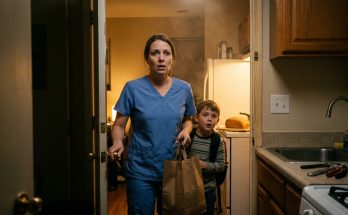
The trunk smelled of hot rubber, gasoline, and old dust.
It was warmer than she expected, the enclosed air dense enough to make her breathing sound louder in her own ears. Verónica curled her knees up to keep herself from shifting when the car moved. Her bag strap dug into her shoulder. A loose tool somewhere near the spare tire pressed against her hip. Above her, she heard Daniel close the passenger door, then the driver’s side. A second later, the engine turned over.
The car began to move.
At first she told herself she could still make this make sense.
Maybe Daniel was taking Emilia to a dentist appointment he had forgotten to mention. Maybe a school meeting. Maybe some errand that looked suspicious only because it had already been filtered through Mrs. Barragán’s misunderstanding and Verónica’s own sleepless imagination. She clung to those possibilities as long as she could.
For the first several minutes, she tried to track the route by feel.
She counted turns. Estimated stops. Noted the rhythm of traffic lights through the rise and fall of the engine. She knew the roads around Narvarte well enough that she expected, sooner or later, to recognize the pattern toward Emilia’s school or toward Daniel’s office. A right turn here. The long light near the pharmacy. The stretch of broken pavement before the avenue opened up.
But the route twisted differently.
After nearly 20 minutes, the pavement changed.
The tires no longer hummed against clean city asphalt. Instead they rattled over rougher ground, uneven enough that the whole trunk vibrated beneath her. Gravel, maybe. Or old industrial pavement breaking down into stone. The movement became bumpier, more irregular. Then a sharp turn. Then another.
Verónica pressed one hand against the side panel to steady herself.
Where were they going?
She listened for voices.
At first she heard nothing except the engine and the occasional sound of Emilia shifting in the back seat. Then, faintly, Daniel spoke.
“Almost there.”
Emilia didn’t answer loudly enough for Verónica to catch the words, but she heard the low murmur of a child’s voice, flat and small.
The car drove on.
The city began to sound different too, or rather, it stopped sounding like the city she knew. The layered noise of traffic thinned. No buses groaned nearby. No street vendors called out. No motorcycles cut close. In their place came longer stretches of emptiness between sounds, as if they were moving into a quieter district, one more removed from the familiar compression of neighborhood life.
Then the car slowed.
Stopped.
The engine idled for a few seconds before cutting off.
Verónica lay still in the trunk, barely breathing.
She heard Daniel get out. Then the rear passenger door opening. The sound of Emilia stepping down. A pause. A metallic gate, perhaps, or some heavy latch being pulled back. Then footsteps over what sounded like concrete.
The voices were clearer now, though not by much.
“Remember what we talked about,” Daniel said.
Emilia answered, but too softly for Verónica to make out the words.
Her entire body had gone tight with the instinctive need to move, to push out of the trunk, to confront whatever was happening immediately. But another part of her, colder and more terrified, held her still. She did not yet know where they were or who else might be there. Bursting out blindly might do nothing except reveal her before she understood the danger.
Then the trunk shifted slightly as someone brushed past the rear of the car.
Verónica closed her eyes and kept her breathing shallow.
A door opened somewhere nearby. Not the car. Something heavier. A metal door, maybe, or one with a thick frame. She heard it close again with a muffled, final sound that made something turn over inside her.
They were inside now.
Verónica counted to 30, then 60, then 100.
No footsteps returned.
Very slowly, carefully, she pushed upward against the trunk.
To her immediate relief, it was not fully latched. Daniel must not have checked it properly in his distraction, or the force of the ճանապարհ, the rough road, had shifted it just enough to spare her. She lifted it a few inches, enough to let in a sliver of daylight, and looked out.
She did not recognize where they were.
The car sat in what looked like the rear lot of a low industrial building. Not abandoned exactly, but not active either. The structure was long and gray, with no visible sign on the wall she could see from her angle. One side was lined with barred windows. The lot was enclosed by a high metal fence with a sliding gate. A few weeds grew through cracks in the concrete. Farther back stood a loading door half rusted at the edges.
Nothing about it suggested school.
Nothing about it suggested anything a child should need to visit mid-morning in secret.
Verónica climbed out of the trunk on shaking legs and crouched behind the car immediately, scanning the lot. The gate was closed. The street beyond looked narrow and unfamiliar, lined with warehouses, repair shops, and shuttered storefronts. She turned back toward the building.
The door Daniel had used stood ahead on the side wall.
Plain gray metal. No number. No window.
She moved toward it without fully feeling her feet on the ground.
When she reached it, she realized her hands were trembling too badly to grip the handle properly the first time. She tried again. It was unlocked.
Inside, the air changed at once.
Cooler. Stale. Faintly chemical, as though the place had once been cleaned aggressively or used for something medical or institutional. A narrow hallway stretched ahead beneath fluorescent lights that hummed too loudly in the stillness. At the far end, a reception counter stood empty. Two plastic chairs sat against the wall. A framed poster hung crookedly above them, the kind of generic smiling-family image used in clinics or administrative offices.
Verónica’s mind reached for explanations again.
A therapist’s office? A private tutoring center? Some special program Daniel had arranged for Emilia without telling her? The hallway was not overtly sinister. It was worse than that. It was ordinary in a way that made secrecy feel even more dangerous.
Then she heard Emilia cry out.
Not loudly. More a choked, frightened protest, quickly suppressed.
Verónica moved.
She ran down the hall, turned past the reception counter, and found a second corridor branching to the right. One door stood partially open. Through it she saw Daniel kneeling beside Emilia while another woman, maybe 50, stood near a desk with a folder in her hands.
Everyone turned when Verónica appeared.
For one terrible second, no one spoke.
Daniel’s face emptied in a way she had never seen before. Not guilt. Not surprise. Something closer to pure alarm at the collapse of a plan.
“Verónica—”
She didn’t let him finish.
“What is this?”
Her voice cracked through the room sharper than she intended, sharp enough that Emilia flinched visibly.
The room itself was small and utilitarian. Desk. Filing cabinet. Two chairs. A box of tissues. Children’s drawings pinned to a corkboard in an attempt to soften the space. On the wall behind the desk hung a framed certificate she did not have time to read fully.
The woman near the desk recovered first.
“Mrs. Salgado?”
Verónica looked at her blankly.
“No one told me you were coming today.”
Today.
The use of the word made her stomach drop further.
Daniel rose slowly.
“It’s not what you think.”
Verónica actually laughed then, one short, shocked sound with no humor in it at all.
“I found my husband taking my daughter in secret to an unknown building after telling me she was at school,” she said. “I am very interested to hear what else I’m supposed to think.”
Emilia began to cry openly now, silent tears first, then harder, uglier sobs that seemed to come from somewhere deeper than the moment itself. Daniel turned toward her automatically, but Verónica got there first. She crouched in front of her daughter and gathered her into her arms, feeling how rigid the small body remained even while shaking.
“It’s okay,” she whispered, though nothing was okay. “I’m here.”
Emilia clung to her with a desperation that terrified her more than the building had.
The woman behind the desk spoke carefully.
“My name is Laura Sarmiento. I’m a child psychologist.”
Verónica lifted her head.
“What?”
Daniel stepped forward.
“She’s been seeing Emilia for 3 months.”
The words hit with the force of a confession because that was exactly what they were.
“Three months?”
He nodded once, shame now visible all over his face.
“I wanted to tell you.”
“When?”
“That’s not fair.”
“No,” Verónica said, standing so fast the chair beside her scraped hard against the tile. “What’s not fair is you taking our daughter to therapy behind my back and making me think she was in school.”
Emilia made a broken sound from the chair behind her, but Verónica could not stop. Weeks of strain, suspicion, work, fear, and the physical humiliation of hiding in her own trunk surged upward too fast to manage.
“What is wrong with her?” she demanded. “What did you think I would do if you told me?”
Daniel swallowed.
“Nothing is wrong with her.”
“Then why is she here?”
Dr. Sarmiento answered this time, and there was enough professional restraint in her voice to keep the moment from tipping fully into chaos.
“Because Emilia has been showing clear signs of school-related anxiety and panic for some time. Your husband contacted me after the episodes worsened.”
Episodes.
Verónica turned slowly toward Daniel.
“What episodes?”
The silence that followed lasted only a few seconds, but it stretched long enough to change the emotional geometry of the room. Daniel looked at Emilia. Then at the floor. Then finally at Verónica.
“She’s been having panic attacks.”
The phrase emptied the room of everything else.
Panic attacks.
Not stomachaches. Not laziness. Not ordinary school resistance. Not childish dramatics she had been too tired to interpret with patience. Panic attacks. Actual fear. Real enough that Daniel had chosen secrecy over confrontation because he believed telling her would only make things worse.
“What are you talking about?” she asked, but the question had already turned inward. She was not only asking Daniel. She was asking every recent morning, every conversation, every dismissal that now came back altered.
Emilia’s voice, small and shredded from crying, rose from behind her.
“I told you.”
That was the moment the anger cracked open and something far worse flooded in.
Not suspicion now.
Recognition.
Verónica turned.
Emilia sat folded inward in the chair, hands twisted in the straps of her backpack, eyes red and wet and old in a way no 8-year-old’s eyes should ever look.
“I told you my stomach hurt,” she said. “I told you I got scared.”
Verónica knelt in front of her again because her legs no longer felt dependable.
“My love…”
But Emilia kept going, because once a child begins telling the truth they have rehearsed alone too many times, adults rarely get to interrupt on their own terms.
“I tried,” she whispered. “But you always said I had to go. And Dad said this doctor helps when the scared feeling gets big.”
Dr. Sarmiento sat quietly, saying nothing. Daniel stood at the edge of the room with the posture of a man who already understood that whatever good intentions had led him here had also led him through betrayal.
Verónica reached for Emilia’s hands.
“Why didn’t you tell me again?”
Emilia gave her a look of such raw, confused hurt that the answer became obvious before the child spoke it.
“Because you were always tired.”
That truth landed without cruelty, which made it worse.
Not an accusation. Just fact.
Verónica lowered her head.
For months she had been coming home with work still burning inside her nerves, with bills in her bag and silence growing between her and Daniel and a constant sense that one more complication might finally break something she could not afford to lose. Emilia’s fear had reached her through that exhaustion again and again, and each time Verónica had answered not as a mother who did not care, but as one who could no longer distinguish between normal childhood resistance and a real emergency.
Daniel’s secrecy now looked different too.
Not righteous.
Not excusable.
But less like betrayal and more like desperation.
He finally spoke again.
“The school counselor called me in April. Emilia had an episode in class. Crying, shaking, couldn’t breathe right. They thought it was asthma until it kept happening.”
Verónica looked up slowly.
“And you didn’t tell me.”
“I tried the first week,” he said. “You were already drowning. Rent. Work. Everything. Every time I started, you were either exhausted or angry or both, and I…” He stopped, then forced himself to continue. “I thought if I handled it first, got answers first, I could tell you when it wasn’t just fear and confusion.”
“So you lied.”
“Yes.”
The room held that for a moment.
“Yes,” he repeated, more quietly. “I lied.”
It would have been easier if he had been cruel. Easier if the hidden morning trips had led somewhere sordid or unforgivable in a simpler way. But this was worse because it exposed not one betrayal, but many smaller failures braided together until they became a secret life inside the family’s ordinary one.
Verónica had not seen clearly enough.
Daniel had not trusted her enough.
Emilia had been the one paying for both.