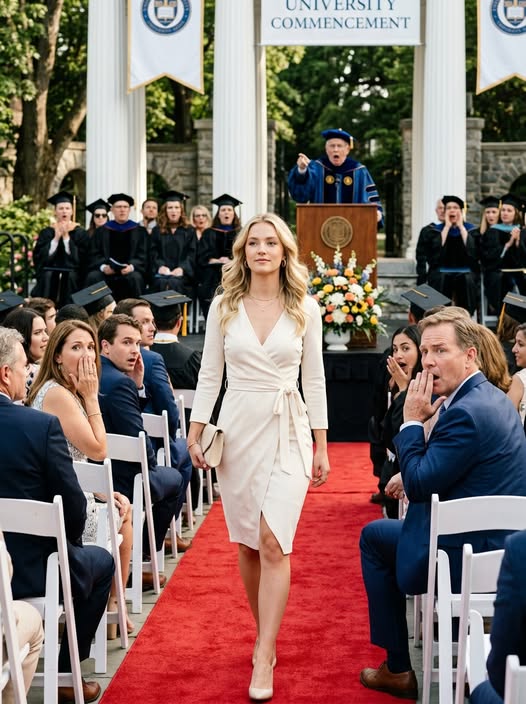
After the ceremony, happy chaos filled the auditorium. Families cried into bouquets. Graduates posed for photos. Children ran between rows.
My father appeared beside me.
“We need to talk.”
“No,” I said. “I’m finding Ethan.”
He stepped closer. “Not until I explain.”
I almost laughed.
For eleven years, I had wanted explanations. Now that he wanted to offer one, it felt too late.
“Move,” I said.
His eyes hardened. “You don’t speak to me like that.”
I looked at him carefully.
The man who had once filled every doorway now stood sweating under fluorescent lights, tie slightly crooked, fear leaking through his anger.
“You don’t decide how I speak anymore,” I said.
My mother arrived then, eyes red.
“Amelia, please. Your father made mistakes, but—”
“You knew,” I said.
Her mouth trembled.
That was enough.
“You knew he told people I quit.”
She looked away.
“And you knew about this.” I lifted the envelope.
Dad snapped, “Your mother had nothing to do with it.”
“Robert, stop,” she whispered.
Then she looked at me.
“The money came from you.”
The room narrowed.
“What money?”
“The checks you sent after your first attending contract. The ones for the store roof. The loan. The bills.”
I remembered those checks. I sent them because Mom’s voice always went thin when she mentioned money. I sent them because, despite everything, I did not want my parents to sink while I built a life.
“I sent that to keep the store open,” I said.
She nodded, crying. “He used part of it for the award.”
I stared at my father.
“And put the family name on it.”
No answer.
Dean Wells returned with a development officer named Priya Shah. They led us into a private conference room off the reception hall.
Priya opened a tablet.
“In 2019, the university received a pledge establishing what was originally titled the Dr. Amelia Rowan Visiting Lecture Fund,” she said.
I went cold.
“The donor listed was Dr. Amelia Rowan. Later amendment paperwork changed the public-facing title to the Rowan Family Medical Legacy Award, with an attached scholarship.”
“I never requested that,” I said.
Priya turned the tablet toward me.
There was the form.
My typed name.
My old Boston address.
A signature at the bottom.
At first glance, it resembled mine.
But I knew my own hand. The A was wrong. Too rounded. Too deliberate. Like someone copying from an old birthday card.
I looked at my father.
“You forged my signature?”
He swallowed.
“I was trying to keep the family together.”
The room went silent.
Ethan, still in his graduation gown, whispered, “Dad.”
My father dragged a hand over his mouth.
“The store was failing,” he said.
“I knew that. That’s why I sent money.”
“You sent it like charity.”
“I sent it because Mom said you needed help.”
“You think a man wants his daughter saving him?”
“I think a leaking roof doesn’t care about your pride.”
Ethan made a sharp sound, half laugh and half pain.
Dean Wells asked, “Mr. Rowan, did you submit the amendment form?”
He stared at the floor.
Finally, he said, “Yes.”
My mother sat down hard.
Ethan looked at him like he was watching a stranger remove a mask.
“Why?” Ethan asked.
Dad’s eyes shone.
“Because your sister already had everything. Degrees. Hospitals. People saying her name like it mattered. And you were still here. You were ours. I wanted something with our name before she took that too.”
Ethan went pale.
There it was.
The hidden center of it all.
My father had not only resented me. He had turned my brother into proof that he still mattered.
“I was never competing with Amelia,” Ethan said.
“Maybe not to you,” Dad replied.
I understood then.
Dad had told people I quit so Ethan could become the doctor in the family. A doctor my father could claim. A success he could control.
Priya closed the tablet.
“Dr. Rowan, the university will correct the records immediately. We’ll cooperate fully if you choose to file a formal complaint.”
My father looked up quickly.
“Formal complaint?”
That fear told me everything.
Part 6: The Mother’s Part
We thought the forged form was the end.
It wasn’t.
Priya returned ten minutes later with a printed email thread.
“This was found in the donor file,” she said carefully.
The sender was my mother.
My hands went numb before I finished the first line.
Dear Ms. Shah,
My husband and I appreciate your discretion regarding Dr. Amelia Rowan’s donation…
I kept reading.
My mother had confirmed mailing addresses. She had requested that donor correspondence go through my parents’ home because I “traveled extensively.” She had attached an old copy of my signature from a medical school loan document.
My father had forged the amendment.
My mother had supplied the ink.
I looked at her.
“You helped him.”
She covered her mouth.
“I thought I was helping everyone.”
“By copying my signature?”
“I thought if your name was on it, he would never accept it. If it became a family award, maybe he could be proud without feeling small.”
That sentence broke something quiet in me.
Because that was always my role in the family. Amelia was strong. Amelia had titles. Amelia had money. Amelia could take it. Amelia did not need tenderness, credit, or protection.
“You both decided,” I said slowly, “that because I survived without your support, I didn’t deserve protection from you.”
My mother sobbed.
Dad muttered, “That’s not fair.”
I turned to him.
“Do not talk to me about fair.”
Ethan stood.
“I don’t want the award,” he said.
Everyone looked at him.
“I don’t want anything with our family name attached to me like this.”
Mom whispered, “Ethan, this was for you.”
“No,” he said. “It was for Dad. Maybe for you. Not for me.”
Then he turned to me.
“I’m sorry.”
“You didn’t do this,” I said.
“I benefited from it.”
“You didn’t know.”
“But I liked it,” he admitted. “I liked hearing people say we had a legacy.”
His honesty hurt.
It also saved him.
I touched his sleeve.
“Then build your own legacy. Start with the truth.”