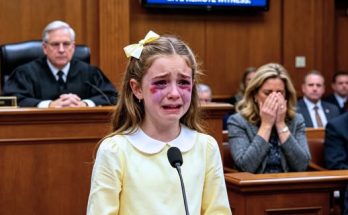
Graham, my husband then and my ex-husband now, had won full custody of our twin daughters and made sure I was kept completely away from them.
“You are not fit to be their mother,” he told me in court, his voice so cold it felt less like a sentence and more like a burial.
I had no money left, no strength left, and no real way to fight back against the polished lies he had placed in front of the judge.
Two years passed. Then one of our daughters was diagnosed with leukemia, and suddenly the hospital reached out to me because she needed a bone marrow donor.
I went without hesitating, without thinking about my work, my pain, or the humiliation I had swallowed for two years. But when the doctor began the first test, her expression changed, and she quietly asked to run it again.
The second test did not calm anyone down. Instead, it brought an entire medical board into the room.
Doctors, nurses, and specialists stood around the results, staring at the papers as though they were looking at something that should not exist.
And then the doctor said the sentence that made Graham’s face collapse, as if the secret he had buried for years had finally crawled back into the light.
The call came at 6:47 a.m. on a Tuesday near the end of August, the kind of gray morning that already felt heavy before the day had even begun.
I remember the exact time because I had been awake since 5, sitting alone in my office, staring at blueprints for the Morrison Tower project and forcing my exhausted mind into load-bearing calculations, steel-frame specifications, elevator shafts, emergency exits, and anything else that could keep me from thinking about the emptiness inside my own life.
Anything was better than remembering that I had not seen my daughters in two full years, not touched their hair, not heard their laughter in my kitchen, not kissed their foreheads before sleep.
My phone buzzed across the drafting table, vibrating against pencils, rulers, and marked-up plans, and an unknown Seattle number lit up the screen.
For one suspended second, I almost let it ring.
Seattle was where they lived now, far from the Portland life they had once shared with me.
Seattle was where Graham had taken Sophie and Ruby after the judge declared me unfit, that ugly word still turning to ash on my tongue every time I remembered it.
But something deep in my chest tightened, and before I could talk myself out of it, I picked up the phone.
“Ms. Hayes.”
The voice belonged to a woman. Calm, careful, but carrying that quiet urgency doctors always have when they are trying not to frighten you too soon.
“This is Dr. Sarah Whitman from Seattle Children’s Hospital. I’m calling about your daughter Sophie.”
My daughter.
Those two words hit me so hard I had to grip the edge of the table. I had not been allowed to say them out loud for 732 days.
“What happened?” I asked, though my throat had gone dry. “Is she hurt?”
“Sophie was admitted to our emergency department early this morning,” Dr. Whitman said. “Her white blood cell count is critically low, around 1,200 cells per microliter. Normal range is usually between 4,500 and 10,000. We are running additional tests, but we suspect acute myeloid leukemia.”
The blueprints blurred in front of me until the careful black lines became nothing but streaks.
Leukemia.
My ten-year-old daughter, the little girl I had once rocked through fevers and nightmares, had cancer.
“I need you to come to Seattle immediately,” Dr. Whitman continued. “Sophie will likely need a bone marrow transplant, and we need to test you as a potential donor. Time is very important.”
“I’m in Portland,” I said, already standing, already reaching for my keys with shaking fingers. “I can be there in three hours.”
“Good. Ask for me at the pediatric oncology unit when you arrive. And Ms. Hayes…” She paused just long enough for dread to crawl up my spine. “I know the custody situation is complicated, but right now Sophie needs her mother.”
When the call ended, I just stood there, staring down at the Morrison Tower plans spread neatly across my desk.
Six months of work lay in front of me. A 2.8 million dollar contract. The project that could rescue my struggling architecture firm from the edge of collapse.
My business partner, Marcus, had scheduled the presentation for 9:00 a.m. The clients were already flying in from San Francisco, expecting confidence, precision, and a future built in steel and glass.
I called Marcus before my courage could break.
“I need you to cancel the Morrison meeting,” I said.
“What? Isabelle, this is our biggest project in two years. If we don’t present today, we may not get another chance.”
“My daughter has cancer,” I said, and the words tore through me all over again. “I’m going to Seattle.”
Silence stretched across the line.
Marcus knew about the custody battle. He had seen me become a ghost of myself after Graham took Sophie and Ruby away, after the judge accepted the fabricated psychiatric report that painted me as unstable, dangerous, and unworthy.
“Go,” Marcus said finally, his voice lower now. “I’ll handle Morrison.”
I grabbed my bag and ran out without looking back.
Interstate 5 north became a long, gray tunnel of wet pavement, blurred headlights, and dark green pine trees sliding past the windows.
I drove ten miles over the speed limit, hands locked so tightly around the steering wheel that my knuckles turned white, while Dr. Whitman’s words repeated in my mind like a punishment.
Acute myeloid leukemia. Critically low white blood cell count. Bone marrow transplant.
I had not seen Sophie since the last custody hearing, the day Graham walked out with both girls and I walked out with nothing.
She had been eight then, small for her age, with Graham’s dark eyes and my stubborn chin, clutching Ruby’s hand while trying to be brave in a hallway full of strangers.
The judge had granted Graham sole custody based on a psychiatric evaluation that claimed I suffered from bipolar disorder, alcohol dependency, and emotional instability severe enough to endanger my own children.
Every word had been a lie.
But lies printed on official paper had more power than a mother sobbing the truth.
And now, two years later, the same system that had helped Graham bury me was calling me back because my blood might be the only thing that could save Sophie.
By the time I reached Seattle Children’s Hospital, my hands were trembling so badly I could barely sign my name at the front desk.
The pediatric oncology unit smelled like sanitizer, plastic tubing, and quiet fear.
Dr. Sarah Whitman met me outside a room with a clipboard pressed to her chest and kindness in her eyes that almost made me fall apart.
“Ms. Hayes,” she said softly. “Thank you for coming so quickly.”
“I want to see her,” I said.
“You will,” she promised. “But first we need to begin donor testing. Sophie’s condition is progressing quickly, and we cannot lose time.”
I nodded because I had no choice. I would have cut myself open in that hallway if they had told me it would help her.
They drew my blood. They took my history. They asked questions about illnesses, pregnancies, medications, and family background while I answered like a machine, my mind fixed on the room down the hall where my daughter was lying sick without me.
Then Dr. Whitman returned.
At first, her face was professional. Then her eyes moved across the page in her hand, and something in her expression shifted.
She looked at me, then back at the report.
“Is something wrong?” I asked.
She did not answer immediately.
Instead, she said, “We need to repeat the test.”
So they did.
Another vial. Another wait. Another hour of me sitting in a plastic chair under fluorescent lights, listening to the distant beep of machines and wondering whether Sophie still remembered the way I used to braid her hair.
When the second result came back, Dr. Whitman was not alone.
Two other doctors came with her. Then another. Then a specialist whose badge I did not read because all I could see was the way they were avoiding my eyes.
Graham arrived during that terrible silence, dressed in his expensive coat, jaw tight, already angry that I was there.
“What is she doing here?” he snapped.
Dr. Whitman did not look at him first.
She looked at the papers.
Then she looked at me.
Then she looked at Graham, and the entire room seemed to hold its breath.
“This result cannot happen in the way you have described your family,” she said slowly.
Graham’s face twitched.
“What are you talking about?” he demanded.
Dr. Whitman’s voice dropped, careful and clinical, but every word struck like a hammer.
“The donor compatibility test has revealed something we must address before any transplant decision is made.”
I felt the floor tilt beneath me.
Graham stepped forward, suddenly pale.
And when Dr. Whitman unfolded the final page, his hand shot out as if he could stop the truth from being spoken.
The doctor’s hand didn’t stop moving. She set the final page down where both Graham and I could see it.
“Ms. Hayes,” Dr. Whitman said carefully, “your HLA typing shows a compatibility profile that’s unusual for a biological parent-child match — unusual enough that our lab flagged it automatically. So we ran a paternity panel alongside the marrow typing, standard protocol whenever a compatibility result comes back this atypical.”
“I don’t understand,” I said. “I’m her mother. I gave birth to her.”
“You are,” Dr. Whitman said gently. “The maternal markers are exactly what we’d expect. It’s the paternal side that doesn’t add up.” She looked at Graham. “Mr. Hale, according to this panel, you are not Sophie’s biological father.”
The room went perfectly silent, the kind of silence that has a texture to it, thick enough to press against your skin.
Graham’s face had gone the color of the hospital walls. “That’s not possible. Run it again.”
“We already did,” Dr. Whitman said. “Twice. That’s why it took as long as it did.”
I stared at him, at the man who had stood in a courtroom two years earlier and called me unfit, who had held our daughters like trophies while a fabricated psychiatric report stripped me of everything, and I watched every ounce of his certainty drain out of his face in real time.
“Graham,” I said slowly, “what did you do?”
He didn’t answer. He didn’t need to. I already understood, the way you understand a shape in the dark once your eyes finally adjust — Sophie and Ruby were twins, and if one of them wasn’t biologically his, there was only one explanation that made any sense to a man who valued appearances over truth: he’d known, or suspected, for years, and had decided the custody battle wasn’t just about winning. It was about making sure I never had proof of anything he didn’t want proven.
“The psychiatric evaluation,” I said. “The one that said I was unstable. Unfit. Dangerous. You didn’t just exaggerate it, did you. You knew there might be a reason I’d fight for a paternity test myself one day. So you made sure I’d never be believed if I ever tried.”
Graham’s jaw worked, but no words came out.
Dr. Whitman, to her credit, didn’t wait for him to recover. “Regardless of paternity, Ms. Hayes, you remain Sophie’s best potential donor match on the maternal side, and we need to move forward with matching protocols immediately. Whatever needs to be resolved about custody and parentage can and should go through the appropriate legal channels — but it does not change what Sophie needs from you medically, right now.”
“I’ll do it,” I said. “Whatever she needs. I never once needed a lab result to tell me she was mine.”
Graham finally found his voice, thin and cracking in a way I had never heard from him in twelve years of marriage. “Isabelle, I can explain—”
“You had two years,” I said. “You had a courtroom, a judge, and every opportunity in the world to explain, and instead you used it to erase me. You don’t get to explain now, in a hallway, while our daughter is fighting for her life down that corridor.”
I walked past him into Sophie’s room.
She was smaller than I remembered, pale against the white sheets, an IV taped to the back of one thin hand, but her eyes lit up the moment she saw me, two years of silence collapsing in an instant.
“Mom?” she whispered, like she wasn’t sure the word was still allowed.
“I’m here,” I said, and sat down beside her bed, and didn’t let go of her hand for the rest of that day.
The transplant took place five weeks later. My marrow was, as Dr. Whitman had promised, an excellent match — biology settling the question my ex-husband’s lies never could. Sophie’s recovery was slow, and frightening, and not without setbacks, but six months later her counts came back clean, and the word “remission” appeared in her chart for the first time.
The custody case reopened within the year. The fabricated psychiatric evaluation didn’t survive scrutiny once Sophie’s medical team was subpoenaed and the paternity finding entered the record alongside it — a judge doesn’t look kindly on a father who buried a mother’s rights under a false diagnosis while sitting on a secret of his own. I was granted full custody of both girls. Graham’s visitation with Sophie became a separate, complicated legal question entirely, one still working its way through family court — a question about love and biology that no lab result could fully answer, and one I’ve told the girls, gently, isn’t theirs to solve. It’s the adults’.
Two years after that Tuesday morning call, Sophie is twelve, cancer-free, and insists on braiding her own hair now, though she still asks me to do the back where she can’t reach. Ruby, my other daughter — biologically Graham’s, as it turned out, in a twist none of us saw coming until the second round of testing — sleeps in the room next to hers, in the house I rebuilt slowly out of the ashes of two years I never got to have with either of them.
Some mornings I still stand in their doorway before they wake, just to watch them breathe, the way I used to when they were small enough to fit in one arm each.
I never once needed a test to know they were mine.
THE END