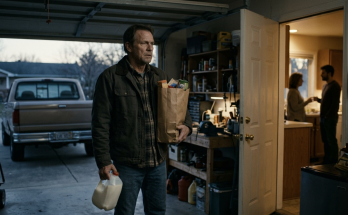
When the dust from the courtroom finally settled, it felt as though the house itself exhaled. Conversations that had snapped and frayed for months now softened into halting exchanges, the tone of voices traveling a careful line between apology and guarded pride. June and Rachel stood at the heart of that cautious quiet, their faces reflecting different kinds of wear: June’s composed exhaustion, Rachel’s shocked, brittle relief. What neither woman allowed themselves to do in public—crumple into the rawness of what had happened—was now exchanged in private looks that held the weight of everything they had refused to say aloud.
The family’s formalities returned with the rhythm of small reconciliations: an initial, awkward dinner where Aunt Carol watched June and Rachel across the table as if measuring the limits of an invisible truce; Mark offering a tentative joke that landed too softly; Tommy lingering at the doorway, unwilling to be the first to cross a line that had felt imprinted on the floorboards for decades. No single encounter erased the months of suspicion, but the smallness of ordinary rituals—coffee shared on a Saturday morning, a borrowed tool returned at the back door—began to stitch fraying edges together.
June and Rachel’s earliest conversations after the trial were practical and intentional. They agreed to meet first in neutral spaces: a library with thick carpets and forgiving acoustics, a diner where neither had past claim to a corner booth. Those meetings started with logistics—what to do with the legal papers, how to notify distant cousins, what to say when neighbors asked about the settlement—but the lists always unraveled into memories. June told Rachel about the precise way Grandpa used to falter at the punchline of his favorite joke, and Rachel, in turn, described how she had hidden a yellowing postcard of his handwriting in the bottom of her jewelry box. Each memory added color to the other’s perception, building a mosaic neither had cared to assemble before the will made it necessary.
They argued sometimes too. Not about money—by then, the financial outcome had been clarified and quietly accepted—but about acknowledgment. June wanted the family to recognize what she had long felt: that devotion should not only be proven in caregiving but honored in word. Rachel bristled at the implication that her inheritance required public justification, that her grief should be vetted for authenticity. Those clashes were sharp and occasionally ugly, but they were followed by apologies that were genuine and immediate. Both women discovered they could be fierce without being permanent enemies.
Aunt Carol moved through the reconciliation like someone learning a new language. She attended more family gatherings, though never with the ease she had before. Some of her remarks remained barbed, a reflexive spat of irritation when old grievances surfaced, but the edges dulled as she observed, firsthand, how June and Rachel held one another up. Watching them, she began to relent on her assumption that affection needed to be zero-sum. It took her weeks, then months, to stop measuring loyalties as if they were pieces of pie that could only be divided.
There were practical matters to resolve, too. The bank’s investigation closed with the determination that fraudulent activity had been initiated by an unknown third party and that Rachel’s authorized account had been used without her consent. The investigators apologized to Rachel for the intrusion and offered their findings to the family, but the legal file closed with an ambiguous addendum: while it was clear funds had been siphoned, the trail evaporated in a tangle of shell transfers. This was not the neat, vindicating conclusion anyone had hoped for, but it at least lifted the suspicion that had hung over Rachel like an accusation.
June insisted on attending every meeting where legal documents were discussed. She wanted transparency not because she suspected Rachel of deceit, but because she had spent too many years defending the simple, unadorned truth of what she knew about Grandpa. Sitting in those fluorescent-lit rooms, she learned as much about the language of trusts and fiduciaries as she had about the small complexities of estate law. Rachel, in turn, entrusted June with small tasks: reading dense clauses aloud, making lists of questions to ask the attorney, keeping a steady watch on deadlines. The collaboration was a quiet pledge to one another that knit them into allies instead of adversaries.
The house that had been the center of the conflict required more tender tending than anyone expected. Family members took turns repairing the yard, painting borders that had peeled under years of neglect, and sorting through trunks of photographs whose captions had once been assumed and now demanded explanation. Photos that had been places of contention became conversation starters: here was a day at the river neither June nor Rachel had remembered the same way, here a holiday where Aunt Carol’s smile looked both younger and more cautious. Handling these objects together allowed the past to be examined without the gauntlet of accusation; it became possible to say, with care, “We were there.”
The settlement itself was handled with an economy of ritual. Rachel chose, quietly, to give a portion of the money to causes Grandpa once supported: the local veterans’ fund, the tiny hospice that had cared for his neighbor, and the community center where June had once taught art classes. Those gestures soothed an ache in June, who had feared the money might be used as a wedge rather than an olive branch. Rachel’s donations were not about absolution but about continuity—keeping alive the parts of Grandpa’s life that, even in his omissions, had mattered.
On a brisk October afternoon, June and Rachel took the last of Grandpa’s belongings to the thrift store together. The act felt both irreverent and liberating: letting go of the physical detritus that had come to carry too much symbolic weight. There, amid racks of clothes and shelves of dusty glassware, the two women laughed as they debated whether a faded recliner could possibly be the chair Grandpa had once favored. Their laughter was tentative but real, a sound that smoothed old lines in the faces of those who had grown weary of the feud.
Neighbors, too, adjusted to the new equilibrium. People who had taken sides in whispered conversations in grocery store aisles now offered neutral, polite remarks that carried a new respect. There were still stares, sometimes, the kind that lingered long enough to make June’s jaw tighten. But they learned to reply with facts rather than pleadings. If asked, June would briefly say, “We’ve reconciled,” and allow that phrase to hold more than it could possibly contain.
There were nights when June, lying awake, revisited the scene of the will as if replaying a movie she could never quite edit to her liking. She saw again the cue of Aunt Carol’s Buick, the way the envelope had changed everything, the face of the cousin who had always assumed she would inherit the mantle of care. But those late hours also allowed room for gratitude—the gratitude of being known by the man she had once shaved every Wednesday, of having loved without the need for recognition. That thought warmed her in a way that revenge never could have.
Rachel, who had once been baffled by the mechanics of love in that family, learned that affection could be messy and uneven and still real. She began to visit the neighborhood more, not for any obligation, but because the house and the people inside it no longer felt like tests to be passed. She engaged in small acts of care: bringing over a casserole after someone had surgery, sending a text to check on Aunt Carol after a rainstorm. These things did not erase the past, but they softened its edges.
At the heart of their reconciliation lay many small admissions: June admitted that she had, at times, been possessive of the role she had played in Grandpa’s life; Rachel admitted that she had feared she would always be interpreted as opportunistic because of how she inherited. Each confession unlocked a corridor to deeper understanding. They found themselves apologizing for the ways they had assumed motives and for the bitterness that followed. Forgiveness, they discovered, was not a single act but a collection of moments—an airy exchange of courtesies that ultimately meant more than either had expected.
Aunt Carol’s apology came late and public. One Sunday afternoon, after a pot roast had been shared and the sun had tipped toward the west, she pulled June and Rachel into the small, cluttered kitchen and said the words aloud. They were not theatrical—no grand gestures, no swells of sentiment—but they were unequivocal. She acknowledged the cruelty of her assumptions, the damage done by accusations flung like knives, and the pettiness that had smelled like self-righteousness. It was a small but necessary absolution, and it landed in the room like a window letting in fresh air.
Even with apologies offered and accepted, some scars refused to vanish. There were family members who remained distant, who made their discomfort known in curt RSVPs and half-hearted holiday greetings. The family’s unity had been repaired, but not perfectly rebuilt; there would be future stumbles. June understood that this was the nature of long-standing wounds—they healed into ridges and calluses rather than disappearing. The important change was that when those ridges rose, the family now addressed them instead of pretending they did not exist.
Community conversations shifted too. Where gossip had once been a currency, curiosity became more tempered by insight. Neighbors began to see the case as a complicated human story rather than a spectacle of moral failure. That recontextualization relieved some of the pressure social scrutiny had inflicted on the family, and it meant fewer jerseys pulled on for battles that no longer served anyone.
Rachel used a portion of her inheritance to set up a modest scholarship in Grandpa’s name for local students who worked while attending high school. The fund was small, an intimate gesture rather than a headline-catching donation, but it satisfied a shared desire to honor his memory in a practical way. The scholarship committee included June and Aunt Carol; the three of them sat together to choose recipients, and in those meetings they found a rhythm of cooperation that felt almost miraculous given how recently they had been at odds.
They held a quiet memorial on an anniversary of Grandpa’s death. It was informal—neighbors, a few close relatives, cookies on paper plates—and it served as a final punctuation mark on a chapter that everyone wanted to close with dignity. People shared small, specific recollections: his knack for always fixing a loose hinge, the way he hummed while he did simple tasks. The stories were ordinary and perfect; in their aggregation they formed a portrait of a man who could not be summarized in a single act of omission.
One evening, months into the healing, June and Rachel sat together on the old screened porch and listed, aloud, the things they had learned about each other. The exercise was not meant to be performative but restorative. June confessed that she had believed recognition was the only currency of love. Rachel said she had feared never being seen as she truly was. They both laughed at how absurd their certainties had seemed after being shaken loose. That laughter felt like permission to be less certain and more curious.
Family rituals returned in altered form. The Wednesday meatloaf tradition shifted into something less formulaic; sometimes June still took the wheel and drove the twenty-nine miles, and sometimes others took over. There were afternoons when Rachel would bring a homemade pie and sit with June and Aunt Carol as they reminisced about trivialities. The significance of these gatherings was not in their uniformity but in the fact that they happened at all, that the people who had once been estranged now chose, repeatedly, to show up.
There were practical lessons, too. The legal ambiguities that had made the suit possible prompted the family to update wills, list clear directives for guardianship, and document the kinds of care each member preferred as they aged. These conversations were awkward—no one delights in orchestrating the end of life—but they became acts of responsibility and love. Drafting instructions for future generations allowed them to imagine a different inheritance: not of money alone, but of clarity and foresight.
Over time, the community’s appetite for the family’s turmoil dimmed, replaced by the slower attention that accompanies lives lived in modest proximity. The initial spark of scandal faded, leaving behind a quieter, truer appreciation of what had happened and what it had taught them. People still occasionally asked June or Rachel about the events, but those questions were softer; they sought not to pry but to understand how ordinary people navigated extraordinary hurt.
As autumn gave way to winter, June found herself less guarded and more present. She stopped rehearsing defenses before entering the room and started listening with the patience of someone who had been proven wrong and therefore humbled. Rachel, for her part, carried less of the defensive posture she had worn like armor. She accepted kindness without flinching; she offered it in return. Their mutual respect hardened into something reliable—an invisible scaffolding that steadied the family through ordinary domestic crises and the occasional flare-up of old resentments.
The saga of the will would never be a story of tidy justice. There were moments of lingering doubt, unresolved threads of where the money had moved and why certain documents had appeared. Law enforcement had closed its inquiry with a respectful shrug, and the family accepted that some questions might remain unanswered. The new peace they fashioned depended less on absolute facts than on a decision to move forward with dignity. That choice did not erase the past; it framed it in a way that allowed them to coexist without perpetual accusation.
On the porch, as winter pressed its nose against the panes, June and Rachel planned small things: a joint birthday dinner, a memorial garden where they could plant bulbs for spring, a rotation for bringing casseroles to elderly neighbors. They also spoke of the future in quieter terms—of how they would explain the past to children who might one day ask what happened and why. They wanted their explanation to be honest but not cruel, to acknowledge complexity without celebrating pain. This shared intention was perhaps the truest sign of their mending.
They still guarded themselves against complacency. When old habits surfaced—sharp words from Aunt Carol, a skeptical look from a relative—they addressed them quickly. The family had learned the cost of letting grievances fester, and so they practiced an unadorned thrift: speak plainly, repair fast, do not let bitterness calcify. It was a discipline that required vigilance but yielded a warmer, steadier home life.
Friends who had watched the drama from a distance remarked on the unlikely trinity June, Rachel, and Aunt Carol had become—three women who once stood on opposite sides of an ugly divide, now working together with a tenderness that felt earned. Those who witnessed the change most closely felt something like awe at how resilient affection can be, and at how, when raw need is met with patience, relationships rearrange themselves into sturdier shapes.
They did not pretend the experience had been a gift. The cost had been real: sleepless nights, public humiliation, the grinding bureaucratic toll of unraveling a fraud. But the outcome—repaired threads, shared responsibility, a more compassionate family—suggested that salvage can sometimes look like treasure. June and Rachel did not forget the hurt, but they allowed it to be one part of a larger story, one that included laughter echoing off a kitchen wall and a porch light left on for late comers.
That porch light, a small bulb with a warm hue, became a symbol of what they hoped to carry forward: steady brightness that welcomes rather than demands. When strangers asked what had healed them, June would sometimes point to the porch and say, simply, “We kept showing up.” In those words was the distilled lesson of the year: presence matters; mistakes can be repaired; love, when practiced with humility, grows more generous.
The End
Read more original stories on Feel Every Story.