The false paperwork.
The insurance claim forms.
And James himself—alive.
That last piece shattered every lie.
The trial lasted three weeks.
It felt like three years.
Each day, I sat on the hard bench in the courtroom and watched my life split into two versions.
The one where Rachel was my daughter—the girl who once fell asleep with her head on my lap during long drives, the teenager who swore she’d never be like the “mean girls” at school, the young woman who cried when James proposed because she said she’d never felt so safe.
And the one where Rachel was the person who put a padlock on a door and waited for insurance money.
Witnesses testified.
Medical experts described James’s condition without drama, as if facts could be sterile.
A forensic accountant traced payments—ten thousand here, five thousand there—money moving like secret currents.
The neighbor from Riverside, Mrs. Chen, testified about the strange cars.
She sat in the witness chair with her hands folded neatly and said, “I knew something was wrong. The house was too quiet. And the cars… they behaved like they were hiding.”
I wanted to reach across the courtroom and thank her again.
James testified.
The day he took the stand, he looked smaller than he used to. Not weak—never that—but stripped down to the essential.
He spoke slowly, carefully, like he was laying bricks one at a time.
When he described waking up in the basement, I felt my throat close.
When he described hearing the funeral happen while he was still alive—because Rachel had played it through her phone one night, laughing at his disbelief—I nearly stood up.
I didn’t.
I kept my hands folded in my lap and let my nails dig into my palms.
Derek Moss testified after cutting a deal.
He looked different without his gym confidence—paler, eyes darting.
He told the jury how Rachel talked about James like he was an obstacle…
How she said she was “done being broke.”
How she said she didn’t want a messy divorce because it would slow everything down.
“She had it planned,” Derek admitted, voice shaking. “Down to the dates.”
Rachel sat through it all with her face blank.
No outburst.
No tears.
It was like watching someone who’d decided feelings were optional.
When it was my turn to testify, my legs felt made of water.
I took the stand, raised my hand, promised to tell the truth.
The prosecutor asked me to describe the day I went to the house.
I spoke about the silence.
The dust.
The expired milk.
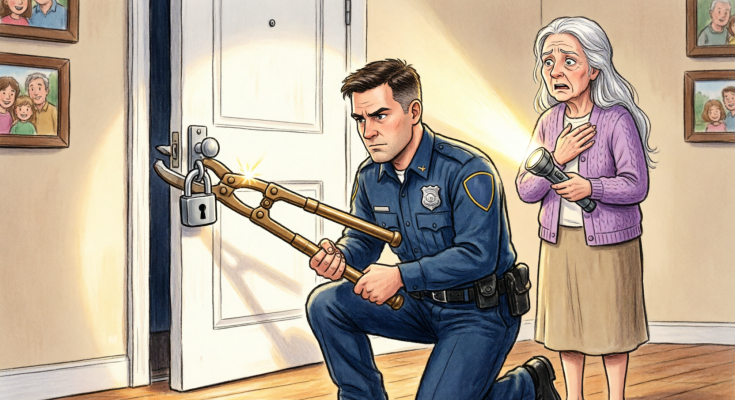
The padlock.
The scratching.
When I repeated James’s whisper—“Please”—I heard sobs in the courtroom.
The defense attorney tried to rattle me.
“Mrs. Hartley,” he said, “isn’t it possible your daughter was in crisis? That she believed she was preventing harm?”
I stared at him.
“I worked in crisis for decades,” I said, my voice steadier than I felt. “I know what panic looks like. I know what fear looks like. And I know what planning looks like.”
The lawyer’s lips tightened.
“What do you mean by that?” he asked.
I swallowed.
“I mean there were fresh screws,” I said. “A new padlock. Chains. A basement prepared to hold a person. That wasn’t spontaneous. That wasn’t protective. That was deliberate.”
When I stepped down from the stand, my knees nearly buckled.
Helen caught my arm.
“Good,” she whispered. “You did good.”
The jury deliberated for six hours.
Six hours of sitting in a hallway with vending machines and stale coffee, listening to murmurs and footsteps.
James sat with his hands clasped, eyes fixed on the floor.
I watched his jaw work as if he were chewing something bitter.
Helen sat like a statue.
When the bailiff finally opened the courtroom doors, my heart started pounding so hard I thought I might be sick.
We filed in.
The jurors took their seats.
Four women stood to read the verdict.
Guilty.
Guilty.
Guilty.
Attempted murder.
Fraud.
Forgery.
Kidnapping.
Conspiracy.
The list went on.
Rachel didn’t react.
She stared straight ahead, face blank.
I waited for something—some crack of humanity.
It never came.
When the judge sentenced her to thirty-five years, I felt no triumph.
No relief.
Just a hollow ache where my understanding of motherhood used to be.
Derek Moss received fifteen years.
Dr. Chen lost his medical license and received ten years for fraud and filing false documents.
The funeral director—whoever had facilitated that unthinkable substitution—received five years, and his business was shut down.
I sat in the courtroom and listened to each sentence like someone reading the results of a storm.
Afterward, reporters crowded the courthouse steps.
Microphones.
Cameras.
Questions shouted like stones.
“How do you feel?”
“Will you forgive her?”
“Did you see this coming?”
I ignored them.
James needed to get home.
He needed quiet.
He needed safety.
In the car, as we drove away from the courthouse, James stared out the window.
The sky was the pale gray of winter coming.
After a long silence, he spoke.
“Do you hate her?” he asked.
I swallowed.
Did I hate Rachel?
I hated what she did.
I hated the choice she made.
I hated the way she looked at a human life and saw an inconvenience.
But hate is a heavy thing to carry for your own child.
“I don’t know,” I admitted. “I hate what she did. I don’t know if I can ever forgive her. But… I don’t feel hate the way people think it should feel.”
James nodded once.
“I dream about that basement sometimes,” he said quietly. “About being down there. Wondering if anyone would ever find me. Wondering if I’d die alone in the dark.”
His voice cracked.
“You saved my life, Margaret,” he said. “If you hadn’t come that day… she was only giving me enough water to last until the claim went through.”
I squeezed his hand.
“You’re not alone anymore,” I whispered. “You’ll never be alone again.”
James recovered slowly.
The physical damage healed faster than the psychological wound.
There were days he couldn’t tolerate closed doors.
There were nights he woke up gasping, eyes wild, convinced he was back in that basement.
I moved him into my house because he needed somewhere he didn’t associate with the smell of damp concrete.
I cleared out my guest room, bought new sheets, set a small lamp by the bed so he wouldn’t wake up in darkness.
We established routines.
Breakfast at the kitchen table.
A short walk around the neighborhood.
Therapy appointments twice a week.
Sometimes, on good days, he’d help me in the yard, trimming branches or pulling weeds, the simple physical work grounding him.
Sometimes, on bad days, he’d sit on the back steps with his head in his hands, and I’d sit beside him without speaking.
Because silence can be comfort too, when it’s chosen.
I helped him find a therapist who specialized in severe trauma.
James hated the first few sessions.
He came home pale and exhausted, like he’d fought a war inside his own head.
But he went back.
He kept going.
Because survival isn’t just breathing.
It’s learning how to live without flinching at every shadow.
Helen visited every month.
Sometimes she brought casseroles and folded laundry like she was trying to repair her son with domestic acts.
Sometimes she brought papers—resources, support groups, legal information.
She was small, but she moved through grief like a force.
James’s brother Tom called often.
He apologized repeatedly for not coming sooner, as if geography were a moral failing.
James always told him the same thing.
“You didn’t know,” he’d say. “None of us knew.”
But I did know something.
I knew I’d ignored instincts.
I’d swallowed red flags because I wanted my daughter to be who I believed she was.
That guilt sat in my chest like a stone.
One afternoon, weeks after the sentencing, I opened a drawer in my bedroom and found Rachel’s letter.
It had arrived months earlier, forwarded from the prison.
Her handwriting was the same—sharp, neat, controlled.
The envelope was still sealed.
I stared at it for a long time.
James walked past the doorway and paused.
“You don’t have to read it,” he said quietly.
“I know,” I whispered.
I slid the letter back into the drawer.
Not because I was forgiving.
Not because I was pretending.
Because some truths don’t become lighter just because you open the envelope.
Over the next year, James rebuilt his life.
He found a new job—one that paid better than the one he’d lost, with people who treated him like a human being and not a problem.
He started going to a support group.
At first he barely spoke.
Then, little by little, he began to tell his story in pieces.
Not the full horror.
Just enough to let it out of his body.
He met Sarah there.
She was kind in a quiet way, the kind of person who listened with her whole face.
She had her own scars, her own reasons for understanding what it meant to claw your way back from something that tried to erase you.
When James told me he was seeing her, I felt a cautious hope flutter in my chest.
Not because I wanted him to move on quickly.
Because I wanted him to believe he still deserved joy.
I sold Rachel’s house.
It wasn’t easy.
Walking through those rooms again—seeing the mantle where the dusty wedding photo had stood, the hallway where the basement door waited like a secret—it felt like stepping into a memory that still had sharp edges.
But the house was poisoned.
James didn’t want it.
Helen didn’t want it.
No one wanted a place where a padlock had been used like a weapon.
The money went into a trust for James.
He tried to refuse.
“I don’t want anything from her,” he said.
“It’s not from her,” I told him. “It’s from the life you were supposed to have. It’s compensation. And I need you to take it.”
He looked at me for a long time, then nodded.
“Okay,” he whispered.
I also went back to work in a different way.
Not as a paid social worker.
As a volunteer.
I began spending mornings at a shelter, helping people navigate the first steps out of unsafe situations—finding housing, filing paperwork, connecting to counseling.
The work was familiar.
But now, it felt personal in a way it never had before.
Because I’d learned the hardest lesson of my career too late.
Evil doesn’t always announce itself.
Sometimes it wears the face of someone you love.
Sometimes it uses grief as camouflage.
Sometimes it puts a padlock on a door and expects the world to look away.
I didn’t look away anymore.
Two years after the trial, James and Sarah got married.
It was small.
Just close friends and family.
We did it in my backyard under a string of white lights, the kind you buy at a hardware store and hang up because you want the evening to feel gentle.
Helen made the cake.
Tom stood as best man.
Sarah’s daughter sprinkled flower petals down the grass with solemn concentration.
When James and Sarah exchanged vows, James’s hands shook.
Not from fear.
From the enormity of choosing hope again.
I watched him kiss his new wife, and for the first time in a long time, I felt something like relief.
Not because the story had a neat ending.
But because it had a living one.
After the ceremony, James came up to me with Sarah on his arm.
“Thank you,” he said simply.
I hugged him tight.
“You don’t need to thank me,” I whispered. “You’re family.”
He pulled back, looked me in the eye.
“Not for saving me,” he said. “I mean—yes, for that. But for not giving up on me even when you thought I was dead. For coming. For listening. For using that spare key.”
My throat closed.
Tears slid down my cheeks.
“I’ll always listen,” I told him. “Always.”
He smiled, and for a moment I saw the gentle man from the wedding photo again.
“I know,” he said. “That’s why I’m still here.”
As the sun set and people laughed softly around us, I thought about the chain of small decisions that had led to this moment.
Rachel’s greed.
Mrs. Chen’s call.
My choice to drive over instead of waiting another day.
The spare key.
The scratching sound.
Every instinct I’d listened to.
Every instinct I’d ignored.
I’d lost a daughter.
But I’d saved a son.
And in the end, that was what mattered.
Not the blood we share.
But the lives we choose to protect.
The people we choose to fight for.
The moment we decide that no lock, no lie, no plot will keep us from doing what’s right.
I still have the spare key to that house on Maple Drive.
I keep it in my desk drawer.
Not because I plan to ever use it again.
Because it’s a reminder.
A reminder that sometimes the people who need saving are right in front of us.
A reminder that a mother’s love can’t excuse evil—but it can help heal its victims.
And most importantly, a reminder that when you hear something scratching in the basement, when you see a padlock that shouldn’t be there, when your instincts scream that something is wrong…
You listen.
You act.
Because someone’s life might depend on it.
James is safe now.
Sarah loves him.
Helen visits every month.
We are a family bound not by blood, but by survival and choice.
That was Rachel’s real punishment.
Not the prison sentence.
Not the loss of her freedom.
It was knowing that despite everything she did, she didn’t win.
James lived.
He healed.
He moved on.
And we’re still here—still writing, still living, still loving.
That’s our victory.
That’s our justice.
That’s how we win.