At 5:12 in the morning, my mother sent me forty-three photographed pages from Michael Parker’s original development agreement.
Jonathan had been wrong about one thing.
He did not possess the original.
He had a copy.
The original had spent seventeen years inside a bank safe-deposit box under my mother’s name, beside the insurance investigation and a sealed envelope of financial statements my father had told her never to destroy.
I read the signature page first.
Michael Parker.
Samuel Langford.
Jonathan Langford.
Three signatures.
Then I read the clause Jonathan had omitted from the version he sent me.
If any founding participant withdrew before Horizon Precision’s formal capitalization, that participant surrendered all future ownership claims in exchange for return of contributed capital and release from liabilities.
Jonathan had signed that clause.
Two pages later was his withdrawal agreement.
He had received his money.
He had surrendered his claim.
Horizon had not been stolen from him.
He had left it.
Samuel stood beside me while I read.
“He told you I changed the agreement.”
“Yes.”
“I didn’t.”
“The original supports you.”
Samuel nodded but didn’t look relieved.
“Michael kept it because he trusted paper more than people.”
“So do I now.”
I sent everything to Reyes.
Then I told him about Jonathan’s demand.
No police.
Boardroom One.
Bring Samuel.
Bring Phoenix Master.
Reyes read the message twice.
“You’re not bringing Phoenix.”
“No.”
“You’re not going alone.”
“No.”
“You’re not going in without us knowing.”
“No.”
He stared at me.
“You’ve become easier to work with.”
“I’ve had a long day.”
The real Phoenix Master remained inside EP-001 under guard. Priya made a bit-for-bit forensic image using my father’s authentication sequence, then placed that image inside an isolated storage module.
That was what I carried.
Useful enough to look real.
Useless without the rest of the system.
Samuel and I returned to Horizon at 5:26.
Boardroom One was on the third floor.
The same room whose terminal had uploaded the parameter package that later sabotaged Bay Three.
The same room whose identity had appeared in the controller backup.
Jonathan had chosen it deliberately.
Reyes’s people were already inside the building, invisible from the board corridor.
Nadia monitored network traffic.
Walter and Mason stayed in Bay Three.
Laura and Evelyn remained with Meridian security.
Daniel Ross was still hospitalized.
Keane was with federal investigators.
Mercer and Elias were both under active federal scrutiny, though Mercer’s exact movements remained uncertain.
Jonathan was the last person still trying to control the story from outside a locked room.
The boardroom door stood open.
He was inside.
For a moment, I understood how Walter had believed Keane’s disguise.
Jonathan and Samuel looked remarkably alike.
Jonathan was older, thinner, and carried himself differently, but the family resemblance was unmistakable.
He looked at his brother.
“Sam.”
Samuel said nothing.
Then Jonathan looked at me.
“You brought it.”
I set the case on the conference table.
“You brought the original agreement?”
He smiled.
“I brought something better.”
He placed a folder beside the case.
“Proof Samuel used your father.”
“I already have proof Samuel used my father.”
That surprised him.
I continued.
“I also have proof my father used Samuel’s company to develop technology, forced Samuel to report quality failures, helped fund restitution, and took royalties under a signed development agreement.”
Jonathan’s smile faded.
“My mother kept the original.”
Samuel looked at him.
Jonathan recovered quickly.
“Margaret always was careful.”
“She was an accountant at Alden.”
“I know.”
“You assumed I didn’t.”
“I assumed you knew very little.”
“That was true yesterday.”
I opened the photographed withdrawal agreement on my tablet.
“You signed away Horizon.”
His eyes changed.
“Under coercion.”
“Your lawyer witnessed it.”
“My lawyer worked for Vale.”
“You received your capital back.”
“That doesn’t erase what Samuel did.”
“No. It erases the claim that he stole your ownership.”
Jonathan leaned against the table.
“You think paperwork tells the whole story?”
“No.”
That answer bothered him more than denial would have.
“I think paperwork tells part of it. Machine data tells part. People tell part. The problem starts when someone chooses only the pieces that make the conclusion they already want.”
Samuel glanced at me.
Jonathan understood the accusation.
“You sound like Michael.”
“I’ve heard.”
“Then you should understand why Phoenix needs to be released.”
“Evidence needs to reach investigators.”
“All of it.”
“No.”
His face tightened.
“Samuel convinced you.”
“My father did.”
That stopped him.
I placed Michael’s letter on the table.
Not the original.
A copy.
Jonathan read the first page.
His expression changed as he reached the paragraph about Horizon’s early defects.
Then the shell vendors.
Then the stolen money.
“He wrote this under pressure.”
“From whom?”
“Samuel.”
“Dad gave it to Daniel Ross.”
Jonathan looked up.
“That man lied for years.”
“He also kept Phoenix away from you for seventeen.”
“You think that makes him honest?”
“No.”
Again, the answer frustrated him.
Nobody in this story got automatic sainthood.
Not Samuel.
Not Daniel.
Not Lena.
Not my father.
Not me.
Jonathan tapped the Phoenix case.
“Open it.”
“No.”
“You came here to negotiate.”
“I came here to hear what you thought was worth trading for it.”
He pushed his folder toward me.
Inside were copies of Horizon bank transfers.
Life-insurance documents.
My father’s accident report.
Samuel’s delayed quality disclosures.
Everything designed to make Samuel look like a murderer.
But now I knew what was missing.
The royalty agreement.
The insurer’s autopsy review.
The customer restitution.
Michael’s letter.
The corrected incident findings.
“You built a persuasive story,” I said.
“It’s the truth.”
“It contains truth.”
“Same thing.”
“No.”
I closed the folder.
“That difference is why you’ve lost.”
For the first time, anger appeared openly.
“You think Samuel deserves Horizon?”
“I don’t care.”
Samuel looked at me but said nothing.
Jonathan stared.
“You don’t care?”
“No.”
“Horizon was supposed to be mine.”
“That sounds like a problem between you and your brother.”
“You’re standing in the company built from your father’s work.”
“And yesterday it fired me.”
Samuel almost winced.
I continued.
“I’m not here to inherit your argument.”
Jonathan’s eyes hardened.
“Then why are you here?”
“Because you used me to continue it.”
Silence.
“You worked through Owen.”
No answer.
“You paid Keane.”
No answer.
“You wanted suspicious files released from Phoenix so I would blame Samuel.”
His jaw tightened.
“You needed Horizon destabilized so you could challenge ownership after a Calder acquisition or board collapse.”
Jonathan said, “Owen wanted Calder.”
“And you wanted the wreckage.”
“Yes.”
At least that answer was clean.
Samuel finally spoke.
“You would destroy the company to prove you should have owned it.”
“I built the plan for this company.”
“You tried to buy Alden’s problems and hide them.”
“I tried to save the useful assets.”
“You mean monetize them.”
“That is what companies do.”
Samuel shook his head.
“That was always the difference.”
Jonathan laughed.
“You nearly bankrupted Horizon because Michael frightened you into confessing quality failures.”
“I reported defects.”
“You humiliated us.”
“I protected customers.”
“After hiding them for six weeks.”
Samuel accepted the blow.
“Yes.”
Jonathan looked at me.
“See?”
“I already knew.”
“He’s not the man you think.”
“I don’t think he’s anything except a man who made decisions.”
Jonathan’s anger sharpened.
“You’ve had Phoenix for one day and suddenly you’re a philosopher.”
“No.”
I looked toward the boardroom window.
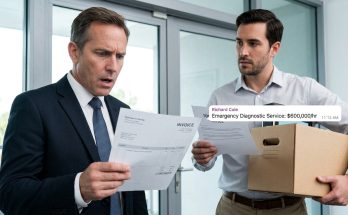
“I had a job yesterday morning. By lunch, my former boss was paying my five-minute-old company six hundred thousand dollars to understand a machine he’d just decided I wasn’t valuable enough to keep.”
Jonathan stared at me.
“That clarified some things.”
Samuel looked down, almost smiling despite the situation.
Jonathan tapped the case again.
“Phoenix.”
“No.”
“I can prove who ordered the Crossfield vehicle after Keane.”
“Elias.”
“No.”
I waited.
“Arthur.”
Samuel frowned.
“Arthur had backed away.”
“Publicly.”
“Lena’s records say otherwise.”
“Lena believed what Arthur told her.”
“Do you have evidence?”
Jonathan reached into his jacket.
Reyes’s voice came through the hidden receiver in my ear.
Easy.
Jonathan produced a small flash drive.
“Arthur’s private correspondence.”
I didn’t touch it.
“Put it down.”
He did.
“Why give me this?”
“Because Michael misunderstood Arthur.”
“Convenient.”
“Arthur wanted Phoenix recovered. Elias wanted Michael silenced. Neither trusted the other.”
“Which one sent the vehicle?”
“Arthur authorized surveillance. Elias escalated.”
“That matches what we already know.”
Jonathan looked disappointed.
He had expected revelation.
Instead, we had corroboration.
“Then what do you want?” he asked.
“The truth about the sabotage today.”
“I didn’t order Tyler to alter Bay Three.”
“I know.”
“Owen did.”
“Through Richard.”
“Yes.”
“Using a package originating from Crossfield’s legacy channel.”
“Yes.”
“Elias?”
“Yes.”
“And Mercer?”
“Provided the values.”
That aligned with our evidence.
“Your role?”
“Keane.”
“Fake Samuel.”
“Yes.”
“The Phoenix collectors.”
“Yes.”
“Why?”
“I needed a copy before Elias or Mercer got it.”
“Not to release truth.”
“To make sure they couldn’t erase it.”
“And to use it against Samuel.”
Jonathan smiled slightly.
“Both can be true.”
Exactly.
That was the entire day.
People doing defensible things for indefensible reasons.
People doing harmful things while claiming useful outcomes.
I asked, “Where is Denise Harrow?”
Jonathan’s expression shifted.
Samuel noticed.
“You know.”
“She found the liability account.”
“We know.”
“She found more.”
“What?”
“The original beneficiary records.”
“Of the Parker Development Trust?”
“Yes.”
My pulse sharpened.
“Where is she?”
“She contacted me.”
“When?”
“Yesterday afternoon.”
“Why?”
“She thought I could explain the old accounts.”
“Could you?”
“Yes.”
“What did you tell her?”
“That the money Michael earned had been redirected after his death.”
“To whom?”
“Some went to Margaret and Ethan. Some to restitution. Some to the foundation.”
“We know.”
“Not all.”
I waited.
“Two hundred thousand remained.”
“For what?”
“A contingency fund.”
“Controlled by?”
“Michael.”
“He was dead.”
“Afterward, trustee control passed to Lena.”
“And after Lena?”
Jonathan looked toward Samuel.
“Samuel.”
Samuel frowned.
“No.”
“You never knew.”
“What was it for?”
Jonathan smiled.
“That is what Denise went looking for.”
A sound came from the hallway.
Footsteps.
Reyes’s voice in my ear.
Movement east corridor.
Jonathan heard it too.
“You brought police.”
“Of course.”
He moved toward the case.
I stepped between him and the table.
“Don’t.”
He stopped.
For one second, the two of us stood close enough that I could see the exhaustion in his face.
Not madness.
Not theatrical evil.
A man who had spent twenty years convincing himself that ownership and justice were the same thing.
“You’re making Michael’s mistake,” he said.
“What mistake?”
“Believing documentation protects you.”
“No.”
I looked at the hidden receiver.
“It just makes lying harder.”
Reyes entered.
Jonathan didn’t resist.
As officers secured him, his phone vibrated on the table.
Nadia remotely isolated it.
One new message.
FROM: DENISE HARROW.
I FOUND THE CONTINGENCY LEDGER.
Jonathan stared at the screen.
So did Samuel.
Then a second message arrived.
MICHAEL PARKER WAS NOT THE ONLY PERSON HORIZON INSURED.
Samuel went pale.
I looked at him.
“Who else?”
He answered slowly.
“Me.”
That made sense.
“Who was beneficiary?”
“Horizon.”
“Anyone else?”
Samuel hesitated.
“Jonathan.”
The officers holding Jonathan stopped.
I stared at him.
He stared back.
Then Denise’s third message arrived.
The document attached to it was seventeen years old.
A key-person policy.
Insured:
JONATHAN LANGFORD.
Beneficiary:
MICHAEL PARKER DEVELOPMENT TRUST.
My father had once held a financial interest in Jonathan staying alive.
Jonathan looked genuinely stunned.
For the first time that night, he was looking at a piece of the past he had never seen.
And whoever had hidden that policy had just destroyed another simple story about who benefited from whose death.
Click here to continue reading: PART 18: Denise’s Ledger Finally Separated the Real Money From the Manufactured Motive, and Federal Agents Arrived Before Anyone Could Rewrite It Again
Five Minutes After Horizon Took My Badge, the Machine Only I Understood Failed With the Company’s Biggest Contract at Stake
Part 17 of 24