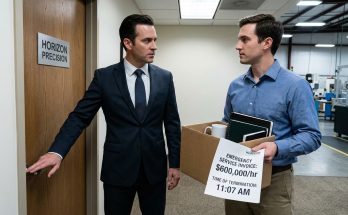
The first Parker Precision office had one framed document on the wall.
Not a diploma.
Not an award.
Not the company registration.
An invoice.
PARKER PRECISION SERVICES.
Emergency diagnostic services.
Rate:
$600,000 per hour.
One-hour minimum.
Paid.
Walter hated the frame.
“Looks arrogant.”
“It is arrogant.”
“Then why keep it?”
“Historical artifact.”
“You could put it in a drawer.”
“I could.”
Beside it was my Horizon termination notice.
Effective:
11:07 A.M.
Reason:
Position eliminated through organizational restructuring.
I had framed that too.
Between them hung my old contractor badge.
The arrangement told the story without explanation.
11:07:
My position had no value.
11:12:
The machine failed.
Minutes later:
The knowledge that supposedly belonged to the eliminated position had a price Horizon was willing to pay immediately.
People occasionally asked whether I charged six hundred thousand dollars an hour because I believed one hour of my labor was worth six hundred thousand dollars.
No.
That had never been the point.
The price reflected the emergency.
The contract at risk.
The years required to understand the machine.
The liability of stepping into a sabotage scene after being fired.
The fact that Horizon had no immediate substitute.
Price and value were related.
They were not identical.
That distinction became one of the first things I taught new Parker Precision engineers.
Another was simpler.
Never overwrite evidence because somebody wants the machine running faster.
Save the original.
Record the state.
Photograph the screen.
Preserve the logs.
Understand before changing.
Walter called it the Ethan Rule.
I hated the name.
So naturally everybody used it.
A year and a half after my firing, Parker Precision had twenty-three employees.
Not hundreds.
I didn’t want hundreds yet.
We were large enough to handle multiple commissioning projects.
Small enough that I knew every engineer.
Our work covered aerospace, automotive, medical manufacturing, advanced machining, and forensic controls diagnostics.
Meridian remained one of our biggest customers.
Horizon became a regular one.
Samuel stopped complaining about our rates.
That worried me.
“You feeling okay?” I asked during one call.
“Why?”
“You approved the proposal without arguing.”
“I’ve matured.”
“I’m calling Nadia.”
He hung up.
Some relationships survived because they changed shape.
Samuel never became my boss again.
That made it easier to respect him.
He had done things I disagreed with.
He had delayed quality disclosures early in Horizon’s life.
He had hired me partly because of my father without telling me.
He had watched for signs that I possessed Phoenix.
He had mistaken secrecy for protection.
None of that disappeared because he later helped expose the sabotage.
But he admitted what he had done.
Corrected what he could.
Stopped trying to control what came next.
That mattered.
My father’s Phoenix evidence remained divided between federal investigators, protected legal archives, and controlled technical custody.
The criminal cases eventually produced outcomes too complicated for headlines.
Mercer’s attempted sale of Phoenix, credential theft, and role in the sabotage became central to his prosecution.
Elias Crossfield’s legacy systems tied him to the Meridian manipulation and Crossfield recovery network.
Jonathan’s server infrastructure, old founder credentials, Keane communications, and curated evidence package established how deliberately he had tried to manufacture a story around Samuel.
Owen’s acquisition conspiracy ended his career.
Richard’s cooperation mattered, but so did his decisions.
Tyler’s cooperation mattered too.
Daniel Ross faced consequences for unauthorized methods even while his preservation of evidence helped investigators.
Nobody received the ending I would have written for them during the first angry hours.
That was probably good.
Courts were better places for consequences than my imagination.
The most important conclusion for me arrived quietly.
There was no evidence my father had been murdered.
The road incident was real.
The pursuit was real.
Crossfield security involvement was real.
Robert Keane’s truck had been struck.
My father had swerved.
His car had left the roadway.
But he survived.
He returned home.
Then his heart failed.
Massive myocardial infarction.
Natural death.
The two-million-dollar Horizon insurance policy had not been a murder motive.
It was ordinary key-person coverage.
The four-million-plus dollars paid to Michael were not hush money.
They were royalties, consulting compensation, and development payments under a real agreement.
The suspicious facts were authentic.
The sinister connection was manufactured.
That was Jonathan’s method.
It was also the central lesson Phoenix had left me.
Data could be accurate while the story built around it was false.
A servo gain of 184 was real.
That did not prove I entered it.
My badge opening Bay Three was real.
That did not prove I carried the badge.
My login writing parameters was real.
That did not prove I was at the terminal.
Horizon paying my father millions was real.
That did not prove Samuel bought his silence.
Horizon collecting insurance after Michael died was real.
That did not prove anyone wanted him dead.
Facts needed context.
Machines needed interpretation.
People did too.
My mother eventually gave me the original development agreement.
I stored it professionally.
Not in a toolbox.
Not inside a toy machine.
Not behind a picture.
She objected.
“Your father would be disappointed.”
“Why?”
“No secret compartment.”
“I’m breaking the cycle.”
She approved.
The Phoenix Master remained a harder question.
Lawyers eventually separated substantial portions of Michael’s personal intellectual property from Alden successor claims, Horizon licenses, and independently developed later work.
I could have pursued commercialization.
Investors called.
Technology companies called.
One offer contained enough zeroes to make Walter read it twice.
I declined.
Not forever.
Just then.
Phoenix had spent too long being treated as something worth hurting people to possess.
I wanted Parker Precision to succeed because of what we knew how to do today, not because I inherited a technical artifact from my father.
Maybe someday Phoenix would become a product.
Maybe a research tool.
Maybe it would remain evidence and history.
I was finally comfortable not knowing.
My father’s mechanical pencil sat on my desk.
That mattered more.
One afternoon, nearly two years after the firing, Mason visited our office.
He was still Horizon’s engineering manager.
Still complaining about meetings.
“You hiring?”
I looked at him.
“Seriously?”
“Maybe.”
“Samuel know?”
“No.”
“Then I’m not discussing it.”
He frowned.
“Why?”
“Because you work for a customer, and I’m not secretly recruiting their engineering manager.”
“That is irritatingly ethical.”
“I learned from watching everyone else.”
He laughed.
Three months later, Mason left Horizon properly.
He gave notice.
Helped select a replacement.
Completed transition.
Then applied to Parker Precision like everyone else.
Walter wanted me to make him interview.
I did.
Mason complained for the entire hour.
We hired him.
Nadia stayed at Horizon.
She liked security more than she admitted.
Her title eventually became Director of Information Security, and she built systems strict enough that even Samuel had to call the help desk when he locked himself out.
He complained to me.
I sided with Nadia.
Always.
Claire stayed too.
Horizon’s rebuilt HR and governance procedures became part of the company’s Meridian recovery documentation.
The company did not become perfect.
No company does.
But it became harder for one ambitious executive to remove an engineer, clone a credential, alter a machine, and manufacture a story without leaving evidence other people could see.
That was improvement.
One Friday evening, Walter and I were the last two people in our office.
He stood in front of the framed invoice.
“Still arrogant.”
“Still historical.”
“You know what I remember?”
“What?”
“You walking back into Bay Three wearing that stupid visitor badge.”
“I remember Richard’s face when I gave him the rate.”
“That too.”
Walter looked at the termination notice.
“Did you really think you were unemployed?”
“I was unemployed.”
“For five minutes.”
“Approximately.”
He laughed.
“Best five minutes of your career.”
I thought about it.
“No.”
“What was?”
“The five minutes after.”
He nodded.
That was closer.
Getting fired had not been the gift.
I would never romanticize that.
Richard had tried to sacrifice my career to protect his own.
The sabotage could have ruined me.
If Nadia hadn’t preserved logs, if Walter hadn’t remembered Tyler, if the camera hadn’t caught the cloned badge, if my documentation had been weaker, the ending could have been very different.
The valuable part was not losing the job.
It was what I chose after.
I refused to repair the machine as a favor.
I refused to pretend I still worked for people who had just removed me.
I created a company.
I named a price.
I preserved evidence before touching the parameters.
Those choices changed everything.
Walter left.
I stayed another few minutes.
On my desk was a proposal for a new aerospace customer.
Beside it, a hiring plan.
A calibration report.
A photograph of my father and me in the restored oak frame.
The hidden cavity was still there.
Empty now.
I liked it that way.
I looked at the photograph.
For years, I thought my father’s legacy might be Phoenix.
Then I thought it might be money.
Then evidence.
Then some secret ownership claim inside Horizon.
It wasn’t.
The most useful thing he left me was a habit.
When something didn’t make sense, he documented it.
When records disagreed with physical reality, he trusted measurement enough to investigate.
When somebody powerful wanted an inconvenient fact erased, he kept a copy.
He had made mistakes.
So had Samuel.
So had my mother.
So had nearly everyone whose name ended up in Phoenix.
But the habit survived.
Measure what moved.
Not what you meant to move.
I finally understood why that recovery phrase had mattered so much to him.
Intentions were invisible.
Results weren’t.
At 6:18, my phone rang.
The display showed Horizon Precision.
I answered.
“Parker Precision.”
Samuel said, “I have a problem.”
“Machine?”
“Yes.”
“Emergency?”
“Potentially.”
“Then call dispatch.”
“I wanted to talk to you.”
“You are talking to me.”
“You know what I mean.”
I smiled.
“What machine?”
“New grinding cell.”
“Alarm?”
“Position drift after warmup.”
“Send the logs.”
“Already did.”
“Good.”
“Are you coming?”
“No.”
“Why?”
“Because I have people who are better at that cell than I am.”
Samuel was quiet.
Then:
“That must feel strange.”
“It did.”
“And now?”
“Now it feels like a company.”
He laughed.
“Fine. I’ll call dispatch.”
“Samuel.”
“Yes?”
“Emergency rate increased again.”
“You are a terrible person.”
“So I’ve heard.”
He hung up.
I shut down my laptop.
On the way out, I stopped beside the three framed objects on the wall.
The contractor badge.
The termination notice.
The first invoice.
For a long time, I had thought the termination notice represented what Horizon took from me.
A job.
A title.
A desk.
An email account.
A badge.
Security.
Eventually I understood the notice represented the limits of what Horizon could take.
They could deactivate my account.
They could remove my nameplate.
They could escort me from the building.
They could decide my position no longer existed.
They could not erase eleven years of experience.
They could not remove what I knew about Bay Three.
They could not take the judgment built from thousands of failures, repairs, mistakes, commissioning nights, alarms, drawings, conversations, and measurements.
They could take the badge.
Not the engineer.
Five minutes after my boss fired me, he stopped me at the door and asked me to repair the machine before I left.
That was the moment the contradiction became impossible to ignore.
If my knowledge was valuable enough to save the machine after I was fired, then its value had never come from the job title in the first place.
I had simply been pricing it like an employee.
Parker Precision began the moment I stopped.
I switched off the office lights.
The framed invoice disappeared into darkness.
Tomorrow there would be another machine.
Another problem.
Another customer.
And this time, when somebody asked what my work was worth, I already knew who got to answer.
Me.
The End
Read more original stories on Feel Every Story.