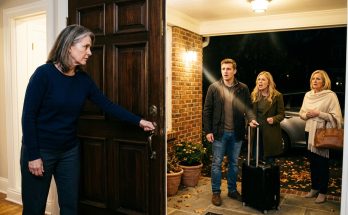
Evelyn Brooks agreed to speak with investigators.
She also agreed, through proper channels, to let me hear the portion of her account that concerned George.
I did not meet her immediately.
Detective Alvarez summarized first.
Evelyn had been a night nurse on George’s floor during his final admission.
She remembered Susan because Susan did not behave like most visitors.
“She asked questions,” Alvarez said.
“What questions?”
“About medication schedules.”
My stomach tightened.
“George’s?”
“Not initially.”
Susan claimed to be helping the family and asked when medications were usually administered because I was exhausted and sometimes left the hospital to sleep.
That part was true.
I had gone home some nights.
Maya had stayed others.
Liam visited when he could.
Jessica had apparently visited without telling us.
“Did Evelyn give Susan information?”
“General information. Nothing confidential at first.”
“Then what?”
“One night she found Susan near the medication station.”
“What was she doing?”
“According to Evelyn, looking at a patient-information board.”
My hands went cold.
“George’s name?”
“Possibly.”
“Was she authorized to be there?”
“No.”
“Did Evelyn remove her?”
“Yes.”
“Did Susan enter George’s room?”
“That’s where the timeline becomes complicated.”
I met Evelyn two days later with Alvarez present.
She was in her fifties now, with silver threaded through dark hair and the measured manner of someone accustomed to speaking carefully.
“I’m sorry I didn’t remember sooner,” she told me.
“You had dozens of patients.”
“Hundreds since then.”
“Why do you remember Susan?”
“Because she complained about me.”
That surprised me.
“To whom?”
“The charge nurse.”
“Why?”
“I told her she couldn’t stand near the medication station.”
“What did she say?”
“That she was family.”
“She wasn’t.”
“I know that now.”
Evelyn remembered Susan carrying a large handbag.
She also remembered Jessica.
“Were they together?”
“Not when I first saw Susan.”
“Did Susan visit George?”
“I didn’t personally see her enter his room.”
“But?”
“She knew which room was his.”
That alone proved little.
She could have learned it from Jessica.
“Why did Crane try to find you?”
“I don’t know.”
“Did anyone contact you after George died?”
Evelyn thought.
“A woman called the hospital asking whether staff remembered visitors from his final days.”
“When?”
“A few weeks afterward.”
“Name?”
“She didn’t give one.”
“Did you speak to her?”
“No.”
The call had been transferred to administration.
No useful record remained.
Then Evelyn remembered something else.
On the night Susan appeared, George had asked for his door to remain closed.
“He was tired?”
“Upset.”
“Did he say why?”
“He said too many people were coming in.”
“Did he name anyone?”
“No.”
“Was he lucid?”
“Yes.”
That mattered.
Again.
George had periods of clear thinking almost until the end.
“He asked whether we could restrict visitors.”
“Did you?”
“We noted that visitors should check at the desk.”
“Did Susan?”
“Not that I saw.”
“Then how did she reach the medication station?”
Evelyn looked uncomfortable.
“There was a side entrance from the family waiting area.”
“Could anyone use it?”
“Technically, yes. It should have been monitored.”
Hospital systems were built by humans.
Humans got busy.
Doors opened.
People followed others through.
But Alvarez had found another record.
A visitor badge issued that night.
Name: Susan Whitaker.
I stared at it.
“She used my last name.”
“Yes.”
Relationship: sister.
I almost laughed.
Susan had turned herself into George’s sister.
“Who issued it?”
The employee no longer worked there.
Identification requirements were looser at the time.
Susan had known George’s room.
My name.
His condition.
Enough to sound convincing.
But the badge record included a sponsor.
Someone had confirmed her visit by phone.
“Who?”
Alvarez slid the record toward me.
Liam Whitaker.
My son stared when I showed him later.
“I didn’t do that.”
“Could someone use your information?”
“Yes.”
“Who?”
He did not need to answer.
Jessica.
She came to the house that evening voluntarily.
“I confirmed it.”
Liam stood across the room.
“Why?”
“Mom said she needed to apologize to George.”
“Did you know she used my name?”
“No.”
“Did you tell the hospital you were me?”
Jessica hesitated.
“It was an automated call.”
“What does that mean?”
“They asked for a family contact. Mom said use your number because you were his son.”
“Whose phone?”
“Mine.”
“Did you say my name?”
“Yes.”
Liam closed his eyes.
“You impersonated me again.”
“I know.”
“Stop.”
She corrected herself.
“I did.”
“Why didn’t you just use your own name?”
“Mom said they wouldn’t let her in otherwise.”
“That should have told you something.”
“Yes.”
“Did she see Dad?”
“I thought she did.”
“You thought?”
“She told me she apologized.”
“Did George mention it?”
“No.”
“Did you ask him?”
“No.”
Liam turned away.
Jessica did not cry this time.
That was new.
She sat with the discomfort instead of using tears to fill it.
“What did Susan tell you happened?”
“That George forgave her.”
I felt anger rise.
“George’s notes say he wanted her kept away.”
“I know that now.”
“Did Susan tell you he agreed not to tell me?”
“Yes.”
“Did you believe her?”
“Yes.”
Of course.
Susan had returned from every confrontation carrying a version in which the other person eventually understood her.
Daniel had misunderstood.
George had overreacted.
I was too emotional.
Liam was manipulated.
Jessica was confused.
Only Susan remained consistently reasonable in Susan’s stories.
Detectives examined George’s hospital medication records.
No unexplained administrations were documented.
No medication went missing according to inventory.
There was no evidence Susan had reached his medicine there.
That was important.
The nurse’s memory placed her in the ward, not inside a medication drawer.
I refused to let suspicion outrun facts.
But another record existed.
George’s bedside phone had called hospital security at 9:18 that night.
The call lasted forty-six seconds.
No recording survived.
A security incident note did.
Patient reports unauthorized visitor. Female. Left before officer arrived.
My throat tightened.
“Did George name her?”
No.
But twelve minutes later, Susan’s visitor badge was scanned at the exit.
Circumstantial.
Strong.
Not absolute.
Evelyn remembered checking on George after security left.
“He was angry.”
“What did he say?”
“That people kept treating him like he couldn’t make decisions because he was dying.”
I looked down.
That sentence felt like the center of everything.
George’s illness had made others believe his boundaries were negotiable.
Susan gave him medication because she believed she knew better.
Jessica lied because she believed truth would create unnecessary conflict.
I accepted incomplete explanations because I believed a sick man’s confusion accounted for things I did not understand.
Even love could become disrespect when it stopped allowing the person at its center to choose.
“What else did he say?” I asked.
Evelyn thought.
“He asked me whether dying people still had the right to be difficult.”
Tears filled my eyes.
“What did you say?”
“I told him especially dying people.”
I laughed through the tears.
“He would have liked you.”
“He was difficult.”
“Yes.”
She smiled.
“Good.”
Before we left, Evelyn gave Alvarez one additional detail.
Susan had not carried the same large handbag when she exited.
“What do you mean?”
“She had a canvas tote when I saw her near the station. When I saw her leaving, I remember only the handbag.”
“Could you be mistaken?”
“Absolutely.”
That answer made me trust her more.
“What was in the tote?”
“I never saw.”
No evidence showed she took anything from George’s room.
No missing property was documented.
Still, investigators searched Susan’s storage unit inventory again.
One item had initially seemed meaningless.
A canvas hospital tote.
Inside were old magazines and toiletries.
At the bottom was a small digital recorder.
The recorder belonged to George.
I recognized it.
He used it for voice memos before switching mostly to his phone.
“How did Susan get this?”
Nobody knew.
The device no longer powered on.
Forensic technicians extracted its memory.
Most recordings were mundane.
Doctor instructions.
Thoughts.
Reminders.
Then a recording from the night Susan visited.
George’s voice:
“You should not be here.”
Susan answered.
Her voice was unmistakable.
“I came to make peace.”
“There is no peace where you keep lying.”
“George, you’re sick.”
“I am sick. I am not stupid.”
I closed my eyes.
Susan lowered her voice.
“Nancy does not need this.”
“She needs the truth.”
“She needs to get through your death.”
“So do my children.”
A pause.
Then Susan:
“Liam will hate Jessica.”
“If she keeps lying, maybe he should.”
“You don’t mean that.”
“I mean he deserves a choice.”
There it was.
Choice.
The same principle George had defended from the beginning.
Susan said, “You think choices matter more than family.”
George answered immediately.
“No. I think choices are how family proves it respects you.”
I pressed my fingers to my lips.
The recording continued.
Susan asked where his evidence was.
George laughed weakly.
“Somewhere you won’t find it.”
The toolbox.
“Give it to me.”
“No.”
“You’re going to destroy your son’s life.”
“No. You’re afraid I’ll stop you from arranging it.”
Then movement.
A scrape.
George saying, “Put that down.”
Susan: “I’m taking nothing.”
George: “Then leave.”
The recording ended.
No violence.
No confession.
No medication.
But Susan had lied again.
She had visited him.
She had asked for his evidence.
And somehow his recorder ended up in her storage unit.
Alvarez told me possession of the recorder could be significant depending on how it was obtained.
Susan’s attorney claimed George had given it to her.
The recording itself made that explanation difficult to believe.
Then investigators found fingerprints on the battery compartment.
George’s.
Susan’s.
And Jessica’s.
Jessica stared at me when told.
“I never touched that recorder.”
“Are you sure?”
“Yes.”
“Could you have years earlier?”
“Maybe.”
Again, fingerprints did not provide dates.
Evidence was rarely as neat as television wanted it to be.
Then Crane provided another message Susan had sent him after the hospital visit.
Got the device. Still no papers.
My stomach turned.
Alvarez read the timestamp.
Twenty-three minutes after Susan left the hospital.
George had not given her the recorder.
She had taken it.
Perhaps from his room.
Perhaps from a table.
Perhaps after he told her to put something down.
The recording captured its own theft.
Liam listened to it alone.
Afterward he came to me.
“He said I deserved a choice.”
“Yes.”
“I kept giving mine away.”
“What do you mean?”
“I let Jessica tell me what you meant. I let Susan tell me what Dad meant. I let money decide what problems disappeared.”
He sat beside me.
“And whenever someone said no, I treated it like they were hurting me.”
I thought of the train.
Do not make this a thing.
One sentence.
A lifetime of habit inside it.
“What will you do differently?”
“Ask.”
“For what?”
“Permission. Information. Help.”
He gave a small smile.
“And maybe accept the answer.”
“That part is useful.”
He nodded.
Then his expression changed.
“There’s something I need to tell you.”
“What?”
“After Dad died, Susan asked me for something from his hospital room.”
My body tightened.
“What?”
“His phone.”
“Did you give it to her?”
“No.”
“Why did she want it?”
“She said Jessica had sent him private messages and wanted them deleted before you saw them.”
I stared at him.
“What did you do?”
“I told her Dad’s phone was with you.”
It had been.
I had kept it.
Susan never got it.
“What happened then?”
“She asked about his laptop.”
My pulse increased.
“Did you tell her?”
“I said Martin had most of Dad’s documents.”
That explained why Susan knew to search for legal files.
“Anything else?”
Liam looked ashamed.
“She asked whether Dad kept backups.”
“And?”
“I told her about the external drive.”
Maya, across the room, froze.
“The drive we’ve been using?”
“Yes.”
“Did she ever access it?”
“I don’t know.”
We checked.
The drive had remained in George’s office until months after his death.
Susan had visited the house during that period.
Several times.
Usually with Jessica.
Usually bringing food.
Again, help as access.
Maya examined the drive’s file history.
One directory showed deletion dates three weeks after George died.
“What was deleted?”
She recovered the directory listing.
A folder named DANIEL ORIGINALS.
Empty.
The copies we had came from Martin and the toolbox.
But George’s originals had been erased.
Another folder:
MEDICATION.
Empty.
A third:
LIAM.
Empty.
Someone had deleted targeted evidence from George’s backup drive while I was grieving.
The drive’s connection logs recorded the computer used.
Not George’s desktop.
A laptop.
Device name:
JESS-BENNETT.
Jessica’s old computer.
When confronted, she did not deny bringing it to my house after George died.
She denied deleting anything.
“Did Susan use your laptop?”
“All the time.”
“Password?”
“She knew it.”
Liam laughed bitterly.
Jessica accepted it.
“I know.”
He did not correct her this time.
Because she was not using the phrase to escape.
She was acknowledging a fact.
Then Maya recovered one file from the deleted MEDICATION folder.
Not the original.
A temporary copy.
A photograph.
George’s kitchen table.
Two medication bottles.
One Eleanor Bennett’s sedative.
The other an over-the-counter sleep aid.
Beside them was a handwritten note.
Found both in Susan’s tote after she left it here. Photographing before returning bag.
My heart stopped.
George had found both substances before his collapse.
Susan had brought both into my house.
The sleep aid she later purchased during the missing hour was almost certainly a replacement for the bottle George had already photographed.
We finally understood what she had been fixing.
Not George.
The evidence.
Click here to continue reading: PART 20: Susan’s Attempt to Replace the Evidence Finally Explained the Missing Hour, but George’s Last Recording Refused to Give Us an Easy Verdict
A Stranger Was Sitting in My Reserved Window Seat, but My Son’s Explanation Made the Real Insult Impossible to Ignore
Part 19 of 32