The criminal summons came six weeks after Ethan walked into the police station voluntarily.
He told me himself.
In person.
No dramatic phone call.
No request for rescue.
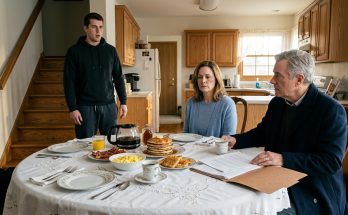
He came to the house on a Wednesday evening while Lily and Noah were at Dad's.
I let him into the kitchen.
He did not sit until I did.
“They're charging me.”
I had expected it.
Still, my stomach tightened.
“With what?”
“Identity fraud. Forgery. Fraudulent loan applications.”
“How many counts?”
“Daniel says the prosecutor consolidated some.”
“That doesn't answer me.”
“Five.”
I looked at him.
“Felonies?”
“Yes.”
The word sat between us.
“Could you go to prison?”
“Yes.”
My hands became cold.
For all my anger, I had never imagined explaining incarceration to Lily and Noah.
“What does Daniel think?”
“The prosecutor is open to a plea.”
“Because you confessed?”
“And cooperated.”
“With the Matthews investigation?”
“Yes.”
“What kind of plea?”
“He thinks probation is possible.”
“Possible.”
“Yes.”
“Restitution?”
“Yes.”
“Record?”
“Probably.”
Ethan looked exhausted.
“Employment?”
“I may lose my job.”
I absorbed each consequence.
This was no frozen card.
No sold boat.
No uncomfortable therapy session.
This could alter his life permanently.
I expected fear to trigger the old Ethan.
Excuses.
Negotiation.
A request that I tell prosecutors I had implicitly authorized something.
Instead, he reached into a folder.
“Daniel needs to know whether you want to submit a victim-impact statement.”
I stared.
“What do you want me to say?”
“Whatever is true.”
“That could hurt you.”
“Yes.”
“You're okay with that?”
“No.”
The answer was immediate.
“I'm terrified of it.”
I waited.
“But you should still say what is true.”
There it was again.
Fear without concealment.
I looked at the form.
“What would old Ethan have done?”
He gave a broken smile.
“Asked you to say we had a misunderstanding.”
“Yes.”
“Then reminded you the kids needed me.”
“Yes.”
“Then probably cried.”
“You're crying now.”
He wiped his face.
“Bad habit.”
“No. Crying isn't the bad habit.”
He looked at me.
“Using tears to make other people carry your consequences is.”
He nodded.
“I'm trying not to.”
I believed that.
The following week, I wrote the statement.
It took four days.
The first version was angry.
I deleted it.
The second sounded forgiving.
I deleted that too.
Neither was accurate.
The truth lived between them.
I wrote about the financial harm.
The fear of discovering debts attached to my name.
The humiliation of realizing my children had gone without while money flowed toward secrets.
I wrote about stitching Noah's backpack.
I wrote about checking my credit report at one in the morning.
I wrote about seeing my forged signature.
Then I wrote something harder.
Ethan had confessed.
He had cooperated.
He had sold assets.
He had reported misconduct investigators had not yet confronted him with.
He had entered counseling.
He had not pressured me to minimize what happened.
Those facts were true too.
I refused to become George in reverse.
I would not manipulate reality simply because one version helped me.
Rebecca reviewed the statement.
“You're comfortable with this?”
“No.”
“Good answer.”
At the hearing, I sat behind the prosecutor.
Carol sat farther back.
Dad came with me.
Mom stayed with the children.
Ethan stood beside Daniel.
He looked toward me once.
Then faced forward.
The judge asked whether he understood the charges.
“Yes, Your Honor.”
Whether he understood his rights.
“Yes.”
Whether anyone had forced his plea.
“No.”
Whether he admitted using my identity without permission.
His shoulders tightened.
“Yes.”
Whether he forged or caused my signature to be forged on financial documents.
“Yes.”
Whether he knew those documents could create legal obligations for me.
A pause.
“Yes.”
No explanations.
No George.
No Carol.
No childhood.
Those things mattered in sentencing.
They did not change the act.
The prosecutor described Ethan's cooperation.
Daniel described George's coercive influence and the recording.
Then the judge read part of my statement.
Not the forgiving part.
Not the harshest part.
The backpack.
Of all things.
She read about me sewing a broken zipper while Ethan sat nearby knowing hidden debt had made seventy dollars feel unaffordable.
Ethan lowered his head.
The judge looked at him.
“Why does that detail matter?”
Daniel started to stand.
The judge stopped him.
“I asked Mr. Matthews.”
Ethan swallowed.
“Because that's when I knew I wasn't protecting anyone.”
“Explain.”
“I had told myself I was borrowing to help family.”
He looked toward me briefly.
“But my son needed something ordinary, and my wife thought we couldn't afford it because of choices I hid.”
The judge waited.
“I watched her repair the backpack instead of telling the truth.”
“Why?”
“Because I was ashamed.”
“And?”
He hesitated.
“Because I was a coward.”
The courtroom remained silent.
The judge asked, “What changed?”
“I got caught.”
The honesty surprised everyone.
Even Daniel turned slightly.
Ethan continued.
“I wish I could say I changed because I suddenly became brave. I didn't.”
His voice shook.
“My card failed at a hotel. My wife checked the account. She found everything.”
The judge watched him.
“So accountability began with discovery.”
“Yes.”
“What makes you believe it will continue?”
Ethan looked down.
“I don't know that I can prove that today.”
That was the right answer.
“I can only stop hiding when hiding would still be easier.”
The judge nodded.
Sentencing was deferred pending restitution arrangements and completion of additional investigative cooperation.
No immediate prison.
No guarantee against it.
We left the courthouse separately.
Ethan did not approach me.
I appreciated that.
Dad and I walked toward the parking garage.
Halfway there, he said, “He did all right.”
“You mean in court?”
“I mean telling the truth when lying would've sounded prettier.”
I nodded.
“That impressed you.”
“A little.”
I smiled.
“Careful.”
He gave me the same warning I had heard before.
“I know.”
Two months passed.
Winter arrived.
The farm slowed.
The Matthews Holdings investigation did not.
Thomas Grant entered a cooperation agreement relating to false notarizations.
Several property owners filed civil claims against George's estate.
Carol voluntarily placed remaining estate assets under legal review.
She sold the large house.
That surprised everyone.
She moved into a modest two-bedroom townhouse.
“What happened to the money?” I asked.
“Escrow.”
“All of it?”
“Most.”
“You didn't have to do that.”
“I know.”
“Why?”
She looked at me.
“Because I spent years benefiting from money I was afraid to understand.”
No excuses.
“I need to know what's actually mine before I keep anything.”
That sounded healthy.
Painful.
But healthy.
Vanessa continued repayments.
She visited the children without turning every encounter into a referendum on Ethan.
Our relationship became cautiously ordinary.
Ethan lost his job.
His employer learned of the charges and placed him on leave.
Then terminated him.
He called me afterward.
“I figured you should know.”
“Are you okay?”
“No.”
“What are you going to do?”
“Look for work.”
“Doing what?”
“I don't know yet.”
Old me would have offered solutions.
Contacts.
Resume help.
Money.
I didn't.
“I hope you find something.”
“Me too.”
He understood.
Three weeks later, he took a job at an agricultural equipment warehouse.
Lower pay.
Longer commute.
No prestige.
Dad heard through Carol.
He said nothing.
Then one Saturday, Dad needed a replacement hydraulic fitting.
The local supplier was out.
Ethan's warehouse had one.
Dad drove there.
When he returned, he placed the receipt on my counter.
“What?”
“Nothing.”
“You have a face.”
“I have always had a face.”
“Dad.”
He sighed.
“He didn't use his employee discount.”
“Why would that matter?”
“I asked.”
“And?”
“He said using it for me without permission would be another version of deciding for someone else.”
I stared.
Dad shook his head.
“Therapy has made that boy irritating.”
I laughed.
But later, alone, I cried.
Not because of a hydraulic fitting.
Because change often appears in places too small to perform for anyone.
No audience.
No reward.
Just a choice.
Christmas approached.
The children asked whether Ethan would come.
I said yes.
Not overnight.
Dinner.
Presents.
Family time.
Lily accepted the arrangement.
Noah asked, “Is Dad still in trouble?”
“Yes.”
“With police?”
“Yes.”
“Are you still mad?”
“Yes.”
He thought.
“That's a long mad.”
I smiled sadly.
“It is.”
“Do you love him?”
Children again.
Straight through the armor.
“Yes.”
The word surprised me by coming easily.
I loved Ethan.
That had never actually stopped.
Love was not the unresolved question.
Trust was.
Christmas Eve, he arrived carrying two gifts.
One for each child.
Nothing for me.
I noticed.
After dinner, Lily opened art supplies.
Not expensive.
A good sketchbook, pencils, watercolors.
She looked at him.
“Art class?”
Ethan smiled.
“If Mom agrees, I've set aside money from my paycheck for the spring program.”
He looked at me.
“Directly to the school. Not through you.”
I nodded.
“That sounds okay.”
Lily hugged him.
Noah opened a backpack.
His face fell.
“I like my old one.”
Everyone laughed.
Ethan did too.
“I know.”
He held up his hands.
“I made a terrible gift choice.”
Noah examined the new backpack.
Then looked at me.
“Can I keep both?”
“Yes.”
“Old one is quality control.”
Naturally.
Later, after the children went to bed, Ethan stood by the front door.
Snow had begun outside.
He put on his coat.
“Thank you for today.”
“You're their father.”
“I know.”
He hesitated.
“I have sentencing next month.”
“I know.”
“Daniel thinks probation is likely.”
“I know.”
“I don't want you to write anything else.”
“I wasn't planning to.”
“Good.”
He reached for the doorknob.
Then stopped.
“I still love you.”
I looked at him.
“I know.”
He did not ask whether I loved him.
That restraint mattered.
“Good night.”
“Good night.”
He left.
I watched through the window as he walked to his car.
Then I went upstairs.
My wedding ring remained on the dresser.
I picked it up.
Held it.
For months, the ring had represented a promise Ethan violated.
Now I wondered whether it had to represent the old marriage at all.
Maybe any future between us would require something different.
Not restoration.
Reconstruction.
You restore something when you want it exactly as it was.
I did not want what we had.
Too much silence had been built into it.
If Ethan and I ever tried again, it would need new rules.
Separate access.
Full disclosure.
No secret rescues.
No assumed permission.
No moving costs onto invisible people.
No calling silence protection.
I placed the ring back on the dresser.
Not yet.
The next morning, Rebecca called.
On Christmas Day.
That alone told me it mattered.
“I am sorry to interrupt.”
“What happened?”
“Investigators finished reviewing George's remaining digital files.”
My stomach tightened.
“And?”
“They found a draft document.”
“What kind?”
“A will amendment.”
“George's?”
“Yes.”
“What does it say?”
She paused.
“It changes how Matthews Holdings assets were supposed to pass after his death.”
“To Ethan?”
“Partly.”
“What else?”
“There is a trust.”
“For whom?”
Rebecca's answer made me sit down.
“For Lily and Noah.”
My children.
George had placed their names into a financial plan I had never seen.
“What kind of trust?”
“A substantial one.”
“How substantial?”
“We don't know the final enforceable value.”
“Rebecca.”
“The draft references assets worth several hundred thousand dollars.”
I stared at the Christmas tree.
“Why would George leave money to them?”
“That is what we need to understand.”
“Did Ethan know?”
“According to him, no.”
My instinct was immediate suspicion.
Then Rebecca added, “The document was created after George knew Ethan had preserved the Carter records.”
I became still.
“What does that mean?”
“We don't know.”
But I had learned enough about George to understand that he rarely gave money without attaching a purpose.
And if he had tried to reach my children from beyond the grave, I wanted to know exactly what he expected them to carry in return.
Click here to continue reading: PART 17: George’s Secret Trust Put My Children’s Names Beside His Money, but Refusing His Final Bargain Became the Clearest Decision I Had Made
Ethan Chose a Luxury Weekend Over the Harvest, but One Casual Remark Made Me Question Who Was Paying for Everything
Part 16 of 20