The legal notice arrived on a Monday.
Rebecca had warned me.
That did not make seeing my name easier.
The investment company was called Harrow Capital Partners.
It had purchased a bundle of distressed Matthews Holdings assets eighteen months before George died.
Buried in that portfolio was a reference to our house.
Not the house itself.
A claimed interest connected to the unrecorded deed.
Harrow wanted a court declaration.
So did we.
The difference was what each side hoped the court would declare.
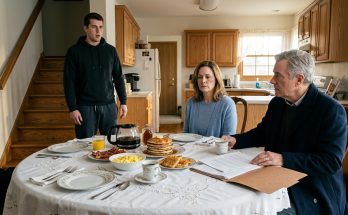
I read the complaint at Mom's kitchen table.
Dad stood behind me.
“Can they win?”
“Rebecca doesn't think so.”
“That isn't what I asked.”
“I know.”
He sighed.
Law had taught all of us to distrust absolute answers.
My forged signature should invalidate any transfer of my interest.
Ethan's genuine signature complicated his.
George's company had never recorded the deed.
The deed itself referenced a debt Rebecca believed could be shown fraudulent.
Harrow had purchased assets without apparently knowing the full history.
Every fact pulled in a different direction.
“What does Ethan want?” Mom asked.
“To disclaim his interest if that protects mine.”
Dad frowned.
“That's foolish.”
I looked at him.
“You've spent weeks saying he needs consequences.”
“Consequences aren't the same as setting yourself on fire.”
Mom nodded.
Dad continued.
“If the company has no right to that house, he shouldn't hand them anything just because he feels guilty.”
That surprised me.
“You're defending Ethan's share?”
“I'm defending reality.”
He tapped the complaint.
“That house belongs to the two people who bought it.”
“George helped with the down payment.”
“George's money doesn't make his fraud legitimate.”
Dad looked at me.
“Don't let guilt rewrite ownership either.”
I called Rebecca.
She agreed.
“We fight the claim.”
“With Ethan?”
“Legally, your interests align on this issue.”
Emotionally, the idea was harder.
Fighting beside my husband felt dangerously close to becoming his partner again.
Rebecca noticed my hesitation.
“Cooperation in litigation does not determine your marriage.”
I smiled.
“You say things like you've met me before.”
“I've met divorce clients.”
“We haven't decided on divorce.”
“Exactly.”
That word mattered.
Haven't.
Not won't.
Not will.
Haven't.
Ethan and I met at Rebecca's office with Daniel.
For the first time since the crisis began, we were on the same side of a table.
It felt strange.
Harrow argued Matthews Holdings had acquired a partial interest through Ethan's valid signature.
Rebecca argued the deed was part of a fraudulent transaction unsupported by legitimate consideration and contaminated by forgery.
Daniel added that George obtained Ethan's signature through misrepresentation and coercion.
The lawyers discussed doctrines.
I watched Ethan.
He took notes.
Asked questions.
Did not try to control the meeting.
When numbers appeared, he didn't automatically answer for me.
That should have been ordinary.
It felt revolutionary.
At one point, Harrow's attorney joined by video.
He proposed settlement.
Harrow would release all claims if we paid $38,000.
I almost laughed.
Dad would have called it buying back your own cow from the thief.
Rebecca rejected it.
The attorney said litigation could cost nearly that much.
Ethan looked at me.
I knew what the old Ethan would have done.
Pay.
Make it disappear.
He had $63,418 sitting in the silence account.
Enough.
I watched the temptation cross his face.
Then he said nothing.
After the call, I asked, “What were you thinking?”
“You know.”
“Say it.”
“Pay them.”
“Why didn't you?”
“Because paying isn't the same as solving.”
I nodded.
“And because the money may belong to victims.”
“Yes.”
“Was it hard?”
“Very.”
That honesty almost made me smile.
Rebecca requested historical underwriting documents from Harrow.
The company resisted.
A judge ordered limited production.
Three weeks passed.
Harvest ended.
The last truck left Dad's farm on a cold, bright morning.
Dad stood at the end of the drive until it disappeared.
Noah raised both arms.
“WE WON CORN!”
Nobody knew what that meant.
We celebrated anyway.
Mom cooked dinner for everyone.
Including Ethan.
Including Carol.
Including Vanessa.
It was the first time all of us had sat at one table since the cards were frozen.
The meal began stiffly.
Carol brought pie.
Vanessa brought salad.
Ethan brought nothing.
When Mom asked why, he said, “I was told not to solve anxiety by purchasing gifts.”
Dad nearly choked on his tea.
“Therapist earning their money.”
Even Carol laughed.
The sound felt strange.
Good strange.
Nobody pretended things were repaired.
That was why the evening worked.
There was no performance.
Carol apologized to Dad again.
This time he stopped her.
“You already said it.”
“I know.”
“Then do something with it.”
She nodded.
“I've been contacting families.”
“What families?”
“People in George's files.”
Dad stared.
“With investigators' approval?”
“Yes.”
Rebecca had apparently helped arrange it.
Carol was not confessing crimes she hadn't committed.
She was telling people she had records and directing them to legal assistance.
“That sounds hard,” Mom said.
“It is.”
Carol looked down.
“Some hate me.”
Dad ate another bite.
“Some probably always will.”
“I know.”
Again, no comfort where false comfort would be dishonest.
Vanessa had repaid nearly a quarter of her card charges.
She showed me a payment receipt only because I asked.
She no longer treated repayment like a performance.
Another change.
After dinner, Ethan and I washed dishes together.
Mom tried to stop us.
I insisted.
For several minutes, the only sound was water and plates.
Then Ethan said, “This feels familiar.”
“It does.”
“I miss it.”
I handed him a bowl.
“I know.”
He dried it.
“I miss you.”
I did not answer immediately.
“I miss parts of us.”
He nodded.
“Which parts?”
“Don't push.”
“Sorry.”
We continued washing.
After a while, I said, “I miss being boring.”
He laughed softly.
“Me too.”
“I miss arguing about thermostat settings.”
“You always won.”
“Because seventy-four degrees is unreasonable.”
“It's comfortable.”
“For reptiles.”
He smiled.
Then sadness returned.
“I would give anything to have those be our problems again.”
I turned off the water.
“No.”
He looked at me.
“Don't say you'd give anything.”
I dried my hands.
“That's how you got here.”
His expression changed.
Then he nodded.
“You're right.”
“Some things aren't worth any price.”
“I know.”
“And some things can't be purchased back.”
“I know.”
That conversation stayed with me.
Two days later, Harrow produced its historical records.
Rebecca called immediately.
“We found the weakness.”
“What?”
“Harrow's acquisition team flagged the deed.”
“When they bought the Matthews portfolio?”
“Yes.”
“They knew?”
“They knew the deed was unrecorded and contained signature irregularities.”
“Then why buy it?”
“They assigned almost no value to it.”
I sat straighter.
“How much?”
“One dollar.”
I stared.
“They're demanding thirty-eight thousand dollars for an asset they valued at one dollar?”
“Settlement leverage.”
My anger became clean and useful.
“Can we use that?”
“Yes.”
Harrow's internal notes were worse.
Possible defective execution.
Potential forgery.
No confirmed title interest.
Do not rely without independent validation.
They had known.
Yet after the Matthews Holdings investigation became public, someone apparently reviewed old assets and decided uncertainty itself might be profitable.
Rebecca filed for summary judgment and sanctions.
Ethan offered an affidavit explaining the deed.
Not minimizing.
Not claiming innocence.
He admitted signing.
Admitted knowing my signature was not mine.
Described George's threat.
Attached the recording.
Harrow withdrew its claim eleven days later.
No payment.
No settlement.
No $38,000 escape.
They released any asserted interest.
The title company recorded corrective documents.
Our house was legally ours again.
I should have felt relief.
Instead, I cried in Rebecca's office.
The house had become a container for too many versions of my life.
The newlyweds carrying boxes through the front door.
Pregnant me sleeping beside a forged deed I didn't know existed.
Children learning to walk in rooms partly financed by George.
Ethan lying about debt in the kitchen.
Was home the building?
Or the trust inside it?
Rebecca let me cry.
Then she asked, “What do you want to do with the house?”
“I don't know.”
“Keep it?”
“Maybe.”
“Sell?”
“Maybe.”
“Move back?”
I looked at her.
“That feels harder than selling.”
“Why?”
“Because moving back might feel like pretending.”
“Then don't pretend.”
The answer was annoyingly simple.
That weekend, I went to the house alone.
Ethan had not lived there since leaving Carol's.
He had taken only clothes and necessities.
The place smelled closed.
I opened windows.
Dust lay on the dining table.
Noah's repaired backpack hung beside the mudroom door.
I touched the zipper.
That stupid backpack.
It had become a symbol I never wanted.
I carried it to the kitchen.
The table where I had stitched it was still there.
I remembered Ethan sitting across from me checking his phone.
He had known about the debt.
Known about the loans.
Known about George.
Known I was sacrificing because of choices he made.
I sat.
For a while, anger returned exactly as strong as the first day.
Then something else arrived.
I remembered him making pancakes there.
Holding Lily after nightmares.
Painting Noah's room twice because I hated the first shade.
Dancing with me badly while dinner burned.
A marriage could contain love and betrayal simultaneously.
That was the problem.
If it had all been false, leaving would have been easy.
My phone buzzed.
Ethan.
I almost ignored it.
Then answered.
“Hi.”
“Hi.”
He sounded nervous.
“Rebecca said the title is clear.”
“Yes.”
“Good.”
Silence.
“Are you there?”
“At the house.”
He didn't ask to come.
Another small thing I noticed.
“What are you doing?”
“Remembering.”
He exhaled.
“Dangerous.”
“Very.”
I looked around.
“Do you want this house?”
He took time before answering.
“I want whatever makes the kids stable.”
“That's not what I asked.”
“No.”
He corrected himself.
“I love the house.”
“So do I.”
“But if you want to sell it, I won't fight.”
“What if I want to keep it?”
“Then we'll figure out ownership based on whatever happens with us.”
“What if I want to move back?”
His breathing changed.
“Then I'll stay away until you tell me otherwise.”
That answer mattered.
No pressure.
No assumption.
No using the house as a path back into the marriage.
“Thank you.”
“For what?”
“Answering the question I asked.”
He laughed softly.
“Low bar.”
“It used to be.”
After we hung up, I walked through every room.
By sunset, I made one decision.
Not about Ethan.
About myself.
I was moving home.
Not because the marriage was restored.
Because I refused to let George Matthews turn my house into another piece of land my family abandoned under pressure.
The next morning, I told Dad.
He nodded.
“I figured.”
“How?”
“You opened the windows yesterday.”
“You drove past?”
“Farmer.”
Apparently that explained surveillance.
Mom hugged me.
Lily cheered when I told her.
Noah asked about Wi-Fi.
“Better than Grandpa's.”
“I'm going home.”
Dad looked offended.
The move happened the following Saturday.
Ethan did not appear until I asked him to help.
He carried boxes.
Fixed a loose cabinet hinge.
Reconnected Noah's game console.
Then he left before dinner.
He stood at the doorway.
For a second, old habit made him reach toward the hook where his keys had always hung.
His hand stopped.
Those keys no longer belonged there.
He looked at me.
“Good night.”
“Good night.”
He walked out.
I closed the door.
Not angrily.
Not permanently.
Just because tonight, the house belonged to the people sleeping inside it.
Me.
Lily.
Noah.
I went upstairs.
On my dresser lay the wedding ring.
I had brought it from Mom's house.
Still not wearing it.
Still not throwing it away.
For now, that was enough.
Click here to continue reading: PART 16: Ethan Faced Charges for Forging My Name, and His Decision Before Court Showed Whether Accountability Would Survive When the Cost Became Real
Ethan Chose a Luxury Weekend Over the Harvest, but One Casual Remark Made Me Question Who Was Paying for Everything
Part 15 of 20