
Dylan remained just inside the kitchen.
Robert entered behind him and quietly closed the door.
No one mentioned the resemblance to that morning.
They did not need to.
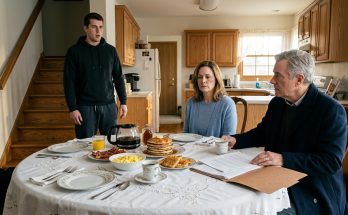
The same tablecloth lay across the table.
The same blue-floral china.
The same three people.
Everything else was different.
Dylan placed the bakery bag on the counter.
“I got sourdough.”
Helen nodded.
“Good.”
He smiled.
“There it is.”
Robert looked between them.
“What?”
“Mom has a rating system now.”
Helen ignored them.
“Sit.”
Dylan hesitated.
“Where?”
The question caught her.
Years ago he would have dropped into whichever chair he wanted.
On that morning, he had stood at the table grabbing toast until Robert’s voice stopped him.
Now he waited.
Helen pointed to the chair opposite hers.
“There.”
Dylan sat.
Robert took the third place.
Helen served soup.
No pancakes.
No bacon.
No elaborate breakfast prepared to disguise an ultimatum.
Just lunch.
Dylan looked around the kitchen.
“The screen is new.”
“Yes.”
“Locks?”
“New.”
“Alarm?”
“New.”
He nodded.
“Good.”
Helen noticed he did not ask for the code.
They ate.
For several minutes, conversation remained ordinary.
Miguel’s shop.
Robert’s apartment.
Helen’s attorney.
A neighbor who had accidentally painted part of Helen’s fence while staining his own.
Dylan laughed more easily than Helen expected.
Then he looked toward the staircase.
“My room?”
Helen put down her spoon.
“What about it?”
“Did you clean it out?”
“Mostly.”
“Did you find anything else?”
“Nothing Pierce needed.”
Dylan nodded.
“The notebook?”
“I kept it.”
“Okay.”
Helen waited.
“Do you want to see the room?”
He looked surprised.
“Can I?”
“Yes.”
They went upstairs.
Robert stayed behind.
Helen opened the bedroom door.
Most of Dylan’s belongings were gone.
The bed remained.
So did the dresser.
The wall where the cashbox had been hidden was repaired.
Dylan stood in the doorway.
“You fixed it.”
“Yes.”
He stepped inside only after Helen did.
The room looked smaller without his things.
“I lived here almost three years.”
“Yes.”
“Did you hate having me here?”
Helen considered.
“No.”
“Even at the end?”
“I hated how we were living.”
Dylan looked at the floor.
“That’s different.”
“Yes.”
He sat on the edge of the bed.
Helen remained standing.
“I miss it sometimes.”
“The room?”
“Knowing I could come here.”
Helen felt the conversation approaching something.
She waited.
Dylan looked at her.
“Do you think I’ll ever live here again?”
There it was.
Not a demand.
Not manipulation.
A question.
Helen had imagined it many times.
In some versions she said never.
In others she softened immediately and told him there would always be a home for him.
Both answers had been about fear.
One fear of being hurt again.
The other fear of losing her son.
Now she answered from neither.
“Not anytime soon.”
Dylan nodded.
Helen continued.
“Maybe never.”
His face tightened.
She let him feel it.
“This house cannot be your safety net anymore.”
“I know.”
“That doesn’t mean you can never visit.”
“I know.”
“It means your adult life needs to exist somewhere that isn’t built around my ability to catch you.”
Dylan stared at his hands.
“What if I fail?”
“You will.”
He looked up.
Helen smiled faintly.
“Everyone does.”
“What if I lose the job?”
“Find another.”
“What if Dad gets tired of me?”
“Then you and your father handle that.”
“What if I’m convicted?”
“Then you face whatever sentence comes.”
Dylan swallowed.
“And you?”
“What about me?”
“Would you still visit?”
Helen thought of the courthouse.
The restraints.
His question.
Will you come?
“Yes.”
His eyes filled.
“But I would not lie to get you out.”
“I know.”
“I would not pay someone to make consequences disappear.”
“I know.”
“I would not blame Jeremy.”
“I know.”
“I would not blame Robert.”
Dylan nodded.
“Or Wallace.”
He looked at her.
Helen continued.
“Even though Wallace targeted you.”
Dylan’s jaw tightened.
“That part is hard.”
“I know.”
“Sometimes I get furious.”
“At him?”
“At all of them.”
Dylan stood.
“At Chris for finding me. At Carol for telling him things. At Dad for leaving.”
He looked ashamed.
“And sometimes at you.”
Helen did not flinch.
“For what?”
“For making it easy.”
She waited.
Dylan rushed to explain.
“I know that sounds terrible.”
“It sounds honest.”
He breathed.
“You paid things. Fixed things. Let me come back.”
“Yes.”
“I sometimes think maybe if you had kicked me out sooner—”
Helen raised a hand.
“No.”
Dylan stopped.
“That is where your responsibility becomes mine again.”
He stared.
Helen continued.
“I should have set boundaries sooner.”
“Yes.”
“I should not have paid your debts.”
“Yes.”
“I should not have lied for you.”
“Yes.”
“But you do not get to make my mistakes the cause of yours.”
Dylan nodded slowly.
“Right.”
“We can each carry our own.”
He looked around the room.
“That’s harder.”
“Yes.”
“But lighter too.”
Helen smiled.
“Eventually.”
They returned downstairs.
Robert had cut the bread.
Badly.
Helen looked at the uneven slices.
“What did you do?”
Robert appeared offended.
“I cut bread.”
“With what, a shovel?”
Dylan laughed.
Robert pointed at him.
“You’re welcome to take over.”
Dylan did.
He found the bread knife without asking Helen where it was.
Then stopped.
His hand rested on the drawer.
Helen noticed.
“What?”
“I remembered.”
“What?”
“Where everything is.”
Helen understood.
Knowing where things were had once allowed him to find her desk key.
Her card.
Her Social Security information.
The house had given him familiarity.
He had turned familiarity into access.
Dylan closed the drawer.
“Can you hand me the knife?”
Helen looked at him.
It was already inches from his hand.
He was asking anyway.
She took it from the drawer.
Then handed it to him.
“Thank you.”
He sliced the bread.
That tiny exchange affected Helen more than she expected.
After lunch, Robert washed dishes.
Dylan dried.
Helen sat at the table.
“You’re both doing that wrong.”
Robert turned.
“There is no wrong way to wash a plate.”
“You’ve discovered one.”
Dylan laughed.
For twenty minutes, they looked almost like a family from before.
Helen caught herself thinking the word before.
Then realized there had never been a single before.
There had been good years with problems.
Bad years with laughter.
A marriage that failed without being entirely loveless.
A son who had done terrible things without being entirely terrible.
Memory liked clean categories.
Life resisted them.
When the dishes were done, Robert went outside to take a call.
Dylan remained in the kitchen.
He touched the edge of the tablecloth.
“The stain didn’t come out.”
“No.”
“From Dad hitting the table.”
“Yes.”
Dylan smiled faintly.
“He was trying so hard not to hit me.”
Helen looked at him.
“Yes.”
“Did you know?”
“I did.”
“He was angry.”
“Very.”
Dylan rubbed the fabric between two fingers.
“You kept it.”
“It’s a tablecloth.”
“That’s not why.”
Helen looked at the embroidery.
“I made this when you were a baby.”
Dylan smiled.
“I know.”
“You know?”
“You’ve told me.”
“I suppose I have.”
Dylan traced one blue flower.
“Do you wish you’d thrown it away?”
“No.”
“Even with the stain?”
Helen looked at him.
“The stain is not the whole cloth.”
Dylan became very still.
Helen realized what the sentence sounded like.
She had not planned it.
Dylan’s eyes filled.
“Mom.”
“Don’t turn it into a speech.”
He laughed through the emotion.
“Okay.”
Helen touched the stain.
“It also doesn’t disappear because the rest is beautiful.”
Dylan nodded.
“I know.”
“That’s closer to how I think about you now.”
He looked at her.
Helen continued.
“What you did matters.”
“Yes.”
“It will always matter.”
“Yes.”
“But it is not the only thing that exists.”
Dylan swallowed.
“Thank you.”
“You’re welcome.”
He did not ask whether that meant forgiveness.
Helen was grateful.
At three, Robert came back inside.
“We should go before traffic.”
Dylan nodded.
He picked up his jacket.
Helen felt something unexpected.
She did not want him to leave yet.
That frightened her less than it might have weeks earlier.
Wanting him to stay for another hour did not require allowing him to move back.
Affection did not cancel boundaries.
“Coffee before you go?” she asked.
Dylan looked surprised.
“Sure.”
Helen made three cups.
They sat again.
Robert drank his black.
Dylan added a little milk.
Helen used the blue-floral cup that had belonged to her mother.
Dylan looked around.
“I used to think this house was mine too.”
Helen listened.
“Not legally.”
“I know.”
“I mean emotionally.”
“That makes sense.”
“But I think I turned that into something else.”
“What?”
“Permission.”
Helen nodded.
“I thought because I belonged here, everything here belonged to me.”
Her money.
Her time.
Her attention.
Her forgiveness.
Even her body’s right not to be struck.
Dylan looked at his coffee.
“I don’t think I understood boundaries because I thought boundaries meant rejection.”
Helen considered that.
“And now?”
“Now I think maybe boundaries tell you where another person begins.”
Helen smiled.
“Therapy?”
“Obviously.”
“Worth the money.”
“Dad’s insurance.”
Robert raised a finger.
“My money.”
Dylan laughed.
Then he looked at Helen.
“Can I come again?”
“Yes.”
“When?”
“We’ll decide.”
He nodded.
No bargaining.
No calendar negotiation.
No attempt to secure the next invitation before leaving this one.
At the door, Robert hugged Helen.
Then Dylan stood before her.
“Can I?”
“Yes.”
He hugged her.
His arms were stronger than hers.
That fact had once frightened her.
Today he held her carefully enough that strength did not feel like danger.
When he stepped back, Helen handed him the remaining bread.
“You bought too much.”
“I thought you liked sourdough.”
“I do.”
“Then keep it.”
“I’m one person.”
Dylan smiled.
“Freeze it.”
Helen stared.
“What?”
“You always tell me to freeze bread.”
She laughed.
“Fine.”
He took the bag back.
“I’ll freeze it.”
“Good.”
Robert opened the door.
Dylan stepped onto the porch.
Then he stopped.
He reached into his pocket.
Helen’s body tightened before she understood why.
Dylan pulled out a small brass key.
Blue plastic cap.
Helen stared.
The old back-door key.
“I found it.”
Her heart accelerated.
“Where?”
“In the lining of my duffel.”
Robert turned.
Dylan held it on his palm.
“I thought I lost it.”
Helen looked at the key that had allowed Wallace’s warning to become more terrifying, even though the locks had since been changed.
Dylan extended his hand.
“This is yours.”
Helen took it.
The key no longer opened anything.
That did not make the gesture meaningless.
Dylan looked at her.
“I know you already changed the locks.”
“Yes.”
“I still wanted to give it back.”
Helen closed her fingers around it.
“Thank you.”
Dylan nodded.
He walked down the steps.
Robert followed.
Helen remained in the doorway.
Neither man looked back until they reached the car.
Then Dylan did.
He lifted one hand.
Helen raised hers.
The car pulled away.
She closed the door.
Locked it.
Not from Dylan.
Because people locked doors.
Helen carried the useless key to the kitchen.
She placed it beside the betting notebook.
Two artifacts from the old life.
One had once represented access.
The other entitlement.
Neither controlled anything now.
Her phone buzzed.
A message from Mercer.
Final order entered. Title is clear. Your property is officially free of the fraudulent lien and foreclosure claim.
Helen read it.
Then read it again.
She walked to the front window.
The house was quiet.
Entirely hers.
Not because a court had suddenly made it so.
It had always been hers.
The order merely restored the truth on paper.
Helen looked toward the kitchen table.
Three used coffee cups remained on the embroidered cloth.
She did not hurry to wash them.
For the first time, evidence that Dylan had been inside her house did not feel like evidence of danger.
Click here to continue reading: PART 25: When Dylan’s Sentence Was Finally Decided, Helen Refused to Ask the Court for Mercy That Required Pretending She Had Never Been Afraid
The Night My Son Raised His Hand, I Finally Understood What All My Years of Protecting Him Had Created
Part 24 of 27

One Comment on “PART 24 – Returning to His Mother’s Table Without a Key, Dylan Asked the Question Helen Had Feared, and Her Answer Proved the House Had Changed”