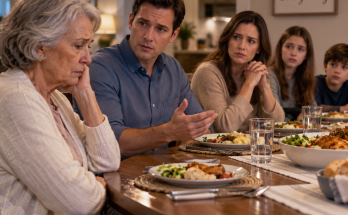
The first thing I noticed after my mother struck my son was not the sound of the slap. It was the silence that followed. A spoon stopped halfway to Valeria’s mouth. My brother-in-law lowered his glass without drinking. Even the ceiling fan seemed suddenly loud, clicking above us as Mateo stood beside my chair with his head turned sharply to one side. His small hand rose toward his left ear. When he pulled his fingers away, there was a thin smear of red on them.
Nobody moved.
My mother, Teresa Robles, remained standing at the head of the table as though she had merely swatted a fly. Her palm was still open. The anger had not even left her face. “Maybe now he’ll learn,” she said.
Mateo looked at me.
He was six years old, and there are certain expressions no six-year-old should ever learn to make. His was not the face of a child about to cry. It was the face of a child trying to determine whether crying would make things worse.
I pushed back my chair.
On the opposite side of the dining room, eight-year-old Damián held the little red car against his chest. He had taken it from Mateo less than a minute earlier. One of the wheels was crooked, the paint worn pale on the hood from years of being carried in warm hands. To anyone else it looked like something that belonged in a box of discarded toys.
To Mateo, it was the last thing his father had given him.
Julián had bought that car from a street vendor when Mateo was barely three. It had cost almost nothing. Julián had crouched outside our apartment and rolled it across the pavement toward our son, making an engine noise so ridiculous that Mateo had laughed until he hiccuped. Six months later, Julián died after an accident on his way home from work.
Mateo remembered very little about his father.
He remembered the car.
Everyone in my family knew that.
Damián knew it too.
The argument had begun after dinner, while the adults were still lingering over plates of mole and rice. Mateo had been sitting on the floor near my chair, guiding the red car along the grout lines between the tiles. He was careful and quiet, as he had learned to be in my mother’s house.
Damián noticed the car and pointed at it. “Give me that.”
Mateo tucked it closer to his knee. “No.”
Valeria glanced away from her phone. “Mateo, don’t be selfish.”
“It was my dad’s.”
Damián crossed the room anyway.
I saw his hand close around the car before I could intervene. Mateo grabbed for it. Damián jerked it upward and laughed. He was taller, stronger, and accustomed to the idea that wanting something inside that house usually made it his.
“Give it back,” Mateo pleaded.
“You can get another one.”
“No, I can’t.”
Mateo reached again.
That was when my mother sprang from her chair.
“Don’t hit my boy!”
Her words made no sense. Mateo had never touched Damián. He was reaching for his own toy. Yet before I could correct her, her arm moved.
The slap turned Mateo’s face aside.
Now he stood frozen beside me while the entire family behaved as though reality might become negotiable if nobody acknowledged it.
I crossed the small distance between us and knelt.
“Mateo.”
His breathing was shallow. The skin across his cheek was already reddening. His lower lip trembled once before he pressed it tight.
“Can you hear me?”
He nodded.
“Does your ear hurt?”
Another nod.
Valeria let out an irritated breath. “Clara, please. Mom barely touched him.”
I looked at her.
She had already drawn Damián close, one arm around his shoulders, while he continued holding Mateo’s car.
“Give that back,” I said.
Damián tightened his grip.
Valeria frowned. “He’s playing with it.”
“It belongs to Mateo.”
“They’re children.”
“One child took something. The other child got hit for trying to take it back.”
My mother clicked her tongue. “There you go again. Turning everything into some tragedy.”
That sentence was so familiar I could have spoken it along with her.
For six years, since Julián’s death, Mateo and I had lived in the back rooms of my mother’s house. She reminded me frequently that she had saved us from homelessness. She also reminded me that Valeria had never needed saving.
Valeria had married a man my mother approved of. She wore pressed blouses, never missed family birthdays, and never made choices that required explanation. I had married Julián against Teresa’s wishes, because he came from an ordinary family, repaired machinery for a living, and laughed when my mother tried to impress him.
After he died, coming back to that house had felt like surrender disguised as necessity.
I cleaned.
I cooked.
I contributed whatever I could from my salon work.
And whenever my mother reminded me that I owed her gratitude, I swallowed whatever answer rose in my throat.
I had convinced myself that enduring humiliation was not the same as accepting it.
Standing beside Mateo now, I understood how wrong I had been.
He touched his ear again.
This time a bright drop of blood appeared on his fingertip.
My stomach tightened.
“Come here.”
I lifted him.
He had grown long-legged and heavy enough that carrying him was awkward, but the moment I put my arms around him, he folded against my shoulder like a toddler. His hands gathered the fabric at the back of my blouse.
My mother scoffed.
“You’re encouraging him.”
I turned toward her.
She stared back without apology.
There were things I wanted to say. Years of things. Every insult about Julián. Every time she had compared the boys. Every evening she had given Damián a second helping while telling Mateo not to be greedy. Every moment I had noticed and then explained away because we needed the roof above us.
Instead I asked, “Where is my purse?”
“Clara.”
“My purse.”
“What are you doing?”
“I’m taking him to a hospital.”
Valeria laughed once in disbelief. “For that?”
I stared at the blood on Mateo’s fingers.
“Yes.”
My mother stepped around the table. “You will not embarrass this family because a child needed discipline.”
Something inside me went very still.
“You hit him hard enough that his ear is bleeding.”
“He moved at the wrong moment.”
“You hit him.”
“He was attacking Damián.”
“He never touched Damián.”
“He was going to.”
I looked toward my sister.
“You saw what happened.”
Valeria glanced at our mother, then at Damián.
Her silence answered me before she spoke.
“They were both grabbing at the car,” she said. “It happened quickly.”
I almost smiled.
Not because anything was funny, but because there are moments when a lie becomes so transparent that it clears away years of confusion.
Valeria had seen.
My mother had seen.
My brother-in-law had seen.
They simply preferred another version.
“Give him the car,” I said.
Damián backed away.
His mother put a protective hand in front of him. “Don’t frighten him.”
Mateo lifted his face from my shoulder.
“It’s Daddy’s,” he whispered.
I walked toward Damián.
My brother-in-law stood, perhaps expecting an argument. I stopped a few feet from the boy.
“Damián, put Mateo’s car on the table.”
He looked at his grandmother.
That was the habit my mother had taught him: when confronted with a boundary, find the adult who would erase it.
Teresa stepped between us.
“Leave him alone.”
For one second nobody spoke.
Then Damián did something small, almost careless.
He let the car fall.
It hit the tile.
The already-loose wheel snapped free and skittered beneath the sideboard.
Mateo made a sound against my shoulder.
Not a cry.
A breath collapsing.
Damián stared down at the broken toy, startled by what he had done. Valeria immediately reached for him.
“It was an accident.”
My mother added, “Now look what you caused, Clara.”
That was the sentence that ended something.
Not the slap.
Not even the blood.
That sentence.
I shifted Mateo higher against me and walked to the sideboard. I crouched with him in my arms, found the tiny black wheel beneath the cabinet, and picked up the broken car from the floor.
I put both pieces into my pocket.
Then I crossed the foyer, took my purse from the hook, and opened the front door.
“Where do you think you’re going?” my mother demanded.
“To get my son examined.”
“If you walk out and start making accusations, don’t expect to come back here behaving as though nothing happened.”
I rested my hand on the door.
For years, that threat would have stopped me.
Where would we go?
How would I pay rent?
Who would watch Mateo when I worked?
How could I rebuild after losing Julián?
Fear had made those questions sound like chains.
Now Mateo’s cheek was hot against my neck.
I opened the door wider.
“Maybe I shouldn’t have kept coming back as though nothing happened.”
The night air struck us sharply.
I heard my mother calling after me, but I did not turn around.
At the curb I tried to order a taxi, then discovered my phone battery was nearly dead. The screen dimmed while I entered the hospital address. When the car finally arrived, I climbed into the back seat and pulled Mateo close.
For several blocks he said nothing.
Streetlights passed over his face in pale intervals.
His injured cheek had begun to swell.
Then he whispered, “Mom?”
“Yes.”
“Was Grandma mad because I didn’t share?”
I had spent years trying to protect him from adult ugliness by softening everything.
Grandma is tired.
Aunt Valeria didn’t mean it that way.
Damián is just excited.
This time I would not teach him to distrust what he had seen.
“No,” I said. “You were allowed to keep your own toy.”
“But she hit me.”
“I know.”
“Did I do something bad?”
The question almost undid me.
I pressed my lips against his hair.
“You tried to take back something that belonged to you. Grandma was wrong to hit you.”
He was quiet again.
Then his fingers crept toward my pocket.
“Do you still have Daddy’s car?”
“Yes.”
“And the wheel?”
“Yes.”
His shoulders loosened by the smallest amount.
“We’ll fix it,” I told him.
I meant the car.
At that moment I did not yet understand how many other broken things would have to be examined before our lives could be repaired.
The emergency entrance came into view under white lights.
I paid the driver and carried Mateo through the sliding doors.
The woman at reception looked up.
Her expression changed the moment she saw his face.
“What happened to him?”
My first instinct was the one my family had trained into me.
Say he fell.
Say it was an accident.
Keep private things private.
Do not create trouble.
Mateo’s arms tightened around my neck.
I looked at the nurse.
“My mother hit him.”
Her fingers stopped over the keyboard.
Then she leaned forward and asked a question that would pull open far more than the events of that evening.
“Has anyone in that house hurt your son before?”
Click here to continue reading: PART 2: A Doctor Asked One Question I Had Spent Years Avoiding, and Mateo Answered Before I Could Protect Anyone
The Red Car Was the Only Thing Mateo Had Left of His Father, Until One Dinner Changed Everything
Part 1 of 27