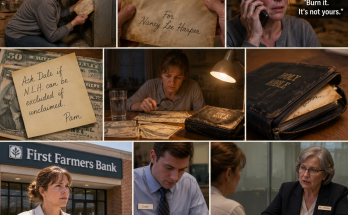
The hospice agency still kept paper visitor logs.
Not because every visitor was required to sign in, but because the home-care team had used a binder during Claire’s final weeks to track nurses, equipment technicians, social workers, and volunteers entering the Whitman house.
Most names meant nothing to Greg.
Pharmacy delivery.
Oxygen technician.
Home-health aide.
Chaplain.
Meal volunteer.
Then Marcus found Nicole’s name.
Not her current surname.
Her maiden name.
Nicole Mercer.
Date:
Four days before Claire died.
Reason:
Community support delivery.
Greg stared at the photocopy.
“She was in my house?”
“Yes.”
“I never met her.”
“That doesn’t mean you were there.”
He checked the date.
His face changed.
“I was.”
“Are you sure?”
“I took leave that entire week.”
He looked toward the page.
“So I saw her?”
“Maybe.”
“I don’t remember.”
Nobody blamed him.
That week contained the kind of memory overload that erases ordinary faces.
A dying wife.
A frightened child.
Relatives arriving.
Medication schedules.
Phones ringing.
Food appearing on counters from people Greg barely knew.
Nicole could have walked directly past him and vanished from memory.
The hospice binder contained another clue.
Community support delivery had not been a hospice program.
It was a partner-volunteer service operated through Families Forward.
The same nonprofit connected to the later fundraiser.
Dana looked at Marcus.
“Who assigned volunteers?”
“Working on it.”
The answer came from archived emails.
Judith coordinated several partner services for Claire’s household.
She had specifically requested Families Forward support during the final week.
Nicole was assigned.
Coincidence remained possible.
Then investigators found Judith’s email to the volunteer coordinator.
Please send Nicole if available. She understands complicated family dynamics.
Greg read the sentence.
“What complicated family dynamics?”
No one knew.
At that time, Claire and Greg were not fighting.
Evelyn and Marianne were involved.
Kaylee was three.
There was grief.
There was fear.
But nothing that obviously required a volunteer with specialized understanding.
Marcus contacted the retired coordinator.
She remembered almost nothing.
Five years had passed.
But she remembered Nicole.
“She volunteered around bereavement programs,” Marcus told us.
“Why?”
“She had lost someone?”
“Apparently her mother.”
Tasha’s mother too.
A real grief connection.
That complicated the picture.
Nicole may have entered the Whitman home for perfectly legitimate reasons.
Then later recognized Greg’s name when Judith mentioned him.
Still, the secrecy around the fundraiser remained.
“Did Nicole meet Claire?” Greg asked.
“Likely.”
“Kaylee?”
“Likely.”
“Me?”
“Unknown.”
Greg looked toward the old records.
“And then ten months later she helps her sister meet me.”
Marcus did not answer.
Investigators interviewed Nicole again.
This time she could not pretend the old event meant nothing.
She admitted remembering Greg from the hospice visit.
She admitted telling Tasha about him afterward.
Not immediately.
Months later.
“What did you tell her?” investigators asked.
Nicole’s answer was summarized for us.
That Greg was young.
That he had a little girl.
That his wife was dying.
That the family appeared financially stable.
The final detail changed the tone.
Financially stable.
“How would Nicole know that?” I asked.
Dana frowned.
“She says from the house.”
The Whitman home was comfortable, not extravagant.
Still, Nicole noticed.
Then Judith later told her Greg might attend the fundraiser.
Nicole told Tasha.
Tasha went.
“That sounds targeted,” Greg said.
Dana did not disagree.
“What does Nicole say?”
“She says she thought Greg and Tasha might like each other.”
“And don’t make it obvious?”
“Judith claims that meant not to embarrass Greg by making the introduction seem arranged.”
Greg laughed bitterly.
“So everybody knew except me.”
“Possibly.”
“Did Tasha?”
“Yes.”
The answer came after investigators confronted Nicole with more messages.
Tasha knew Greg might attend.
She knew he was widowed.
She knew he had a daughter.
She knew Nicole had seen the family during hospice care.
And she agreed to go.
Still, knowing about someone before meeting them did not explain abuse years later.
Dana repeatedly reminded us of that.
The origin of a relationship can be manipulative without predicting everything that follows.
We had to resist turning every uncomfortable fact into proof of a master plan.
Then investigators found something that weakened that caution.
A message from Tasha to Nicole, sent two weeks after the fundraiser.
He still thinks we met by accident.
Nicole replied:
Better that way.
Greg stared at the recovered text.
No one spoke.
He eventually asked, “Why?”
That question became the focus.
Nicole’s explanation was painfully mundane.
Tasha had been lonely.
Greg was stable.
Nicole thought he would be good for her sister.
They feared he would feel manipulated if he knew the introduction had been planned.
Maybe that was all.
Then another message surfaced.
Tasha:
Kid is attached to dead mom’s family.
Nicole:
That can change.
Tasha:
Mom left money too.
Nicole:
How do you know?
Tasha:
He told me.
That exchange occurred three months into the relationship.
Not before.
The trust had not been the initial reason Tasha approached Greg.
At least there was no evidence it was.
But once she learned of it, she noticed.
And once she learned who controlled it after Greg, she noticed that too.
Evelyn.
Marianne.
The same two women later isolated from Kaylee.
Greg sat with his hands locked together.
“I told her everything.”
“You were dating someone you trusted,” Karen said.
“I told her about Claire’s trust.”
“That is not wrongdoing.”
“I told her about Mom and Marianne.”
“That is normal.”
“I gave her the map.”
Dana intervened.
“No. You gave your partner family information. What she did with it belongs to her.”
Greg nodded but did not look convinced.
Kaylee remained largely unaware of the developing origin story.
That was intentional.
Dana believed it would be cruel and useless to burden her with adult questions about whether her father’s marriage had been engineered.
She needed safety, not conspiracy charts.
Still, pieces reached her indirectly.
Evelyn came for a supervised family visit.
Kaylee asked, “Did you know Tasha before Dad?”
“No.”
“Aunt Marianne?”
“No.”
“Did Mom?”
“Claire?”
“Yes.”
Evelyn frowned.
“Not that I know of.”
“Nicole?”
Evelyn became cautious.
“I don’t think so.”
Kaylee nodded.
“Good.”
“Why good?”
She shrugged.
“I don’t want her in Mom’s stuff.”
The statement was simple.
But it clarified something adults kept complicating.
Claire belonged to Kaylee’s memory.
She did not want Tasha retroactively occupying it.
At the next court hearing, prosecutors requested continued no-contact restrictions and argued that Tasha presented a flight risk.
Her attorney argued she had panicked under false accusations.
The judge ordered her held pending further review.
Kaylee did not attend.
Greg did.
So did Karen.
Tasha appeared in jail clothing.
Greg told me later that seeing her felt unreal.
“She looked at me like I betrayed her.”
“What did you do?”
“Nothing.”
“Did she speak to you?”
“No.”
“But she tried?”
“Her lawyer stopped her.”
After the hearing, Tasha’s attorney approached Karen with a message.
Tasha wanted Greg to know she had “protected Kaylee for years.”
Greg refused to receive anything further directly.
That phrase bothered him.
Protected Kaylee from what?
Investigators soon learned what Tasha claimed.
Claire’s family.
According to Tasha, Evelyn and Marianne had always wanted control of Kaylee and her trust.
Tasha positioned herself as the person who prevented them from taking over.
The accusation inverted reality neatly.
Every person Tasha isolated became, in her story, a threat she had heroically contained.
Every restriction became protection.
Every surveillance measure became documentation.
Every punishment became structure.
Every lie became defense.
Rachel Mercer’s vocabulary echoed throughout.
At 3:00 that afternoon, Marcus brought Greg a copy of a document recovered from Vance’s rural house.
It was old.
Three years old.
Typed.
Title:
Family Stability Plan.
Prepared for:
Tasha Whitman.
No professional signature.
No author.
Sections covered:
External family influence.
Child loyalty conflicts.
Financial boundaries.
Caregiver authority.
Greg read faster as he went.
Then stopped.
“What?”
He pointed to a paragraph.
If father remains guilt-driven regarding deceased spouse, stepmother authority will remain secondary unless maternal relatives are gradually reduced as emotional reference points.
My stomach turned.
“Who wrote that?”
Marcus said, “We don’t know.”
Vance denied it.
Rachel denied it.
Judith denied it.
Nicole claimed never to have seen it.
Tasha refused to answer questions.
Dana asked Greg whether he recognized the language.
“No.”
“Any phrases?”
He read again.
“Guilt-driven.”
His face changed.
“Tasha used to say that.”
“When?”
“Whenever I disagreed about Kaylee.”
“What exactly?”
“That Claire’s death made me parent from guilt.”
Dana wrote it down.
Greg continued reading.
Another section:
Child should learn unified authority. Private appeals to father during travel undermine household structure.
Another:
Maternal-family contact should be contingent on demonstrated respect for stepmother role.
Another:
Independent access to communications may reinforce triangulation.
That explained the tablet.
The blocked calls.
The controlled visits.
The document was not simply descriptive.
It looked like a roadmap.
“Who had the expertise to write it?” I asked.
Dana did not answer immediately.
Then:
“Rachel had custody language.”
“Vance had behavior language.”
“Judith knew the family history.”
“Nicole knew Tasha.”
“And Tasha knew all of them.”
The possibility was frightening.
Not because investigators could prove all four collaborated.
They could not.
But the document seemed to combine knowledge from several sources.
The next breakthrough came from file metadata.
The original digital version was not found.
But printer coding on the pages identified the model used.
A commercial office printer.
Investigators compared known workplaces.
Rachel’s former office used that model.
So did many others.
Then they noticed a faint footer on page six.
R.M. draft 3.
Rachel Mercer.
When confronted, Rachel changed her statement.
Again.
She admitted writing an early family-stability document for Tasha.
She claimed it was never intended as a punishment plan.
She said she believed she was helping a blended family manage boundaries.
“Did she recommend cutting off Evelyn and Marianne?” I asked.
“Rachel says no.”
“Blocking messages?”
“No.”
“Monitoring?”
“No.”
“Meal restrictions?”
“No.”
“Standing?”
“No.”
“Then what did she recommend?”
“Unified rules. Clear caregiver authority. Reduced conflict between adults.”
Normal concepts.
Weaponized later.
But Rachel admitted something else.
She had not created the document alone.
Tasha provided detailed family history.
And Judith Lane had participated in one meeting by phone.
Greg stared when he heard.
“Judith?”
“Yes.”
“When?”
“Three years ago.”
“What did she contribute?”
“Background about Claire’s death and Kaylee’s early grief.”
“She had no right.”
“No.”
“Why was she even involved?”
Rachel’s answer was that Tasha presented Judith as a long-term family support professional.
Greg had no idea those conversations were happening.
Judith had continued discussing his daughter years after leaving hospice care.
Without consent.
Without a therapeutic relationship.
Without his knowledge.
That transformed her role.
She was no longer merely an old nurse who later reappeared.
She had remained connected.
Quietly.
The question became why.
The answer came through money.
Investigators subpoenaed payments.
Over four years, Judith received periodic transfers from Nicole’s consulting business.
Not huge.
A few hundred dollars at a time.
Description:
Care support.
Nicole said the payments were legitimate.
Judith had helped with Nicole’s elderly aunt.
Records did confirm some home-care visits.
But several payments matched dates when Judith communicated with Tasha about Kaylee.
One arrived the day after the family-stability meeting.
Another after Kaylee’s urgent-care visit.
Another after Marianne’s child-services report.
Patterns are not proof.
But patterns tell investigators where to look.
That evening, Judith’s attorney requested another meeting.
Her client wanted to amend her statement.
Dana called Greg before the interview finished.
“She is beginning to cooperate.”
“What does that mean?”
“She says she stayed involved because she believed Tasha was preventing the family from falling apart.”
Greg stared at the phone.
“By helping her isolate my daughter?”
“That is not how Judith describes it.”
“Of course not.”
Then came the first major admission.
Judith knew about the standing punishments.
Not the worst versions, she claimed.
But enough.
Tasha told her Kaylee was required to stand in one place for lying.
Judith advised her to avoid anything physically painful.
She did not report.
She did not tell Greg.
“Why?” I asked.
Dana’s answer was quiet.
“Because Judith says she believed Greg would collapse emotionally if his second marriage failed.”
I stared.
“She protected him from the truth?”
“That is how she frames it.”
“By leaving Kaylee with it?”
Dana said nothing.
Then Judith admitted something worse.
She had told Tasha that Kaylee’s grief made her vulnerable to loyalty conflicts.
Tasha later used that language to convince Greg that Kaylee’s complaints were grief-driven.
Judith had handed her a professional-sounding explanation.
Whether intentionally or carelessly, she helped build the shield.
That night, Kaylee sat beside me on the couch and asked why adults kept having secret meetings.
“Because some things are still being figured out.”
“About me?”
“About what adults did.”
She considered that.
“Are they all in trouble?”
“Some may be.”
“All because I took my shoes off?”
My chest tightened.
“No.”
She looked at me.
“Then why now?”
Because blood had finally become visible.
Because a sleepover created a crack in the system.
Because she trusted Mia enough to stay.
Because I eventually stopped accepting explanations.
But none of that meant she caused what followed.
“Because adults finally started comparing what they knew.”
Kaylee looked down at her feet.
Her wounds were healing.
The worst areas had closed.
“Should’ve done that before.”
“Yes.”
She leaned back against the couch.
Then, almost casually:
“Judith told Tasha Dad needed her.”
I went still.
“When did Judith say that?”
Kaylee shrugged.
“At our house.”
“You saw Judith there?”
“Yes.”
The answer was effortless.
“How many times?”
“I don’t know.”
“Recently?”
“Sometimes.”
Every adult had treated Judith’s appearance at Vance’s rural house as a shocking reunion.
Kaylee had just revealed there was nothing surprising about Judith and Tasha being together.
Judith had been visiting the Whitman house all along.
Click here to continue reading: PART 27: Kaylee’s Memory of Judith’s Secret Visits Exposed the Adult Who Had Helped Tasha Turn Greg’s Grief Into a Tool of Control
The Sleepover Began Normally Until Kaylee Wouldn’t Take Off the Pink Sneakers She Had Worn Inside All Evening
Part 26 of 44