School ended on a Thursday.
By Friday morning, Kaylee had already declared summer boring.
This was impressive considering summer had existed for approximately seventeen hours.
Greg told her she could clean the garage if she needed stimulation.
She withdrew the complaint.
Mia arrived before lunch carrying a water balloon launcher.
I refused to ask where she got it.
By noon, the backyard was soaked.
By one, Greg’s shirt was ruined.
By two, Winston had eaten part of a balloon and caused a minor household emergency.
Summer began properly.
Nicole’s trial started the following Monday.
Kaylee knew.
She also knew she did not have to attend.
At breakfast, Greg asked whether she wanted any updates.
“No.”
“None?”
“Tell me when it ends.”
“Okay.”
“What if something important happens?”
Kaylee looked at him.
“Important to who?”
Greg stopped.
“Fair.”
That question showed how far she had come.
For months, every adult development had been treated as though it belonged inside her emotional world.
Now she was learning to ask whether it needed to.
Nicole’s trial centered on narrower questions than Tasha’s case.
Did she knowingly help corrupt the prior child-services investigation?
Did she route money to Pike for that purpose?
Did she knowingly help Tasha evade arrest?
Did she interfere with evidence or communications?
The prosecution had messages.
Financial transfers.
Pike’s testimony.
Some of Beth’s communications.
Tasha’s recovered texts.
Nicole’s own contradictory statements.
The defense argued ambiguity.
Sisters talk.
Family members help each other.
Money moves for innocent reasons.
Fear after an arrest warrant does not automatically prove conspiracy before it.
Some of that was legally reasonable.
The case had to be proven, not merely assumed.
Greg attended only the opening day.
He came home angry.
Kaylee was at Mia’s.
He sat at my kitchen table because he did not want to take the anger back into his house before he understood it.
“She looked at me.”
“Nicole?”
“Yes.”
“And?”
“Nothing.”
I waited.
“I wanted her to look guilty.”
“That would make things easier.”
“She looked annoyed.”
“People don’t always display the emotion we need.”
“I know.”
He rubbed his forehead.
“Pike testified.”
“How was it?”
“Ugly.”
Pike admitted Nicole approached him after Marianne’s report.
Admitted discussing what kind of collateral information would allow him to close the case.
Admitted accepting money through Nicole’s business.
The defense attacked his credibility.
He had lied before.
He had incentive to cooperate.
His sentence could benefit from testimony.
All true.
Then the prosecution introduced financial records and messages corroborating parts of his account.
Greg stared at my table.
“She paid him.”
“The records show money moved.”
“Dana would be proud of you.”
I smiled slightly.
He continued.
“And Beth testified.”
That surprised me.
“Voluntarily?”
“Subpoena.”
“What did she say?”
“That Nicole called her before Pike contacted the school.”
Beth testified that Nicole told her a family member had made a false report.
Beth admitted she spoke to Pike as though she represented the school’s overall position.
She did not.
She admitted saying Kaylee had attention-seeking behavior without clinical basis.
She admitted she never told Mrs. Fox that CPS had called.
That detail hit hard.
“If Mrs. Fox had known…”
“She might have told him about Kaylee’s questions.”
“Yes.”
Instead, Pike heard only Beth’s framing.
The case closed.
Another missed connection.
Greg exhaled.
“How many times does the same thing have to happen before it stops feeling unbelievable?”
“It happened because information stayed separated.”
“I know.”
“Which means it can happen again if people don’t share concerns properly.”
He looked at me.
“You sound like Kaylee’s sentencing statement.”
“She was right.”
Nicole’s defense tried to show that she genuinely believed Marianne was hostile.
There was evidence she did.
Marianne had sent furious messages.
Called Tasha controlling.
Threatened legal action after seeing Kaylee punished.
Nicole interpreted that as family warfare.
The problem was what she did with that belief.
She helped suppress the report rather than letting investigators decide.
That distinction became central.
At home, none of this entered Kaylee’s summer.
She and Mia built a tent in the backyard.
They lasted forty minutes before mosquitoes defeated them.
Greg took them to a public pool.
Kaylee refused the diving board.
Then used it ten minutes later.
No one applauded.
Per her request.
Don’t make it weird.
Therapy continued weekly, though the sessions changed.
Fewer discussions of Tasha.
More about ordinary frustration.
Kaylee became furious when Greg said no to a phone app.
The therapist considered the argument useful.
“Why?”
Greg asked.
“Because she was angry and still believed the relationship would survive.”
Greg looked at Kaylee.
She shrugged.
“I knew you wouldn’t put me in laundry room over an app.”
The sentence still hurt.
But it was also progress.
Greg held the boundary.
No app.
Kaylee slammed her bedroom door.
He nearly followed.
Stopped.
Ten minutes later she came down.
“You’re still wrong.”
“Possibly.”
“Can I have ice cream?”
“Yes.”
The argument did not expand into punishment.
No moral category.
No chart.
No consequences unrelated to the issue.
The next day, they negotiated a different app.
Regular parenting.
During Nicole’s second week of trial, prosecutors introduced the messages from the morning Tasha fled.
They’re coming today.
Then don’t be there.
The defense argued Nicole meant Tasha should go to her attorney.
Then another message appeared.
Where can I go?
Not me.
And later:
Leave the kid alone.
That line helped Nicole in one sense.
It showed she warned Tasha not to contact Kaylee.
But prosecutors argued it also proved Nicole understood Tasha might do exactly that.
Mixed evidence.
Human evidence.
Nothing perfectly clean.
Nicole took the stand against her attorney’s recommendation.
Greg did not attend.
He read summaries through Karen.
Nicole admitted helping Tasha plan the fundraiser introduction years earlier.
She denied targeting Greg for money.
She said Tasha had wanted a family and Greg seemed kind.
She admitted hiding the planned nature of the introduction because they feared Greg would find it manipulative.
She admitted helping with communications later.
Blocked calls?
She claimed she did not know.
Pike payment?
She admitted arranging it but said Tasha described the report as malicious harassment that would destroy the family.
Did she know Kaylee was being physically punished?
Nicole said no.
Did she know about standing?
“Yes.”
Food restriction?
“Not as punishment.”
Camera?
“No.”
Recorder?
“No.”
Ankle cord?
“No.”
The prosecution confronted her with one message.
Tasha to Nicole:
She won’t stand flat anymore because her feet hurt.
Nicole:
Then stop doing that.
That message complicated everything.
Nicole had objected at least once.
Tasha responded:
You don’t live here.
Nicole wrote:
Exactly.
The exchange suggested Nicole knew some punishment was painful.
It also suggested she told Tasha to stop.
Then she continued helping her in other ways.
People did not fit neatly into categories.
The jury deliberated two days.
Kaylee spent those days at summer camp.
She made a clay bowl.
It collapsed.
She declared pottery stupid.
On the second afternoon, Greg got the call.
Nicole was convicted on the corruption-related financial count and obstruction tied to Tasha’s flight.
She was acquitted on one broader conspiracy charge.
Mixed verdict.
Greg stared at his phone.
Kaylee was not home.
He called me.
“It’s over.”
“For Nicole.”
“Yes.”
“How do you feel?”
“I don’t know.”
Reasonable.
When Kaylee returned from camp, Greg told her only because she had asked to know when it ended.
“What happened?”
He explained simply.
“Some charges guilty. One not guilty.”
“Is she going to jail?”
“Probably some time. Sentencing comes later.”
Kaylee nodded.
“Okay.”
That was all.
Then she showed him the collapsed clay bowl.
“Look.”
Greg took it.
“This is beautiful.”
“It’s terrible.”
“It has personality.”
“It looks like a potato.”
“A beautiful potato.”
Kaylee laughed.
Court lost to pottery.
Exactly as it should.
Later that summer, Dana called for what she described as an unofficial check-in.
Her formal role had ended.
Kaylee answered the phone.
“You’re not my worker.”
“I know.”
“So why are you calling?”
“I was told there might be pizza.”
Kaylee looked at me.
“Did you invite her?”
“Yes.”
“Traitor.”
Dana came for dinner.
No clipboard.
No file.
That changed everything.
For months, Dana had entered rooms carrying institutional weight.
This time she brought soda.
Kaylee inspected her hands.
“No paperwork?”
“No paperwork.”
“You sure?”
Dana turned out her pockets.
“Keys.”
“Phone.”
“Lip balm.”
Kaylee approved.
At dinner, they talked about school.
Pancakes.
Winston.
The ridiculous yellow laundry room.
Dana asked whether the pothos had survived.
Greg looked offended.
“It thrives.”
Kaylee said, “He watches it more than me.”
“That is demonstrably false.”
“Face.”
Everyone laughed.
After dinner, Kaylee took Dana upstairs.
Not to show her the blue box.
Not the old shoes.
She showed her the purple wall.
Then the yellow laundry room.
Dana stood inside.
The room looked absurd in evening light.
Plants everywhere.
A bench.
Towels.
Laundry half folded.
One sock on the floor.
“Wow.”
“It’s yellow.”
“I noticed.”
Kaylee pointed to the tiny latch holes.
“I kept those.”
Dana nodded.
“Why?”
“So I don’t pretend it didn’t happen.”
“That makes sense.”
Then Kaylee pointed at the bench.
“I eat snacks here.”
“Also good.”
“You’re doing adult voice.”
Dana laughed.
“Occupational hazard.”
Kaylee sat.
Dana sat beside her.
For a minute, neither spoke.
Then Kaylee asked:
“Do you ever think about kids after cases close?”
Dana took time.
“Yes.”
“Me?”
“Yes.”
“All the time?”
“No.”
Kaylee smiled.
“Good.”
That answer mattered.
She did not want to become anyone’s permanent tragedy.
Dana understood.
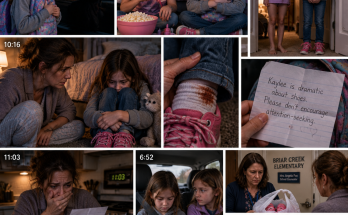
Later, after she left, Kaylee asked me whether she would always be “the pink shoe kid.”
The phrase startled me.
“Where did you hear that?”
“Nowhere.”
“Then why say it?”
“Because everybody knows about the shoes.”
“Not everybody.”
“People in court.”
“Yes.”
“Doctors.”
“Yes.”
“School.”
“Some.”
She looked at the new pink sneakers by the door.
“What if that’s what they remember?”
I thought carefully.
“People remember what helps them understand something. The shoes were the first thing I noticed.”
“But that’s not all.”
“No.”
“What else?”
I looked at her.
“You like terrible amounts of syrup.”
She rolled her eyes.
“You cheat at cards.”
“I do not.”
“You absolutely do.”
“More.”
“You’re stubborn.”
“More.”
“You protect Mia even when she doesn’t need protecting.”
“She does.”
“You hate raisins.”
“They’re disgusting.”
“You’re good at math when you stop pretending you aren’t.”
She frowned.
“You remember every promise adults make.”
That made her quiet.
“You paint rooms terrible colors.”
“Purple is good.”
“Questionable.”
A smile.
“You’re a kid who wore pink shoes once because you were scared to take them off.”
She looked down.
“And?”
“And now you wear pink shoes because you like them.”
Kaylee considered that.
Then:
“That’s better.”
The past stayed.
But it no longer got the final definition.
Click here to continue reading: PART 39: When Kaylee Finally Read the Notebook She Had Written in Secret, She Found Proof That Even Her Own Memory Had Been Trying to Protect Her
The Sleepover Began Normally Until Kaylee Wouldn’t Take Off the Pink Sneakers She Had Worn Inside All Evening
Part 38 of 44