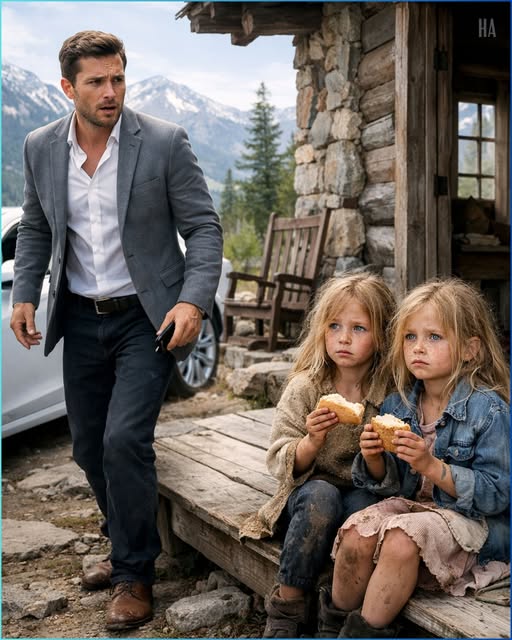
Monday morning arrived in a white county SUV.
Claire Donnelly stepped out first—mid-fifties, practical shoes, clipboard, tired eyes that had seen too much and trusted very little. A deputy came with her, polite and silent.
The girls reacted before Claire even reached the steps.
June and Joy moved behind Mason so fast they nearly tangled each other, each grabbing one of his legs with panicked force.
Claire noticed everything.
That, Mason realized immediately, was both her job and her defense.
“Mr. Sterling?” she said.
“Yes.”
“I’m Claire Donnelly with Virginia Child Protective Services. We appreciate you contacting the county promptly.”
Her tone was professional, but not cold. Merely careful.
Mason nodded once.
She glanced at the girls in his oversized shirts, then back at him. “We need to bring them in.”
June made a small broken sound. Joy pressed her face into the back of Mason’s thigh.
He crouched and turned to them. “Hey. Look at me.”
They did.
“I’m going with you,” he said.
June’s lower lip trembled. “Promise?”
“I promise.”
Claire’s gaze sharpened as she heard that. She wrote something down.
The drive to Roanoke felt longer than the four hours from Charlotte. Mason followed the county vehicle in his black SUV, knuckles white on the steering wheel, rage and fear mixing into something almost adolescent in its helplessness.
At the intake center, he spent nine hours in waiting rooms, offices, and conference cubicles with bad coffee and fluorescent lighting. He learned the words emergency placement, temporary custody, interstate review, unverified identity, abandonment case. He learned that no missing persons report matched. No birth certificates surfaced. No hospital records fit. No adult had yet come forward.
He also learned that the system, while not malicious, was built to distrust sudden attachment from wealthy men who appeared out of nowhere with expensive watches and intense promises.
By evening he had retained the best family attorney in western Virginia and set two private investigators to work.
Claire Donnelly watched him from across a hallway and finally said, “Most people say they’ll follow through. They don’t.”
Mason turned to her. “I’m not most people.”
“No,” Claire said. “That much I believe.”
The next two months consumed him.
He returned to Charlotte only when necessary, conducting board meetings by video and handing operational authority to his COO with the kind of clarity he once reserved for hostile market conditions. The board, predictably, objected.
“You want leave because of two unidentified children found in another state?” one director demanded.
Mason, standing at the head of the conference table in the office he had barely entered for a year, looked at the man long enough to make him uncomfortable.
“Yes.”
“This is not rational.”
“No,” Mason said. “It’s not. It’s more important than rational.”
By the end of the meeting, nobody argued.
He visited June and Joy every day they would allow it. He brought picture books, stuffed animals, tiny sneakers, fruit, hair ties, crayons, a stuffed fox Joy named Pine and a stuffed rabbit June renamed three separate times in one afternoon. He learned that June liked blueberries but hated peas; that Joy disliked loud voices; that both girls fell asleep more easily if someone read in a calm voice instead of singing.
The staff at the temporary foster center began to look at him differently.
At first he was an unusual benefactor.
Then he was a fixture.
Then he was the man the girls ran to.
One afternoon, as he knelt to zip June’s jacket after an outdoor play session, she cupped his face in both hands and asked with devastating seriousness, “You come back tomorrow?”
“Yes.”
“And the next day?”
“Yes.”
“The next day too?”
He smiled, though his throat had gone tight. “Yes, June.”
Joy, standing nearby, took his hand.
That was her version of asking the same question.
Not long after, one of the older nurses stopped him in the corridor.
“Mr. Sterling,” she said quietly, “I don’t usually say things like this to prospective placements. But in fifteen years I have never seen children attach to someone this fast unless something in them is answering something in him.”
Mason looked past her toward the playroom window, where June and Joy were pressing stickers onto construction paper with grim concentration.
The nurse followed his gaze. “They don’t just feel safe with you. They expect you.”
Those words stayed with him.
So did the legal obstacles.
Virginia questioned his residence in North Carolina. The court questioned whether a man still in grief therapy should assume custody of traumatized children. Social services wanted home studies, background checks, psychological evaluations, financial disclosures, parenting plans, pediatric contingencies, live-in support arrangements. Mason gave them everything. He hired a child therapist. He modified bedrooms. He consulted trauma-informed specialists. He installed gates, cabinet locks, blackout curtains, softer nightlights, child-height shelves full of books and puzzles.
He approached the process the only way he knew how at first: methodically, relentlessly.
But underneath the structure was terror.
Because somewhere in those weeks, the possibility of losing them had become unbearable.
The clue came from the porch.
A storm rolled through the mountain on a cold October afternoon, the kind of rain that lashed sideways and rattled shutters loose. Mason had driven up to the cabin because he could not bear Charlotte that weekend, and because after meeting the girls there, the place no longer belonged solely to memory.
The wind had torn one section of porch skirting half away. When the rain passed, Mason went outside with a flashlight and toolbox. He knelt in damp leaves, pried loose a warped board, and found a rusted metal tin shoved deep into the crawlspace beneath the steps.
At first he assumed it was old hardware.
Inside was a folded dish towel, stiff with age and damp. Wrapped in it were three things:
A small silver locket.
A photograph.
And a letter in a woman’s trembling hand.
Mason read the first line and had to sit down on the wet porch.
If this is Mason Sterling, then I am sorry for leaving them this way.
The rest he read twice.
The writer’s name was Lena Brooks.
Years earlier, while hiding from an abusive man named Caleb Voss, Lena had lived for a time at a women’s refuge in the Blue Ridge called Sparrow House. Beatrice Sterling had volunteered there quietly during her treatment, never using the foundation name, never bringing cameras or press. She had met Lena while Lena was pregnant with the twins.
According to the letter, Beatrice had returned more than once.
She had brought diapers, books, groceries, money, and the kind of attention that does not make poor people feel studied. When Sparrow House later lost its lease and some residents dispersed off-grid rather than risk being found by violent partners, Beatrice had given Lena the mountain house address and a spare key.
She said if danger ever got close and I had nowhere left to run, this porch belonged to mercy, the letter read.
She said her husband was a good man even if grief ever made him forget it.
Mason shut his eyes hard.
Rain dripped from the porch roof. The mountains exhaled mist into the clearing.
The letter explained the missing records. Caleb Voss was the son of Victor Voss, a wealthy developer with enough local influence to make police reports disappear into apathy. Lena had left before formal prenatal care. The twins had been born with the help of two older women from the refuge, under aliases, while Lena hid from the Voss family. No legal father. No clean trail. A life built from avoidance and fear.
Weeks before Mason found them, Lena had learned Caleb had started looking for her again—less out of love than because Victor Voss was under financial pressure and desperate to tidy any scandal that might affect negotiations on a land deal. Lena fled through a patchwork of cheap motels, church basements, and rides from strangers. She got sick. Fever, coughing blood, weakness.
The last page shook so badly the writing tilted.
I think I waited too long. I think I am dying. The girls still have the bread I saved from the last loaf because I needed them to hold something while I made them walk. If I can get them to your porch, maybe they live. If I don’t, tell them I did not leave because I stopped loving them. I left because I ran out of body.
At the bottom was a postscript.
Beatrice told me once that some families are made by birth and some by who opens the door. If you are reading this, then maybe she was right.
Mason lowered the pages slowly.
Behind the letter lay the photograph.
It showed Beatrice on the cabin porch, thinner than he remembered her being that final summer, one hand over her hair against the wind. Beside her stood a pregnant young woman Mason did not recognize—Lena—and on the back, in Beatrice’s handwriting, were five words:
For when mercy finds you.
Mason stared at the words until the ink blurred.
For the first time since Beatrice’s death, grief did not feel like an anchor dragging him under.
It felt like a bridge.
The letter changed everything.
Claire Donnelly read it twice in silence. Mason’s attorney, Evelyn Hart, used it to petition for emergency review of paternal claims and to reopen old incident reports involving Caleb Voss. The private investigators, finally armed with a real name, moved faster than state systems could.
They found enough.
Enough witness statements from former Sparrow House residents. Enough evidence of stalking. Enough transfers of cash from Victor Voss to local deputies who never filed formal charges. Enough to paint a clear picture: Caleb had terrorized Lena for years, denied the twins when it suited him, and only resurfaced when rumors of abandoned children near Voss-owned development land threatened to connect back to him.
Then Caleb made the mistake of filing a late custody petition.
He arrived at the preliminary hearing in a navy suit and a smile Mason recognized instantly: entitled men wear versions of the same face.
Tall, handsome in the brittle way of men who mistake charm for character, Caleb Voss looked more irritated than emotional.
Mason saw June and Joy in the waiting room through the glass of a family services office, each coloring at a tiny table while a case aide sat with them. He turned back as Caleb approached.
“You must be Sterling,” Caleb said. “The rescuer.”
Mason did not offer his hand. “You mean the man who answered the door?”
Caleb’s smile thinned. “Careful. You’re emotionally involved. That makes people sloppy.”
“You abandoned them.”
“I never got the chance to know whether they were mine.”
Mason took one step closer. He did not raise his voice. That made it worse.
“The mother ran from you across three counties without taking them to a hospital because she was more afraid of being found than of giving birth off the books. So let’s not pretend this is about fatherhood.”
Caleb’s eyes hardened. “This is about you trying to buy a family.”
Mason felt the insult land and burn.
Then he thought of June asleep against his shoulder. Joy’s hand on his in the kitchen. The bread in their fists.
“No,” Mason said. “This is about me being willing to become one.”
Inside the courtroom, the hearing stretched through the morning.
Claire testified first. She described finding the girls terrified of separation from Mason and increasingly regulated in his presence. The foster center nurse testified next, then the child therapist, who carefully stated that while adoption decisions were legal matters, the twins showed a rare depth of trust with Mason and significant fear around discussion of unknown men.
Caleb’s attorney tried to reduce Mason to type: wealthy widower, unresolved grief, impulsive attachment. A man projecting his dead wife onto found children.
Evelyn Hart stood and dismantled the narrative piece by piece.
Yes, Mason had grieved. He had also remained in treatment, submitted fully to evaluation, reorganized his life, reduced professional obligations, built support systems, and demonstrated consistent caregiving for months.
Yes, he was wealthy. That mattered less than the evidence that he showed up every day.
Then Evelyn introduced Lena’s letter, the photograph, and witness affidavits from former Sparrow House staff who identified Beatrice and confirmed Lena’s history with Caleb.
By the time the judge asked Caleb whether he had ever provided financial support, sought legal acknowledgment, or filed any report regarding the girls before the abandonment case became public, the man had lost his composure.
“This is absurd,” Caleb snapped. “Those kids were hidden from me.”
“By a woman,” Judge Eleanor Whitcomb said coolly, “who apparently feared you enough to disappear off the map.”
Victor Voss himself appeared in the back row halfway through the hearing, silver-haired and furious, but old power looked strangely weak in family court under fluorescent lights.
The final blow came from an unexpected place.
Claire Donnelly, recalled briefly to clarify placement preference, set down her notes and said, “For the record, Your Honor, I was skeptical of Mr. Sterling. Men with money often think systems are inconveniences. Men with grief sometimes confuse rescue with replacement. I do not think that is what is happening here.”
The room quieted.
She continued, “These children have had almost no reliable constants. Mr. Sterling has become one. In my professional opinion, removing that bond now in favor of a biological claimant with a documented history of coercive abuse would not serve their welfare.”
Mason did not realize he had stopped breathing until Evelyn touched his sleeve.
The judge recessed.
When court resumed, Caleb Voss’s petition was dismissed pending further investigation, and his contact with the twins was suspended entirely.
Mason didn’t celebrate.
Not yet.
Because the victory he wanted had not happened.
Not until weeks later, after home studies cleared, interstate placement approved, and every remaining obstacle had been argued into dust.
Not until a bright Tuesday morning in December, when Judge Whitcomb signed the adoption decree and looked over her glasses at him.
“Mr. Sterling,” she said, not unkindly, “these girls found the right porch. Do not make me regret believing that.”
Mason’s voice failed him the first time he tried to answer.
“I won’t,” he managed at last.