On the courthouse steps, June and Joy came running the moment the social worker released their hands.
By then they wore matching wool coats and little boots with stars near the ankles. They hit him with enough force to nearly knock him backward. He dropped to one knee and gathered them both, arms locking around their tiny bodies while everything in his chest gave way at once.
“It’s done,” he whispered into their hair. “You’re coming home.”
June pulled back first, eyes huge. “Forever?”
“Forever.”
Joy studied his face carefully, as if checking for cracks. “Really forever?”
He put a hand to each cheek. “Really.”
June leaned in until their foreheads touched. “So you’re our daddy now?”
All the air left him.
For one strange, suspended second, he thought of the man he had been before grief hollowed him out. Then of the man he had been after. Then of Beatrice on that porch with Lena, writing words he would not read until years later.
He heard himself answer in a voice rough with wonder.
“Yes,” he said. “I’m your daddy.”
June smiled first. Joy second, slower and deeper.
Then both girls yelled, “Daddy!” loud enough to startle two attorneys and an elderly bailiff halfway down the steps.
Mason laughed so hard he cried.
The Charlotte house did not become warm all at once.
That would have been too easy, too cinematic. Real homes heal by accumulation.
By juice boxes left half-finished on side tables. By fingerpaint on expensive paper. By toy animals beneath grand pianos. By one bedroom lamp replaced with a moon-shaped night-light because Joy said the dark in big houses felt different. By June insisting every stuffed animal required a blanket. By Mason learning how to brush hair without pulling too hard and how to explain, for the sixth time in one week, why pancakes cannot be dinner every night.
The mansion that grief had emptied became inconvenient, noisy, smeared, interrupted.
It became perfect.
There were setbacks. Nightmares. Sudden crying when a stranger’s cologne smelled wrong. Joy’s silence on certain days. June’s panic if Mason was ten minutes late getting home. There were therapy appointments, doctor visits, legal follow-ups, kindergarten evaluations, and one memorable disaster involving glitter in an air vent that no amount of wealth could solve quickly.
Through it all, Mason kept seeing Dr. Hale.
One evening in January, he sat in the familiar leather chair and said, “I don’t know what to do with the fact that Beatrice knew. That she met their mother. That she left that thread waiting.”
Dr. Hale listened.
Mason rubbed a hand over his jaw. “Part of me thinks it was chance. Part of me thinks she somehow set a lighthouse burning before she died. And part of me is afraid if I give it too much meaning, I’ll stop dealing in reality.”
Dr. Hale smiled faintly. “You built your life on the belief that only what can be controlled is what can be trusted.”
“That belief made me rich.”
“And nearly destroyed you.”
Mason looked away.
The doctor continued, “Meaning does not have to be superstition. Your wife was a compassionate woman. She helped someone in danger. Years later, that act returned to your life when you were finally forced to step back toward the place that held her memory. That is not magic. It is the long reach of love.”
Mason let that sit between them.
Then he nodded once.
In spring, he took the girls to the mountain house again.
They remembered more than he expected.
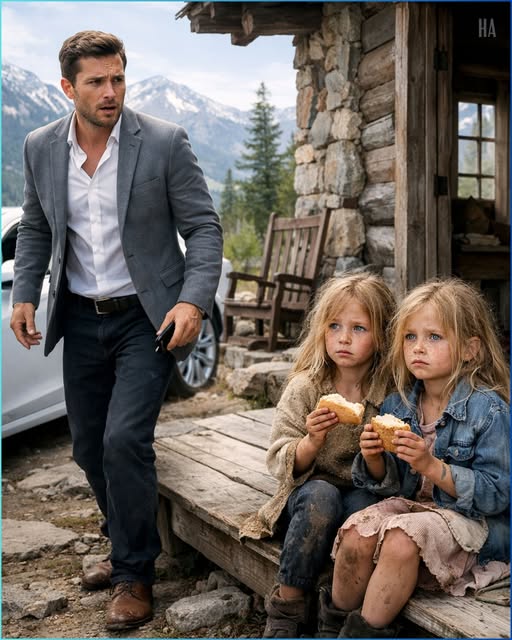
June jumped out of the car and shouted, “Our porch!” as if she owned the deed. Joy stood very still for a moment, staring at the steps where she had once stood with bread in her hand, then slipped her fingers into Mason’s.
He squeezed gently.
Inside, the cabin no longer felt haunted.
It still held Beatrice. Of course it did. Her favorite mug was still in the second cupboard. Her gardening gloves still hung from a hook by the mudroom door. Her novels still lined the bedroom shelf with bent spines and penciled notes in the margins.
But memory had changed temperature.
It no longer froze the room.
That afternoon the girls played in the meadow while Mason sat on the porch steps with the rusted tin beside him. He had repaired it enough to keep it closed. Inside were Lena’s letter, the photograph, and the small silver locket. He had finally opened the locket weeks earlier.
Inside was a picture of June and Joy as newborns, red-faced and swaddled, one with her mouth open in outrage, the other sleeping through it.
On the opposite side was a single line in tiny print, almost too worn to read.
Find the kind ones.
Mason closed the locket and watched his daughters race each other through tall grass.
“Daddy!” June called. “Look how fast!”
“I’m looking.”
Joy, always more deliberate, wandered back to the porch and sat beside him. After a while she leaned against his arm.
“Was this where Mama brought us?”
Mason was careful with truth now. Children deserved honesty shaped for their age, not comforting lies that later hardened into mistrust.
“Yes,” he said. “Your first mama brought you here because she wanted you safe.”
Joy thought about that. “And then you opened the door.”
“Yes.”
She nodded as if a complicated equation had finally balanced. “Good.”
June came running back and climbed into his lap even though she was getting too big for it. “Can we leave snacks on the porch?”
“What kind of snacks?”
She looked scandalized by the question. “For anybody lost.”
Mason stared at her.
Joy added, “So if someone’s hungry, they know this house is nice.”
He looked from one girl to the other. Their hair had grown longer. Their cheeks were fuller now. Their eyes were still that impossible shade of sea green. They no longer looked like ghosts dropped by the woods. They looked like children who expected the world to answer them with care.
And suddenly he understood that this, more than the legal decree or the new bedrooms or even the word Daddy, was the clearest proof of healing:
they wanted to pass safety on.
His vision blurred.
“Yeah,” he said softly. “We can do that.”
So they made a small plate of buttered bread and apple slices and set it on the porch rail as dusk settled over the mountains. It would probably be eaten by raccoons or birds before midnight. That wasn’t the point.
The point was the offering.
The point was that once, two little girls had arrived at that door with almost nothing, and now they wanted the door to remain open in spirit even when it was shut in wood.
As twilight deepened, Mason stood at the edge of the meadow with June on one side and Joy on the other. The sky bruised purple above the ridge. Fireflies began to appear in the grass like tiny signals.
Behind them, the cabin glowed gold through the windows.
Ahead of them, the mountain darkened into night.
He thought of Beatrice. Of Lena Brooks. Of Dr. Hale telling him grief was not a place to live forever. Of the man he had been when he first drove up that road, wanting only silence.
He had once believed the great tragedy of his life was that love had left him.
Now he knew better.
Love had changed forms. That was all.
It had moved through a hospital room, through a frightened young mother, through a hidden letter under a porch, through two tiny fists clutching bread, through the stubborn decision to keep showing up.
Somewhere in the deepening dark, June yawned. Joy pressed closer to his side.
“Daddy?” June murmured.
“Yeah, baby?”
“Can we come here every year?”
Mason looked at the porch where the plate of bread rested in the fading light.
“Yes,” he said. “Every year.”
Joy tipped her head back to study him. “Even when we’re big?”
He smiled. “Especially then.”
They stood together until the stars came out over the Blue Ridge, three figures stitched into one shadow on the grass.
And for the first time in many years, Mason Sterling did not feel like a man who had survived loss.
He felt like a father walking home.