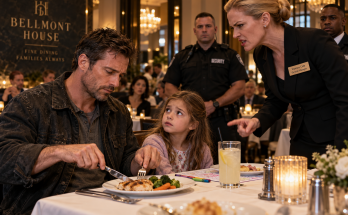
Toby sold the company six months later.
Not because he had to.
Because he wanted to.
The buyer retained all twenty-three employees.
Toby stayed for a year as operations director.
He negotiated carefully.
Used his own lawyer.
His own accountant.
Read every page.
Then called me after signing.
“It’s done.”
“How do you feel?”
“Terrified.”
“Good.”
“Good?”
“Means you understand you made a real decision.”
“I was hoping for maternal reassurance.”
“You can have some tomorrow.”
He laughed.
Paige supported the sale without managing it.
That distinction pleased both of them.
Their marriage did not become perfect.
They argued.
Sometimes about money.
Sometimes about Sherry.
Sometimes about whether Toby left cabinet doors open because he was careless or because he enjoyed irritating his wife.
They learned to disagree without recruiting third parties.
That was more impressive to me than romance.
Sherry remained incarcerated.
Paige visited periodically.
Toby eventually went once.
He did not tell me what they discussed.
I did not ask.
Gregory and Paige kept rebuilding slowly.
No grand reconciliation.
He missed one lunch.
Called.
Apologized.
Rescheduled.
Ordinary reliability became its own kind of repair.
Harold finally retired.
For eleven days.
Then began consulting for the Clear Choice Project twice a month.
I accused him of fraud.
“This is not retirement.”
“It is reduced billing.”
“You’re billing us?”
“Of course.”
I threatened to fire him.
He asked me to read the termination clause.
We were fine.
Ruth remained my North Cape representative until the final redemption installment cleared.
Then she resigned the same afternoon.
“No sentimental extension,” she said.
“You could stay.”
“No.”
“Why?”
“Because the job is done.”
A clean boundary.
I respected it.
North Cape survived in smaller form.
No Raven Creek.
No marina.
No road.
The profitable warehouse and infrastructure businesses continued under new management.
The old development parcels were sold or transferred into conservation and ordinary residential holdings under court-approved restructuring.
Jonathan’s name disappeared from management documents.
Not history.
That was different.
The historical correction remained public.
Leon’s thirty percent.
My succession.
The concealed notice.
The invalid transfer.
Facts.
No mythology required.
The cabin stayed.
I repaired the porch.
Replaced the roof.
Removed an ugly carpet Leon had defended for reasons no civilized person could understand.
Toby complained.
“Dad loved that carpet.”
“Your father was wrong.”
“History should preserve his mistakes.”
“I took a photograph.”
“Cruel.”
Mara’s lot stayed mostly wild.
The Clear Choice building settled into the trees.
No giant sign.
Just a small marker near the trail.
CLEAR CHOICE PROJECT.
Information before obligation.
That line was Paige’s.
I liked it.
The project helped people review contracts, understand fiduciary authority, find independent counsel, and recognize coercive financial patterns.
It did not tell people what decision to make.
That mattered to me.
A woman might decide to give property to her child.
Fine.
A man might choose to co-sign a loan.
Fine.
Someone might grant power of attorney to a sibling.
Fine.
The goal was not to make people suspicious of family.
It was to make sure family love did not substitute for informed consent.
Choice without information was often theater.
Information without freedom was not much better.
On Toby’s forty-second birthday, he called me.
“What are you doing tonight?”
“Depends.”
“Dinner.”
“Where?”
“My house.”
“Who?”
“Me. Paige. You.”
“That’s it?”
“Yes.”
“No Harold?”
“He invited himself.”
“Then four.”
“Helen heard Harold was coming.”
“Five.”
“Gregory is bringing pie.”
“Six.”
Toby sighed.
“This is why guest lists become dangerous.”
I laughed.
“Should I bring anything?”
“No.”
“Are you sure?”
“Yes.”
“What time?”
“Six.”
“Where am I sitting?”
Silence.
Then Toby said, “Wherever you want.”
I smiled.
“Good answer.”
His house smelled like roast chicken when I arrived.
Paige opened the door.
“Happy Toby Day.”
“Is that what we call it?”
“He objected to birthday.”
“Why?”
“He says birthdays have a bad brand now.”
From the kitchen, Toby shouted, “I can hear you.”
“Good.”
The table was round.
I noticed immediately.
No head.
No end.
No seat more important than another.
I wondered whether Toby chose it deliberately.
Then decided not to ask.
Sometimes symbolism could remain accidental.
Harold arrived carrying wine.
Helen criticized it.
Gregory brought pie.
Dalton stopped by briefly with a card and refused dinner because he had plans with his grandchildren.
That was good too.
Not everyone needed to remain permanently attached to our story.
We ate.
No one mentioned North Cape for almost an hour.
A record.
Then Harold ruined it.
“Did I tell you the final archive transfer was approved?”
Everyone groaned.
“What?” he asked.
“You’re retired,” I said.
“I am socially sharing.”
“You are billing us emotionally.”
Toby pointed his fork.
“No property law on my birthday.”
Harold surrendered.
Paige changed the subject.
She had received a letter from Sherry.
Sherry was taking bookkeeping courses through a prison education program.
The irony was so complete nobody knew whether to laugh.
Helen finally did.
Then all of us.
Paige smiled.
“She says she wants to understand the rules she spent years breaking.”
Gregory looked down.
“That sounds like her.”
Paige glanced at him.
“You don’t have to defend her.”
“I’m not.”
“Good.”
Then Gregory added, “She was always excellent with numbers.”
Paige laughed again.
No tension followed.
Old relationships could be mentioned without taking over the room.
After dinner, Toby brought out cake.
Forty-two candles would have been ridiculous.
He used two.
One shaped like four.
One shaped like two.
“Economical,” I said.
“I’m financially responsible now.”
“Debatable.”
He cut the cake.
Then paused.
“Wait.”
My body reacted before my mind.
The old reflex.
Something unexpected.
Toby disappeared into the hall.
Returned carrying a thin folder.
I stared.
“No.”
Everyone laughed.
“What?” he asked.
“No folders.”
“It’s not legal.”
“I don’t care.”
“Mom.”
He handed it to me.
I opened it carefully.
Inside was the original guest list from his fortieth birthday.
Not a copy.
The actual sheet recovered from Sherry’s house.
Twenty-four names.
Mine crossed out.
REMOVE — WILL COMPLICATE PAYMENT.
I had not seen the physical page since the investigation.
My chest tightened.
“Why do you have this?”
“Evidence release.”
“Why bring it tonight?”
Toby looked nervous.
“I wanted to ask what you want done with it.”
Not tell me.
Ask.
I stared at the paper.
For years, objects had acquired power because people hid them.
The blue folder.
The cassette.
The ledgers.
The keys.
The guest list.
This piece of paper had once felt like proof I did not belong.
Now it looked cheap.
Ordinary printer paper.
Black ink.
Someone’s ugly handwriting.
“What are my options?”
Toby smiled slightly.
“Keep it.”
“No.”
“Archive it.”
“No.”
“Give it to Clear Choice as educational material.”
“Absolutely not.”
“Burn it?”
I looked up.
“Can we?”
Harold immediately said, “If it has been formally released and no preservation obligation remains.”
Helen stared.
“Did you memorize the evidence notice?”
“Yes.”
“You need hobbies.”
We went outside.
Toby brought a metal fire bowl.
Paige found matches.
Harold insisted on photographing the document first because Harold was still Harold.
Then he nodded.
“Proceed.”
I held the page.
The crossed-out name was visible.
Mara.
One black line through it.
I expected some dramatic feeling.
Instead I thought about how much power I had given that line.
Not because I was foolish.
Because exclusion hurts.
Because sons matter.
Because tables matter when they tell you whether someone expects you.
I handed the paper to Toby.
He looked surprised.
“You do it.”
“Why me?”
“You crossed me out by agreeing not to look.”
His face tightened.
I continued before guilt swallowed him.
“And you looked again.”
He nodded.
Then held one corner over the flame.
Paper curled.
Ink darkened.
The line through my name disappeared first.
Then the names.
Then the note.
Ash folded inward.
Nobody spoke.
I did not make a wish.
Did not forgive anyone again.
Did not declare closure.
The paper burned because we no longer needed it.
That was enough.
Back inside, Paige cleared plates.
Gregory dried dishes without being asked.
Helen stole another piece of cake.
Harold complained that burning historical documents offended him spiritually.
Toby handed me a container of leftovers.
“For tomorrow.”
“Thank you.”
Then he hesitated.
“What?”
“Nothing.”
“Toby.”
He smiled.
“I was going to ask if tonight made up for forty.”
“It doesn’t.”
His smile faded slightly.
Then I touched his cheek.
“It doesn’t have to.”
He understood.
Good things did not erase bad ones.
They simply became true too.
He hugged me.
Not long.
Not desperate.
Then let go.
On my drive home, I passed the turn toward Larks Hall.
I did not slow.
The building no longer felt like the center of anything.
At home, I put the leftovers in the refrigerator.
Made tea.
Opened the back door.
Night air moved through the kitchen.
The house was quiet.
Not lonely.
Quiet.
My revised estate folder sat on the shelf.
Plain label.
MARA HUITT — CURRENT DOCUMENTS.
No blue mystery folder.
No instructions from beyond the grave.
Toby knew where it was.
Harold had copies.
Paige knew which documents concerned her.
Ruth knew the financial structure.
Nothing important depended on one person remembering a secret.
I turned off the kitchen light.
Then noticed an envelope on the counter.
Not mysterious.
I had put it there myself.
The final confirmation from North Cape.
Redemption complete.
All scheduled payments satisfied.
My remaining temporary oversight interest terminated.
Permanent conservation restrictions recorded.
Fraudulent Huitt business liens released.
Historical ownership correction filed.
The last administrative pieces were done.
I had read it already.
Still, I opened it once more.
Not because I distrusted anyone.
Because reading what you sign had become a habit I intended to keep.
Everything was correct.
I filed it.
Closed the drawer.
No music played.
No one applauded.
The next morning, I drove to the lake.
The cabin porch was damp from overnight rain.
I made coffee and carried it outside.
Across the water, sunlight touched the trees around Mara’s lot.
The Clear Choice building was hidden from this angle.
Good.
The land still looked like land.
A boat moved slowly along the far shore.
Somewhere behind me, the repaired step creaked.
I made a mental note to call the carpenter.
Ordinary problem.
Ordinary solution.
I thought about Leon.
Not the investigator.
Not the investor.
Not the man whose handwriting had become evidence.
My husband.
The person who snored when exhausted and burned toast and hid things because he thought carrying fear alone was an act of love.
I missed him.
I was still angry with him.
Neither feeling asked permission from the other.
“Took me a while,” I said quietly.
The lake did not answer.
I smiled.
That was fine.
Then I thought of Toby at forty.
Standing inside Larks Hall.
Letting someone else decide which relationships were inconvenient.
I thought of Toby at forty-two, handing me the old guest list and asking what I wanted done with it.
Change rarely announces itself.
Sometimes it is only a different question.
Sometimes it is someone waiting for the answer.
My phone buzzed.
A message from Toby.
`Did you take my cake container?`
I typed:
`You gave it to me.`
Three dots appeared.
`That does sound like something I’d do.`
I smiled.
Then another message.
`Lunch Sunday?`
I answered:
`Yes.`
A moment later:
`My place or yours?`
I looked across the lake.
No deadline.
No hidden purpose.
No correct answer.
`Mine.`
He sent a thumbs-up.
That was all.
I put the phone away.
Coffee in hand, I sat at the small porch table.
There were two chairs.
One remained empty.
I did not fill it for Leon.
Did not reserve it for Toby.
Did not treat emptiness as rejection.
It was simply a chair.
If someone came, they could sit.
If nobody came, the morning would still be mine.
And for the first time in longer than I could measure, nothing about that felt incomplete.
The End
Read more original stories on Feel Every Story.
I Planned My Son’s Fortieth Birthday With Twenty-Four Chairs, Until Someone Quietly Decided Mine Was the One They Could Remove
Part 47 of 47