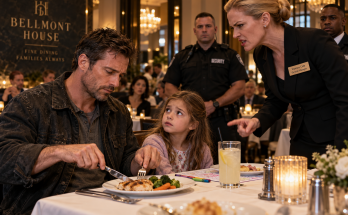
Six months after Bellmont House reopened, Daniel stood in another courtroom.
This time Sophie knew where he was.
“Bad people court?” she had asked over breakfast.
Daniel said that was not exactly the official name.
She preferred hers.
Arthur’s sentencing came first.
The prosecution described decades of fraud.
Corporate manipulation.
Obstruction.
Surveillance.
The conspiracy surrounding Anna’s crash.
The deliberate delay in emergency assistance.
Arthur’s guilty plea and later cooperation mattered.
So did the harm.
Victim statements were allowed.
Daniel had written one.
Then deleted it.
Written another.
Deleted that too.
Eventually he submitted four paragraphs.
No speech about revenge.
No demand for a particular sentence.
He described Anna.
Not as evidence.
Not as Mrs. Mercer.
Anna.
She hated overripe bananas.
She sang badly.
She stole cake.
She closed her laptop when Sophie entered because she believed children should know when they had someone’s attention.
Then Daniel wrote:
The defendants treated her life as one variable among money, evidence, control, and exposure. Whatever sentence the court imposes, I ask that the record remain clear about that choice.
That was enough.
Claire submitted her own statement.
Lauren did too.
Daniel did not read Lauren’s beforehand.
In court, she appeared by video and spoke directly.
“Arthur Bennett raised me to believe being useful was the closest thing to being loved.”
Arthur closed his eyes.
Lauren continued.
“That explains some of what I became. It does not excuse what I did.”
Daniel listened.
She acknowledged helping manipulate trusts.
Targeting Daniel.
Planning control of Sophie.
Creating circumstances where physical harm became possible.
She did not ask the court to treat her as Arthur’s victim instead of a defendant.
She asked only that both truths be preserved.
Daniel respected that.
Arthur received a sentence that meant he would likely spend most, perhaps all, of his remaining life in federal custody.
Daniel felt no celebration.
When marshals led Arthur away, Arthur looked back once.
Daniel did not wave.
The door closed.
That was all.
Vale’s case followed weeks later.
His cooperation reduced some exposure but not the central consequences.
Delaney’s sentencing would take longer because his testimony continued in related prosecutions.
Peter Shaw pleaded guilty to charges connected to emergency-response interference.
Gregory entered a plea covering financial misconduct, obstruction, and concealment.
Evelyn accepted responsibility for her role.
Vanessa faced no charges in Anna’s death conspiracy, though Bellmont permanently terminated her employment for misconduct and she resolved separate employment-related claims.
Thomas Bell cooperated in the document-fraud cases.
Marcus Whitmore resigned as CFO.
The independent review found no evidence he participated in Anna’s death scheme, but it confirmed undisclosed Brightwater conflicts and failures to report irregularities.
Daniel accepted his resignation.
No secret settlement.
No quiet return.
Richard remained general counsel only long enough to complete the restructuring.
Then he surprised Daniel.
“I’m leaving.”
Daniel stared.
“Why?”
“Because Bellmont needs counsel who did not spend years inside the old system.”
“You helped expose it.”
“I also missed things.”
“So did everyone.”
“Yes.”
Richard smiled.
“But I want the governance changes to mean something.”
Daniel disliked it.
Which probably meant Richard was right.
“Where are you going?”
“Teaching.”
Daniel laughed.
“You?”
“Apparently universities have low standards.”
“What?”
“Corporate governance.”
Daniel laughed harder.
Richard looked offended.
“I know things.”
“You certainly know what not to do.”
“Exactly.”
They shook hands.
Then Daniel hugged him.
Richard froze.
“This is inappropriate executive conduct.”
“File a complaint.”
“I helped design the system. I will.”
Richard left two months later.
Bellmont hired independent outside candidates and selected Maya Chen as general counsel.
She had never worked for the Mercer family.
That was the strongest qualification Daniel could imagine.
Harrison Fiduciary survived only in name.
Regulators dismantled much of its old structure.
Court-supervised receivers sold several divisions.
The trust administration unit was rebuilt under independent ownership.
The gray ledgers became evidence in multiple cases.
Charles Rourke’s old mechanisms were formally terminated.
Lauren’s fourteen-million-dollar Beatrice restitution remained under independent management while her criminal case proceeded.
She eventually entered a plea to fraud, conspiracy, and offenses connected to the Sophie plans.
Her sentence reflected both serious conduct and extensive cooperation.
Daniel attended.
He did not speak.
Afterward, Lauren asked through counsel whether Sophie was well.
Daniel answered through counsel.
She is.
Nothing more.
Boundaries did not require cruelty.
They also did not require intimacy.
Gregory asked to meet Daniel before sentencing.
Daniel refused.
Then changed his mind three days later.
Not because Gregory deserved it.
Because Daniel wanted one question answered face-to-face.
They met inside a supervised legal facility.
Gregory looked older.
He sat opposite Daniel.
Neither offered a handshake.
Daniel asked:
“Why did you stay after Peter told you about the ambulance?”
Gregory closed his eyes.
“I was afraid.”
“I know.”
“That’s the answer.”
“No.”
Daniel leaned forward.
“You were afraid before. You were afraid after. Why stay?”
Gregory thought for a long time.
“Because leaving would have meant admitting what I had already become.”
Daniel sat back.
There.
Not family.
Not blackmail.
Not Peter.
Identity.
Gregory had continued because stopping required looking directly at himself.
Daniel understood why that mattered.
“How many times did you tell yourself you would fix it later?”
Gregory laughed bitterly.
“Every day.”
Daniel stood.
Gregory looked up.
“Do you forgive me?”
“No.”
The answer came easily.
Gregory swallowed.
“Will you ever?”
“I don't know.”
Daniel meant it.
Not punishment.
Not promise.
Uncertainty.
He left.
Bellmont changed more slowly than headlines suggested.
Some reforms worked immediately.
Others did not.
The employee complaint system initially produced so many reports that managers complained it encouraged trivial grievances.
Daniel’s response was simple.
“Good.”
Some complaints were trivial.
Some were not.
The point was nobody had to guess whether speaking would cost them a shift.
Teresa remained at Bellmont House.
Emily eventually accepted training for a supervisory position after almost a year.
Not because Daniel offered it.
Teresa did.
Emily made Daniel promise he would not interfere.
He promised.
Marcus Reed moved into corporate safety oversight full-time.
His first policy document was titled:
REMOVAL REQUIRES REASON.
Daniel approved it without edits.
Bellmont House became profitable again.
Not spectacularly.
Steadily.
Corporate communications wanted to advertise the restaurant’s transformation.
Daniel refused.
“Let guests decide.”
Reviews returned.
Some excellent.
Some mediocre.
One person complained the chocolate cake was dry.
Sophie considered that a corporate emergency.
Daniel disagreed.
The company survived.
That was the point.
One year after the night at booth seventeen, Daniel returned with Sophie.
No anniversary event.
No cameras.
They did not reserve booth seventeen.
They reserved a table.
Any table.
Priya seated them near the window.
Sophie was ten now.
Taller.
More opinionated.
She carried a book instead of crayons.
Daniel noticed.
“No drawing?”
“I’m ten.”
“You can draw at ten.”
“That is embarrassing.”
“Yesterday you drew a horse.”
“That was different.”
“It looked like a dog.”
She glared.
Some things remained stable.
They ordered.
Sophie still wanted chicken.
Still wanted chocolate cake.
Daniel tried something new.
Halfway through dinner, a woman at the neighboring table complained loudly about waiting for her entrée.
Teresa came over.
Apologized.
Fixed it.
No special categories.
No panic.
No owner involvement.
Daniel kept eating.
Sophie whispered:
“Are you going to do boss thing?”
“No.”
“Why?”
“Teresa has it.”
Sophie nodded.
Growth, apparently, could be measured by not inserting yourself into restaurant complaints.
After dessert, Sophie asked to see booth seventeen.
A couple sat there.
Daniel pointed.
“Occupied.”
“We can wait.”
“For what?”
“So I can see it.”
“You have seen it.”
“I want to sit there.”
“Why?”
She shrugged.
“Memory.”
Daniel looked at her.
She remembered more than he sometimes wanted.
They waited in the lobby after paying.
Eventually the couple left.
Teresa allowed Daniel and Sophie to sit for five minutes before the next reservation.
Sophie slid into the booth.
Daniel sat opposite.
For a moment neither spoke.
Then Sophie touched the wall.
“Is the secret thing still there?”
“Compartment?”
“Yes.”
“Sealed.”
“Good.”
“Why good?”
“No more papers.”
Sophie nodded.
She looked around.
“Mom sat here?”
“Yes.”
That part Daniel had told her carefully.
“Before us?”
“Yes.”
“Did she eat cake?”
“I don't know.”
“She probably did.”
“Probably.”
Sophie became quiet.
“Do you miss her every day?”
Daniel answered honestly.
“Yes.”
“Me too.”
They sat with that.
No lesson.
No explanation.
Then Sophie asked:
“Are you going to own Bellmont forever?”
Daniel smiled.
“Probably not.”
“Who gets it?”
“I don't know.”
“Me?”
“Only if someday you want something to do with it.”
She frowned.
“I have the land thing.”
“You do.”
“Boring.”
“Excellent.”
“What if I want to be a veterinarian?”
“Then be a veterinarian.”
“What if I want restaurant?”
“Then learn restaurants.”
“What if I want neither?”
“Then neither.”
Sophie studied him.
“Really?”
“Really.”
She smiled.
Anna wanted her to inherit choices.
Daniel finally understood that choices required permission to disappoint expectations.
Even loving expectations.
Especially those.
They left booth seventeen before the next reservation.
No one asked the incoming guests whether they were premium.
Nobody cared what they wore.
The hostess simply checked their name.
Daniel and Sophie walked outside.
Rain had started.
Not heavy.
Enough to darken the pavement.
For a second Daniel remembered the first night.
Muddy boots.
Wet jacket.
Sophie’s frightened question.
Did we do something wrong?
He remembered Anna’s crash.
Hospital corridors.
Hidden ledgers.
Courtrooms.
Arthur.
Lauren.
Gregory.
The weight of all of it remained.
But memory was no longer an emergency.
That difference mattered.
Sophie opened the umbrella badly and hit Daniel in the shoulder.
“Careful.”
“You do it.”
He took it.
They walked toward the car.
Behind them Bellmont House continued serving dinner.
No revelation.
No confrontation.
No secret meeting.
Just people eating.
Anna had wanted boring.
Daniel smiled.
Sophie looked up.
“What?”
“Nothing.”
“You're doing weird face.”
“Apparently I have many faces.”
“Yes.”
They reached the car.
Before getting in, Sophie looked back at the restaurant.
“Dad?”
“Yes?”
“If you didn't own it, would they let us eat there now?”
Daniel looked through the windows.
At servers moving between tables.
At guests in suits.
Guests in jeans.
A family with children.
An older couple sharing dessert.
A construction worker at the bar.
He thought about everything Bellmont had changed.
Then answered:
“They should.”
Sophie frowned.
“That wasn't my question.”
Daniel smiled.
“No.”
She waited.
He looked again.
“Yes.”
Sophie nodded.
“Good.”
She climbed into the car.
Daniel remained outside for another second.
That was the measure.
Not whether Bellmont recognized its owner.
Not whether Daniel regained control.
Not whether Arthur lost.
Not whether the Mercer family kept its land.
A restaurant had once looked at a father and his daughter and decided they mattered less because of what they appeared able to spend.
Everything hidden behind that decision had been enormous.
Fraud.
Inheritance.
Corruption.
Death.
But the first wrong remained small enough for anyone to understand.
Someone had been made to feel they did not belong.
Daniel got into the car.
Sophie was already asking about breakfast.
“Pancakes tomorrow?”
“Yes.”
“Your pancakes?”
“No.”
“Good.”
He started the engine.
Rain moved across the windshield.
Bellmont House disappeared behind them as Daniel turned onto the street.
For years he had believed responsibility meant holding tightly enough that nothing could be lost.
Anna had known better.
Some things were protected by holding them.
Others by telling the truth.
Others by building rules stronger than one person.
And some by finally letting go.
Daniel drove home with Sophie beside him.
The company would continue without being the center of their lives.
The trials would continue.
The reforms would be tested.
People would make mistakes.
No structure could guarantee goodness.
But it could make cruelty harder to hide.
It could make speaking safer.
It could stop rewarding silence.
That was enough work for one generation.
And when Daniel thought about booth seventeen now, he no longer saw Vanessa standing over Sophie’s unfinished cake.
He saw Anna sitting there years earlier, leaving a clue she hoped nobody would ever need.
He saw Aaron’s family laughing in the same booth.
He saw strangers waiting for their reservation.
He saw a table.
Nothing more.
Exactly as it should have been from the beginning.
Click here to continue reading: PART 41: A Final Appeal Threatens Sophie’s Land Trust, but Daniel Refuses to Rebuild His Family’s Future Around Fear of Losing What They Own
A Rain-Soaked Father Takes His Daughter to Dinner and Learns Why So Many Guests Have Been Complaining About Bellmont House
Part 40 of 44