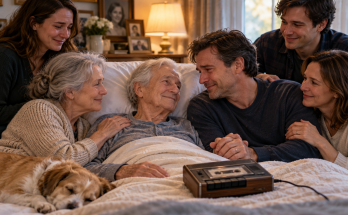
Chemotherapy was scheduled to begin the next morning.
Claire did not sleep.
Every time she closed her eyes she saw the same four words.
DO NOT ALLOW TREATMENT.
The message had been entered into the research file after Sophie’s admission. Whoever wrote it knew where Sophie was, knew what doctors planned to do, and had enough access to Samuel’s system to issue instructions.
Samuel was in custody.
Which meant the experiment had never depended on him alone.
Daniel spent most of the night in the chair beside Sophie’s bed. Around three in the morning, Sophie woke and found him watching the infusion pump that still held nothing but saline.
“You look creepy when you stare at machines.”
Daniel blinked.
“Good morning to you too.”
“It’s not morning.”
“It is technically morning.”
“That’s worse.”
She pushed herself upright, wincing when the surgical incision from the ovarian procedure pulled.
Daniel immediately stood.
“Pain?”
“Little bit.”
He called the nurse.
Sophie stopped him before he reached the door.
“Dad?”
He turned.
“If chemo makes my hair fall out, can we shave yours too?”
Daniel touched his hair.
“I’ve spent years developing this masterpiece.”
Sophie stared at him.
“You’re almost bald.”
“That was unnecessarily cruel.”
She smiled for the first time since Samuel appeared.
Claire watched from the couch.
Normality had become something they collected in seconds.
A joke.
A complaint.
A request for apple juice.
Each moment felt stolen.
At six-thirty, Dr. Shah arrived with Agent Bell.
Chemotherapy had been delayed.
Claire stood instantly.
“Why?”
Dr. Shah explained that a medication order entered overnight contained an incorrect dosage.
The pharmacy caught it before anything reached Sophie.
Daniel’s face changed.
“Incorrect how?”
“High enough to be dangerous.”
Claire stared at Bell.
“Someone tried to poison her.”
“We don’t know intent yet.”
“You have an instruction saying not to let doctors treat her, and hours later somebody changes her medication dose.”
Bell did not argue.
The order had been entered using legitimate credentials belonging to a pediatric fellow who had been home asleep.
The credentials were apparently stolen.
Hospital cybersecurity teams were investigating.
Daniel moved toward the door.
“Who has access to this floor?”
“Thousands of employees have some degree of system access,” Bell said. “Far fewer can alter oncology orders.”
“Give me the names.”
“I can’t do that.”
Daniel laughed once without humor.
“My daughter’s treatment was sabotaged.”
“And if you start confronting hospital employees, you could compromise the investigation.”
Daniel looked ready to ignore him.
Claire put a hand on his arm.
“Sophie needs you here.”
That stopped him.
Bell explained that all future medication orders would require independent verification by two physicians plus pharmacy leadership. Sophie's chart would be moved into a restricted system.
Claire asked whether paper orders would be safer.
Bell gave a tired smile.
“Right now, nothing is automatically safer.”
Dr. Shah still intended to treat Sophie that day once every medication was verified manually.
Sophie had overheard enough.
“Someone changed my medicine?”
Claire sat beside her.
“Yes.”
“To hurt me?”
“We don't know.”
Sophie looked toward the hallway.
“Was it Grandpa?”
“He’s locked up.”
“Then somebody else knows about me.”
Claire nodded.
There was no point pretending otherwise.
Sophie absorbed this quietly.
Then said, “I want a marker.”
Daniel handed her one from the table.
She wrote on the whiteboard beside her bed:
NO SECRET MEDICINE.
Underneath she added:
ASK ME FIRST.
Dr. Shah looked at the words.
“That’s reasonable.”
Sophie pointed at everyone in the room.
“All of you.”
For the next several hours the hospital became a fortress.
Federal agents stationed themselves at elevators and stairwells.
Nurses had identification checked every time they entered.
Medication bags were photographed, logged, sealed, and verified aloud.
Sophie turned the process into a game.
She read every label she could understand.
When a nurse named Jenna arrived with anti-nausea medication, Sophie asked for her full name, employee badge, and whether she had been “approved by the FBI.”
Jenna complied solemnly.
Claire almost smiled.
Then Detective Reeves arrived with another problem.
NorthStar had not merely transported pediatric samples.
Investigators had found evidence that the company maintained a hidden database linking biological samples to family medical histories.
One family appeared repeatedly.
The Hales.
Eric sat very still.
“My family?”
“Your father’s research began with relatives.”
Reeves explained that Samuel had tracked cancer across several generations. He believed conventional screening only reacted after disease appeared.
He wanted prevention before birth or shortly afterward.
Eric stared at her.
“He wanted to eliminate the mutation.”
“Yes.”
“And Sophie was the first child he treated.”
Reeves hesitated.
“No.”
Claire looked sharply at her.
“How many?”
“At least seven children received some version of the experimental vector.”
Eric stood.
“Who?”
“We’re still identifying them.”
“Did they get cancer?”
Reeves looked at Dr. Shah.
The oncologist answered carefully.
“Several developed unusual tumors.”
Claire felt the room shift.
“Several?”
“Three that we know of.”
“And the others?”
“One died in infancy from unrelated complications. Two appear healthy. One cannot currently be located.”
Sophie stared at Dr. Shah.
“So Grandpa tried to stop cancer and maybe gave people cancer.”
Dr. Shah did not soften it.
“That is one possibility.”
Sophie looked down at her hands.
“Then he’s bad at doctoring.”
Daniel exhaled.
“Among other things.”
Eric did not react.
He was focused on the list of children.
“Who was first?”
Reeves named a boy.
Aaron Hale.
Eric’s cousin.
Eric closed his eyes.
Claire knew the name.
Aaron had died when Eric was a teenager.
She remembered him mentioning childhood leukemia.
“He experimented on Aaron?”
“We believe so.”
Eric sat down.
Suddenly Samuel’s obsession had a beginning.
A child in the family became sick.
Samuel decided hereditary cancer was an enemy that could be engineered away.
When his first interventions failed, he did not stop.
He refined them.
Generation after generation.
Child after child.
Claire felt something colder than anger.
Samuel had convinced himself that consent, law, and safety were delays imposed by people too timid to understand him.
And somewhere along the way children had stopped being children.
They became data.
Dr. Shah returned after noon.
Sophie’s chemotherapy was ready.
Claire watched every step.
Two physicians read each label.
A pharmacist confirmed each concentration.
The nurse scanned every code.
Sophie herself checked her name.
Then the drug entered the IV line.
Daniel sat on one side of her.
Claire sat on the other.
Eric remained near the window until Sophie glanced at him.
“You can sit too.”
He looked surprised.
“Here?”
“Not too close.”
Eric pulled a chair several feet away.
It wasn’t forgiveness.
But it wasn’t exile.
Halfway through the infusion, Sophie fell asleep.
Claire watched the clear tubing.
A tiny amount of medication moved toward her daughter.
Poison used carefully to destroy something worse.
Medicine was full of contradictions like that.
So apparently was family.
Bell entered quietly.
He carried a printed photograph.
“We found the source of the order.”
Claire rose.
“The sabotage?”
“The computer used to enter the altered dosage.”
It was a workstation on the pediatric oncology floor.
Security footage showed several people passing it.
One person sat there for nearly four minutes.
The image was grainy.
A woman wearing scrubs.
Dark hair.
Surgical mask.
Claire stared.
“I don’t know her.”
Dr. Shah did.
Her face went pale.
“That’s Dr. Lena Morris.”
“Who is she?”
“She’s a pediatric endocrinologist.”
Claire remembered immediately why that mattered.
Hormones.
Early puberty.
The symptoms Samuel’s fake clinic had monitored.
Bell asked where Morris was.
Dr. Shah reached for her phone.
“No idea.”
Hospital administration tried calling.
No response.
Security went to her office.
Empty.
Her locker contained only ordinary clothes.
Then another agent called Bell.
He listened.
His expression tightened.
Morris had left the hospital forty minutes earlier.
Her access badge showed she had entered the oncology unit, pharmacy corridor, medical records archive, and the restricted laboratory where Sophie's ovarian tumor specimen was being analyzed.
Claire looked at Dr. Shah.
“Why the specimen?”
The oncologist’s face had gone still.
“Because if someone altered or removed it, we might lose the best evidence of what Samuel’s vector did to Sophie.”
They rushed to the laboratory.
Bell stopped Claire and Daniel outside.
Inside, technicians opened the secured freezer compartment.
Sophie's labeled specimen container was there.
For one second Claire felt relief.
Then Dr. Shah examined the seal.
“That’s wrong.”
A technician checked the accession number.
The label matched.
The container did not.
It held ordinary tissue.
Not Sophie's.
Dr. Morris had replaced the sample.
Bell demanded surveillance from every exit.
An alert went to airports, train stations, and border crossings.
Claire stared through the laboratory glass.
“Why steal it now?”
Dr. Shah answered.
“Because Sophie’s tumor may contain the proof.”
“Proof of what?”
“That the experimental vector caused the mutation.”
Daniel looked at Bell.
“And somebody still cares more about protecting the experiment than protecting Sophie.”
Bell’s phone rang again.
This time he put it on speaker.
Security had located Dr. Morris’s abandoned car in the hospital garage.
No sign of her.
But something had been left on the driver’s seat.
A small refrigerated transport box.
Inside was Sophie’s missing tumor specimen.
And a note.
Bell read it aloud.
SAMUEL WAS TRYING TO FIX HIS MISTAKE.
YOU ARE ABOUT TO MAKE IT PERMANENT.
Claire looked through the glass toward Sophie’s room.
Chemotherapy was already flowing.
Whatever Dr. Morris believed would happen, treatment had begun.