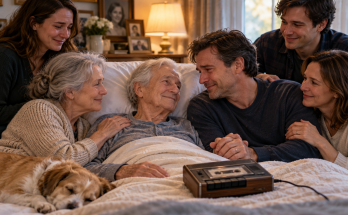
Malcolm died sixteen years after the wedding.
Heart failure.
No dramatic prison attack.
No mysterious circumstances.
He was seventy-eight.
Old enough that the news felt both surprising and inevitable.
My son was forty-three.
Clara was fifteen—
No.
That caught us.
Time had moved.
Clara was twenty-one by then.
Samuel seventeen.
I was old enough that people offered me chairs without asking.
The call came from Malcolm’s attorney.
My son almost hung up.
“There is an item Mr. Price designated for you.”
“No.”
“It’s not a letter.”
“No.”
“It may have evidentiary value.”
“Then send it to law enforcement.”
“They’ve cleared it.”
My son sighed.
“What is it?”
“A key.”
Of course.
He laughed when he told me.
“A key.”
“To what?”
“He wouldn’t say.”
“Then throw it away.”
“That’s what I said.”
Apparently Malcolm anticipated that.
He left a notarized statement.
If the key was refused, destroy it.
No coercion.
No threat.
No condition.
That intrigued my son more than any elaborate instruction would have.
His wife said:
“That is still manipulation.”
“Probably.”
“Are you going to take it?”
“I don’t know.”
Clara, now studying journalism at university, said:
“Take it and don’t use it.”
Samuel said:
“Sell it.”
Nobody knew what it opened.
“Sell mystery key?”
“Internet would buy anything.”
My son looked at me.
“What do you think?”
“I think Malcolm is dead.”
“That’s not advice.”
“It’s the most important fact.”
A dead man could no longer punish refusal.
The key held only whatever significance we gave it.
My son accepted it.
Not because Malcolm asked.
Because curiosity was not obedience.
That distinction had taken our family years to learn.
The key arrived in a plain evidence envelope.
Small.
Brass.
No number.
No label.
My son put it on the kitchen table.
Nobody touched it for two days.
On the third, Samuel used it to open a soda can tab as a joke.
His father yelled.
Then laughed.
That helped.
Malcolm’s attorney eventually provided inventory paperwork.
The key belonged to a storage locker Malcolm rented legally through prison trust arrangements.
Authorities had searched the locker years earlier.
Empty except one sealed crate considered personal property.
No contraband.
No undisclosed evidence.
Why had it remained sealed?
Malcolm’s legal privilege claims delayed access.
After review, investigators determined contents were personal writings already copied in case files.
The crate could be claimed or destroyed.
My son asked:
“Personal writings?”
Malcolm’s journals.
Decades.
My son immediately said no.
Then changed his mind.
Not for himself.
For the restricted university archive.
“If the ethics board wants them.”
The board debated.
Malcolm was a perpetrator.
Preserving his journals risked centering him.
Destroying them erased evidence of how coercive systems operate.
Researchers argued both sides.
Victims were consulted.
Some opposed preservation.
Others wanted scholars to study how he selected targets.
Final decision:
Preserve under restricted access.
No publication of victim identities without consent.
No sensational exhibits.
No public display of intimate material.
My son never read the journals.
Clara did years later as a researcher.
Not all.
Selected sections related to institutional manipulation.
She asked her father first.
“You don’t need permission.”
“I know.”
“Then why ask?”
“Because he hurt you.”
My son smiled.
“That doesn’t give me ownership of history.”
She hugged him.
Then read.
Malcolm’s journals were not what anyone expected.
No villain monologues.
No grand strategy every day.
Most pages were mundane.
Meals.
Complaints.
Bank meetings.
Weather.
Then a line about someone’s weakness.
A debt.
A divorce.
A sick parent.
A clerk who feared exposure.
He cataloged vulnerabilities like other people record appointments.
Clara found that more disturbing than overt cruelty.
One entry described meeting Anna at Mercantile when both were young.
“Turner girl notices too much.”
Another:
“Does not respond well to status.”
Another:
“Could be trouble if frightened enough to become stubborn.”
Clara laughed darkly when she read that.
Anna frightened enough to become stubborn.
Accurate.
Malcolm noticed.
He underestimated what it meant.
Years later, another entry after Anna’s cancer diagnosis:
“She knows about Daniel’s loan.”
Then:
“Expected panic. Got questions.”
Another:
“C. still controllable through guilt.”
Another:
“Robert becoming problem.”
Then:
“Anna recording things. Need access.”
The journals showed no sudden transformation.
Malcolm did not wake one day criminal.
He made small choices.
Justified each.
Learned which worked.
Repeated them.
Expanded.
Protected earlier choices with worse ones.
Clara wrote an academic paper about that.
Title:
THE ADMINISTRATION OF SHAME.
Her father hated the title.
“It sounds like a metal band.”
“That means it’s good.”
The paper argued Malcolm’s power depended less on extraordinary intelligence than institutional cooperation.
Banks accepted documents.
Lawyers rationalized.
Families stayed silent.
Officials looked away.
Malcolm’s skill was connecting those weaknesses.
Not creating all of them.
My son read the paper.
Slowly.
Then said:
“You make him sound boring.”
“He was.”
“He murdered someone.”
“Violence isn’t interesting just because it’s terrible.”
That sentence startled him.
She continued.
“If we make him a genius monster, everybody else gets to pretend normal systems didn’t help him.”
Anna would—
I stopped again.
Even after decades.
Habit remained.
Clara’s paper became part of her graduate work.
She did not build a career around the family case.
That mattered to her.
She covered labor fraud.
Housing corruption.
Public records.
Different stories.
The family history informed her.
Did not own her.
Samuel chose engineering.
He hated journalism.
He also hated family meetings.
At twenty-two he moved across the country.
My son struggled.
“You call enough?”
“Yes.”
“How often?”
“Once a week.”
“Text?”
“Dad.”
“Fine.”
His wife reminded him:
“Home is where he knows he can return.”
The phrase I once told my son on the porch.
It had survived.
Not as rule.
As orientation.
Samuel did return.
Usually hungry.
Clara eventually asked why Malcolm left the journals to my son.
The archive contained a final prison note.
Not addressed personally.
Simply:
He was the one I failed to control.
My son read that once.
Then corrected it aloud.
“No.”
“What?”
“You controlled me at nineteen.”
Clara waited.
“He got me once.”
“That matters?”
“Yes.”
“I don’t want the ending to pretend I was immune.”
Malcolm did control him once.
Through fear.
The important fact was not that my son was uniquely strong.
It was that later he stopped cooperating with the mechanism.
He admitted the forgery.
Accepted consequences.
Refused secret trades.
Told his wife.
That broke the pattern.
Clara revised her paper after that conversation.
She changed one sentence.
Original:
Malcolm’s manipulation failed against individuals who refused shame.
Revised:
Malcolm’s manipulation weakened when individuals disclosed what shame had previously kept hidden.
Better.
People did not need to become fearless.
They needed enough support to tell the truth after fear had already worked.
When Malcolm’s journals were finally archived, my son attended no ceremony.
There was none.
A crate entered climate-controlled storage.
Catalog number assigned.
Key no longer necessary.
The lock removed.
The brass key remained on his desk for years.
Not because it mattered.
Because Samuel had eventually soldered it into a small metal sculpture shaped like a fish.
“Why a fish?”
“It looked like one.”
That was all.
Malcolm’s last key became part of an ugly metal fish.
No symbolism intended.
Which made it better.
Click here to continue reading: PART 44: On the Twentieth Anniversary of the Wedding, My Son Returned the Cassette to the Place Anna First Recorded It and Heard What Silence Meant Now
Eleven Years After His Mother Died, My Son’s Wedding Forced Me to Choose Between Peace and One Last Promise
Part 43 of 47