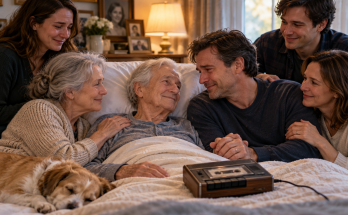
I remembered Anna’s final hospital night too clearly.
She had trouble breathing.
Not an emergency at first.
Then her oxygen level dropped.
The hospice nurse recommended St. Catherine.
Anna hated the idea.
She wanted to stay home.
I insisted.
One of the last arguments we ever had.
I drove.
Our son stayed with a neighbor.
Carol met us at the hospital.
At least that was what I remembered.
Now Carol stood in Edward’s hospital room and said Malcolm had been there too.
“When?”
“After midnight.”
“You saw him?”
“Yes.”
“Why didn’t you tell me?”
“Anna told me not to.”
My son closed his eyes.
Another secret justified by dying wishes.
“What did he want?”
Carol looked toward the detective.
“The DNA material.”
“Which one?”
“Robert’s.”
That surprised us.
Anna had apparently obtained a fresh sample from Robert earlier that week.
A blood card.
He cut his finger deliberately, placed drops on medical collection paper, and sealed it.
Primitive but potentially usable.
She brought it to St. Catherine intending to arrange a private test.
Malcolm learned.
“How?”
Carol believed a hospital employee called him.
The same courier network.
Malcolm came to the hospital.
Anna threatened security.
He threatened something else.
My son asked, “Dad?”
Carol shook her head.
“Not Daniel.”
“Who?”
“Robert.”
Malcolm claimed Robert had committed financial crimes through North Harbor.
Some true.
Some probably fabricated.
He threatened to have him arrested before DNA results could establish anything.
Anna did not care.
Then Malcolm threatened Rachel.
Rachel looked stunned.
“Me?”
Carol nodded.
“Why?”
“Because you were holding copies.”
Rachel sat down.
Anna had already given her some river account records.
Malcolm knew.
He told Anna he could make Rachel appear responsible for stealing client files.
“What did Mom do?”
“Made a bargain.”
There it was.
The bargain I remembered her mentioning.
Not treatment.
Not cancer.
Malcolm offered to leave Robert and Rachel alone if Anna surrendered the DNA sample and one document.
“What document?”
Carol looked at Edward.
He knew.
“Thomas Vale’s signature card.”
Everyone frowned.
Edward explained.
Not a bank signature card.
A personal acknowledgment.
Years earlier, Thomas signed a statement admitting he authorized certain Riverglass payments.
Anna obtained a copy through Robert.
That document could implicate Thomas directly.
Malcolm wanted it.
Anna traded it.
My son’s face hardened.
“So she gave away evidence to protect Robert and Rachel.”
“Yes.”
“Did Malcolm keep his promise?”
“For a while.”
Of course.
Long enough to make the bargain feel real.
Then Anna returned home.
She died the next evening.
I remembered her saying, “I made a bargain I hate.”
I asked whether I could fix it.
She said no.
I believed she meant death.
Now I knew she meant Malcolm.
The detective requested every security record from St. Catherine that night.
Most footage had long since been overwritten.
But access logs survived.
Malcolm entered using a contractor badge at 12:41 a.m.
Left at 1:18.
Another person entered Anna’s floor at 1:04.
Jonathan Vale.
My son stared.
“Jonathan was there too?”
Carol shook her head.
“I didn’t know.”
Neither did Edward.
The detective asked whether Jonathan had any reason to visit Anna personally.
Edward thought.
Thomas Vale may have sent him.
At that time, Thomas was still alive and powerful.
Maybe Jonathan acted as messenger.
Maybe independently.
The hospital records showed Jonathan remained nineteen minutes.
He and Malcolm overlapped.
That made Jonathan’s warning on the phone more interesting.
Ask Malcolm what happened to your wife’s last hospital night.
He wanted us focused on Malcolm.
Anna warned us that Vale family would try exactly that.
The bride said, “What happened during those nineteen minutes?”
No recording.
No camera.
No direct witness yet.
Then Rachel remembered something.
Anna called her.
At 1:12 a.m.
“From the hospital?”
“Yes.”
“What did she say?”
Rachel closed her eyes.
“She asked me where the second copies were.”
“River records?”
“Yes.”
“I told her safe.”
“Then?”
“She said, ‘Good. If a Vale asks, there are no copies.’”
That placed a Vale in her room or imminent.
“What else?”
“She sounded angry.”
“Scared?”
“No.”
Rachel thought.
“Disappointed.”
That word hit differently.
Anna knew Thomas Vale.
Maybe respected him once.
If Jonathan came representing his uncle, she may have seen confirmation that the corruption reached the top.
Rachel remembered the last line.
“Anna said, ‘They’re more frightened of Robert being my father than they are of the money.’”
My son frowned.
“Why?”
We had already assumed inheritance.
But maybe something else.
Edward asked whether Robert’s paternity would expose the Vale fraud.
How?
If Anna was Robert’s daughter, then Robert’s communications with her were family records.
Not enough.
If she inherited his estate, she could control North Harbor documents.
Still mostly financial.
Carol looked toward the river ledger.
“Thomas wanted people to believe Anna could be his daughter.”
“What?”
“Not publicly.”
She struggled.
“Privately.”
Why?
Because it gave him a reason to send money toward Anna’s child without revealing another relationship.
My son’s wife understood.
“The custodial account.”
Exactly.
Thomas could explain suspicious payments to my son as secret paternity support.
The forged letter gave him cover.
Cover for what?
Edward answered.
“Bribe distributions.”
The custodial account was not created simply to manipulate Thomas.
It was a laundering path.
Malcolm used the supposed paternity secret to justify money movements that actually concealed Vale’s kickbacks.
My son stared.
“So my name was used.”
“Yes.”
“As a baby.”
“Yes.”
Thomas may have knowingly allowed it.
Malcolm may have created it.
Either way, proving Robert was Anna’s father weakened the paternity story around Thomas and threatened to expose the account as fraudulent infrastructure.
Robert’s paternity was not just inheritance.
It destroyed a cover story.
That was why Malcolm stole the DNA result.
Why he created a fake posthumous test.
Why Anna’s remains mattered.
Why the grave was disturbed.
My son looked sick.
“My whole existence was paperwork to them.”
His wife took his hand.
“Not to the people who mattered.”
He nodded, but the wound remained.
The detective received an update.
Anna’s hospital medication chart showed something unusual.
At 1:09 a.m., a sedative order appeared.
Anna refused it.
The nurse documented refusal.
At 1:26, a second entry marked medication administered.
No nurse signature.
“What medication?”
Midazolam.
Strong sedative.
My chest tightened.
Anna had been clear when I returned around two.
Sleepy.
I assumed exhaustion.
“Was she drugged?”
The hospital representative would not conclude that from records alone.
The entry could be clerical error.
But with Malcolm present, it mattered.
Then the toxicology archive delivered another surprise.
Blood drawn at 2:03 a.m. contained benzodiazepine levels consistent with sedation.
Anna had refused sedation less than an hour earlier.
Someone administered it anyway.
My son looked toward Carol.
“Did Malcolm?”
“I don’t know.”
“Jonathan?”
“I don’t know.”
The detective asked who ordered the blood draw.
Doctor.
Routine.
That meant objective evidence existed.
Anna was sedated that night against her documented refusal.
Why?
To take something?
Force a signature?
Collect DNA?
Malcolm already wanted the sample.
Then the records director found a consent form scanned at 1:31.
Release of biological material.
Signed by Anna.
Witness:
J. Vale.
Jonathan.
My son stood.
“That signature could be fake.”
Yes.
But the original would need examination.
The form released Anna’s stored buccal sample and Robert’s blood card to a private laboratory courier.
Malcolm controlled the courier.
The bargain had been converted into legal paperwork while Anna was sedated.
Maybe she agreed earlier.
Maybe not.
The timing made it suspicious.
I felt something close to rage.
Not the loud kind.
The kind that narrows the world.
“They drugged her.”
The detective corrected gently.
“We have evidence she received a sedative after refusing it. We still need to establish who administered it and why.”
He was right.
Anna would have insisted on that distinction.
Facts first.
Then blame.
My son asked whether the nurse from that shift was still alive.
Yes.
Retired.
Police contacted her.
She answered after several attempts.
Her name was Denise Morland.
She remembered Anna.
Not every detail.
But enough.
“I remember the argument.”
“What argument?”
“A man in a suit wanted her signature.”
“Who?”
“Mr. Vale.”
Jonathan.
“He said he was family counsel.”
He lied.
Denise told him Anna was not in condition for legal decisions.
Jonathan became angry.
Another man arrived.
Malcolm.
Denise recognized him from later bank advertising.
They argued in the hall.
“What happened next?”
Denise was called to another patient.
When she returned, Anna was asleep.
“Did you administer midazolam?”
“No.”
“Did another nurse?”
“Not that I knew.”
“Who had access?”
Doctors.
Nurses.
Emergency kits.
And anyone who obtained medication improperly.
Malcolm had already stolen zolpidem before.
Drugs were part of his method.
Denise remembered something else.
Anna woke briefly around two.
She asked Denise to hide an envelope.
“What envelope?”
“Small. White.”
“What did you do with it?”
Denise refused.
She said Anna had been lucid.
Scared.
Denise promised.
“Where is it?”
A pause.
Then:
“I still have it.”
Everyone froze.
For eleven years, Denise Morland had kept a dying patient’s envelope because Anna made her promise not to give it to anyone claiming to represent Vale, Mercantile, or Malcolm Price.
“Why didn’t you contact Daniel?”
“I tried once.”
“When?”
“After the funeral.”
“What happened?”
“A woman answered.”
Carol closed her eyes.
“Me.”
Denise said the woman identified herself as Carol.
Before Denise explained why she was calling, Carol said the family wanted no more hospital contact.
Carol remembered.
She thought Denise was calling about unpaid paperwork.
“I’m sorry.”
Denise ignored her.
Anna told Denise if she could not safely reach Daniel, wait until the boy married or turned thirty.
Again.
The same trigger.
My son whispered, “She told everybody.”
Not everybody.
Only enough people.
The envelope had remained hidden in Denise’s home safe.
Police arranged immediate collection.
We drove there under escort.
Denise lived in a small house with wind chimes on the porch.
She recognized me.
“You look older.”
“So do you.”
It was the kindest possible greeting.
She handed the sealed envelope directly to my son.
Anna’s handwriting:
FOR MY SON — IF THEY TAKE THE DNA.
My son sat at Denise’s kitchen table.
His wife beside him.
He opened it.
Inside was a letter.
And a laboratory photocopy.
Not the final paternity result.
A preliminary marker analysis.
Anna and Robert shared genetic markers consistent with a possible parent-child relationship.
Not conclusive.
But enough to make Robert’s claim plausible.
More importantly, Anna wrote what happened that hospital night.
She said Malcolm demanded the samples.
Jonathan demanded the Riverglass evidence.
They argued with each other.
Neither fully controlled the situation.
Then Anna wrote:
Jonathan is more frightened than Malcolm. That makes him more dangerous.
My son read aloud.
She believed Malcolm wanted leverage.
Jonathan wanted disappearance.
Malcolm liked secrets because secrets paid forever.
Jonathan wanted them destroyed because he wanted a clean future.
That distinction explained the last two days.
Malcolm kept archives.
Jonathan burned them.
Malcolm blackmailed.
Jonathan shot Edward.
Malcolm sought immunity.
Jonathan sought silence.
Anna’s final paragraph addressed my son.
If they tell you money is why this matters, do not believe them. Money is the least important inheritance. The truth is that frightened people built their lives by making other people carry consequences for them. Do not inherit that.
My son stopped.
His wife squeezed his hand.
There it was.
The real inheritance.
Not land.
Not millions.
A choice.
Anna ended with one instruction.
Denise knows where I put the copy of the consent form before they sedated me.
Everyone looked at Denise.
She nodded.
“I wondered when we’d get to that.”
From a locked drawer she produced a photocopy Anna made before the confrontation.
Original unsigned consent form.
No signature.
No witness.
Then she produced a second sheet.
A note Anna wrote after waking.
JONATHAN SIGNED FOR ME. MALCOLM TOOK THE SAMPLE. THEY THINK I WAS TOO SEDATED TO KNOW.
The detective photographed it.
This directly alleged forgery.
Not by Malcolm.
Jonathan.
My son looked at the detective.
“Can this prove it?”
“Combined with handwriting analysis, hospital records, Denise’s testimony, and the suspicious medication administration, it’s powerful.”
Denise interrupted.
“There’s more.”
Of course.
She had seen Jonathan leave Anna’s room carrying a document folder.
Malcolm carried the specimen cooler.
They went separate directions.
That meant they were cooperating, but not together.
Jonathan had the forged consent.
Malcolm had the biological evidence.
Each held something the other needed.
Anna knew.
That was why she wrote two different descriptions of them.
Knife and hand.
Except now the hand had begun trying to kill the knife.
My phone rang.
The detective answered for me.
Malcolm.
Again.
His voice was weaker.
“I need protection.”
The detective identified himself.
Malcolm laughed.
“I know who you are.”
“Where are you?”
“Not important.”
“You’re injured.”
Silence.
“Jonathan shot you?”
Another silence.
Then Malcolm said, “He missed.”
“Come in.”
“I will.”
“When?”
“When Daniel brings Anna’s letter.”
My son looked at me.
“Which letter?”
Malcolm answered as if he heard.
“The hospital letter.”
So he knew Denise existed.
Maybe not where.
Maybe Jonathan told him.
Malcolm continued.
“Bring it to the river at dawn.”
The detective refused.
Malcolm coughed.
Then said, “If you want Jonathan Vale, you need me alive.”
“We have the ledger.”
“You have numbers.”
“We have Robert’s tape.”
“You have words from a dead man.”
“We have Denise.”
That silenced him.
Then Malcolm whispered, “You found the nurse.”
“Yes.”
For the first time, he sounded truly afraid.
“Then Jonathan will come for her.”
Everyone turned toward Denise.
The detective immediately ordered officers to secure the house.
Malcolm continued.
“He already knows she kept something.”
“How?”
“Because I told him years ago.”
Denise stared.
The detective asked, “Why would you tell him?”
“To keep him away.”
That made no sense.
Malcolm explained.
He lied.
Told Jonathan Denise had only a sentimental letter.
No documents.
No evidence.
For once, Malcolm’s manipulation may have protected someone.
Why?
Because Denise’s existence gave him leverage over Jonathan too.
Another preserved secret.
Another future payment.
My son looked disgusted.
“You don’t protect people. You preserve assets.”
Malcolm heard him.
“That’s how you survive.”
My son answered quietly.
“No. That’s how you ended up alone.”
The line went silent.
Then Malcolm said the most honest thing I ever heard from him.
“Maybe.”
He gave us coordinates.
Not the bridge.
Not the pumping station.
A river overlook five miles south.
Dawn.
He claimed he would bring Jonathan’s original handwritten authorization for Riverglass.
The document connecting Jonathan directly to Robert’s “resolution.”
The detective asked why he still had it.
“Because I never throw away insurance.”
Of course.
My son said, “And what do you want?”
Malcolm replied.
“Anna’s hospital letter.”
“Why?”
“Because it says Jonathan forged her signature.”
“So?”
“If he thinks you have it, he’ll stop running.”
The detective understood.
Malcolm wanted to use us as bait.
Again.
But this time the bait might work both ways.
Jonathan could not allow the letter to reach prosecutors.
Malcolm wanted him exposed.
The detective ended the call without agreeing.
My son looked at me.
“We go.”
“No.”
He smiled faintly.
“You keep saying that.”
“And you keep proposing dangerous things.”
His wife said, “You’re both done deciding alone.”
She was right.
The detective began constructing a controlled operation.
Denise would be moved.
The real letter secured.
A copy prepared.
Malcolm expected dawn.
Jonathan, if watching, might expect Malcolm to surface too.
Everyone’s plans were converging on the river.
Anna had spent eleven years spreading truth across people, places, dates, and memories.
Now all those threads were pulling toward one point.
The detective looked at the clock.
4:12 a.m.
Less than two hours until sunrise.
And somewhere outside, Malcolm Price and Jonathan Vale were both running out of secrets they could afford to leave alive.
Click here to continue reading: PART 25: At Dawn Malcolm Brought the Paper That Could Destroy Jonathan, but Someone Else Reached the River Overlook Before Either Man Arrived
Eleven Years After His Mother Died, My Son’s Wedding Forced Me to Choose Between Peace and One Last Promise
Part 24 of 47