Clara was four when she first heard Anna’s voice.
Not the whole tape.
That would have been absurd.
She was visiting my son’s house on a rainy Sunday afternoon when she discovered the cassette case in a drawer.
Children find things adults believe are safely stored.
She held it up.
“What’s this?”
My son’s wife looked at him.
He looked at her.
Apparently they had discussed this moment theoretically.
Theory failed.
“A tape.”
“What’s a tape?”
That took ten minutes.
Then Clara saw the handwriting.
“Who wrote it?”
My son answered:
“Grandma Anna.”
Clara knew the name by then.
She knew Grandma Anna was her father’s mother.
She knew Grandma Anna died when Daddy was a teenager.
She knew she liked pancakes, bad Christmas sweaters, and making jokes.
She knew nothing about Malcolm.
Nothing about graves.
Nothing about forged signatures.
That could wait.
“Can I hear her?”
My son called me.
Not because he needed permission.
Because he wanted me there.
Carol came too.
We arrived with pizza.
Clara complained that everyone was acting weird.
Fair.
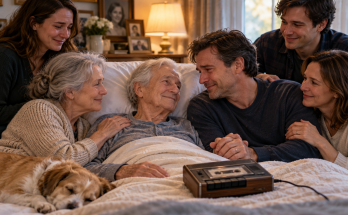
My son put the cassette into the player.
Not digital copy.
Original.
The mechanism clicked.
A little hiss.
Then Anna.
“Hello, my boy.”
My son closed his eyes.
His wife held his hand.
Clara looked around.
“Is she talking to Daddy?”
“Yes.”
“Why does Daddy look sad?”
“Because he misses her.”
Clara accepted that immediately.
Children sometimes understand emotional complexity better when adults stop explaining it to death.
Anna joked about wet towels.
Clara laughed despite not understanding why.
Then asked:
“Did Daddy leave towels?”
His wife answered:
“Everywhere.”
“Still?”
“Everywhere.”
My son protested.
Clara sided with her mother.
Family continuity.
We played only eight minutes.
Then stopped.
Clara wanted cartoons.
That was humbling.
The artifact that changed our lives lost to animated dogs.
My son smiled.
“Mom would appreciate that.”
This time nobody corrected him.
Sometimes imagining what the dead might enjoy is affection, not control.
Context matters.
The tape returned to its drawer.
Months passed.
Clara started kindergarten.
Then first grade.
Our family story entered her life gradually.
She learned Peter Turner raised Anna.
Later, she learned Anna discovered another biological father.
She asked:
“Can you have two dads?”
My son said:
“Sometimes.”
“Did Grandma Anna?”
“In different ways.”
Clara accepted that too.
At seven, she asked why Carol was not her “real grandma.”
My son nearly choked.
Carol answered herself.
“I’m your Carol.”
Clara considered.
Then:
“Can I call you Grandma Carol?”
Carol cried.
Clara looked alarmed.
“Did I do bad?”
“No.”
Carol hugged her.
“You did something very good.”
The title stayed.
Not because biology granted it.
Not because Anna authorized it.
Because Clara chose it and her parents agreed.
That mattered.
By then, Carol and I had been back together for several years.
Not magically healed.
Some arguments still found old wounds.
Once, during a fight about money, I accused her of controlling things.
The word landed badly.
She went silent.
Old Carol would have stayed silent.
Newer Carol said:
“That was unfair.”
She was right.
I apologized.
Another time, she accused me of hiding behind passivity.
She was right.
Marriage after betrayal did not become pure.
It became more explicit.
That was enough.
My son and his wife had a second child.
A boy.
They named him Samuel.
No family middle name.
I did not ask why.
Growth.
The legal-aid fund expanded.
It helped hundreds of people.
My son still refused a board seat.
Occasionally they asked him to speak at fundraising events.
He usually declined.
Once he agreed.
He talked for seven minutes.
No dramatic family details.
Only one lesson:
“Financial abuse survives when shame convinces people they are safer staying quiet.”
Then he sat down.
Anna would—
I stopped myself.
I was learning too.
The Vale foundation survived.
Smaller.
Independent board.
Several assets sold to satisfy restitution and historical claims.
Miriam Hart’s name appeared in the official family archive.
Not as “secret daughter.”
Just:
Miriam Hart Vale, daughter of Charles Vale and Evelyn Hart.
My son visited the archive once.
He took Clara.
She was nine.
She stared at the family tree.
“That’s a lot of people.”
“Yes.”
“Are we rich?”
My son laughed.
“Why?”
“Kids at school say the Vales are rich.”
“Some are.”
“Are we?”
He thought.
“We have enough.”
Not an evasion.
A value.
Clara pointed at Miriam.
“Was she nice?”
“I don’t know.”
“Then why do we care?”
My son crouched beside her.
“Because people pretended she wasn’t part of the family when she was.”
“That’s mean.”
“Yes.”
“Did she want money?”
“Some things were about money.”
“What did she want most?”
“To be named.”
Clara looked at the archive again.
“She is now.”
“Yes.”
That was enough for her.
On the drive home, she asked whether Anna knew Miriam.
A little.
Whether Robert was Anna’s “real dad.”
Biological dad.
Whether Peter was fake.
No.
Peter was the dad who raised her.
Clara became frustrated.
“Families are confusing.”
My son laughed.
“Yes.”
“Why?”
“Because people are.”
That may have been the best explanation any of us ever produced.
When Clara turned ten, she asked about the wedding tape again.
This time she wanted to hear all of it.
My son hesitated.
Not because of Anna’s message.
Because explaining why the tape mattered meant approaching the crimes around it.
His wife said:
“She asked.”
So they told her more.
Not everything.
Enough.
Someone tried to steal money meant for her father.
Some adults lied.
Grandma Anna had left records that helped expose those lies.
Carol had made serious mistakes and later helped tell the truth.
Clara looked at Carol differently for about two days.
Carol noticed.
Did not pressure her.
Then Clara asked:
“Did you say sorry?”
Carol answered:
“Yes.”
“Did Daddy forgive you?”
“Some things.”
Clara frowned.
“Some?”
“That’s how it works sometimes.”
Clara thought.
“Okay.”
Again, children tolerate unfinished answers better than adults expect.
Then came the question none of us anticipated.
“If Grandma Anna was so worried people would lie, why didn’t she just tell Daddy everything before she died?”
Silence.
My son looked at me.
I looked at Carol.
Carol looked at the floor.
There was no satisfying answer.
Because Anna was sick.
Because he was sixteen.
Because she wanted to protect him.
Because she lacked complete information.
Because she trusted adults who failed.
Because she postponed.
Because she was frightened.
Because she thought she had more time.
Because every generation believes one more silence might be harmless.
My son finally answered:
“She made a mistake.”
Clara looked surprised.
“Grandma Anna?”
“Yes.”
“What mistake?”
“She tried to protect me from things she thought I was too young to know.”
“Were you?”
“Maybe for some things.”
“So she was right.”
“Sometimes.”
“But wrong?”
“Sometimes.”
Clara smiled.
“Like you.”
My son laughed.
“Exactly like me.”
That answer mattered more than any defense of Anna could have.
Anna was no longer the dead woman whose foresight controlled the family.
She was Grandma Anna.
A person.
Loved.
Fallible.
Clara listened to the tape.
All forty-seven minutes and twelve seconds.
She got bored around minute nineteen.
Asked for popcorn.
Returned.
Laughed at some jokes.
Missed others.
At the end, she asked:
“Is that it?”
My son smiled.
“That’s it.”
“No secret message?”
His wife looked at him.
Apparently they had told Clara enough about altered copies to create expectations.
“No secret message.”
“Good.”
Clara jumped from the couch.
“Can we watch a movie?”
My son looked at the cassette.
Then at me.
Then laughed.
“Absolutely.”
Anna’s voice had become what it was always supposed to be.
A mother talking to her son.
Nothing more required.
That evening, after the children went home, Carol and I sat on the porch.
We were older.
Enough that stairs had become negotiations.
She asked:
“Do you ever think about what would’ve happened if he never played the tape?”
“Yes.”
“What?”
“Probably nothing.”
She looked at me.
“That’s depressing.”
“I mean nothing would’ve changed.”
The trust money might remain missing.
Malcolm might continue.
Martin might preserve the network.
Miriam’s name might stay buried.
Robert’s death might remain distorted.
Elaine’s crash might remain accident.
Anna’s body might remain misplaced.
Carol and I might remain married inside a lie we called peace.
My son might never tell his wife about the bank.
A lot of nothing.
Silence creates stable-looking lives.
Until someone speaks.
Carol asked:
“Do you wish he hadn’t played it at the reception?”
I thought about the destroyed wedding.
The ring removed.
Police.
Graves.
Hospital rooms.
Trials.
Years.
“Yes.”
She laughed.
“Really?”
“I wish we had found another way.”
“But there wasn’t one.”
“Maybe.”
We could not know.
That was another thing we had learned.
Do not turn what happened into destiny just because it happened.
The wedding tape did not need to be played publicly for the universe to work correctly.
It simply was.
We dealt with what followed.
Inside, Clara had left the cassette case on the coffee table.
I picked it up.
Forty-seven minutes.
So much consequence attached to such a small object.
Then I put it back in the drawer.
No lock.
No ceremony.
Carol turned off the light.
And for the first time I could remember, neither of us checked the drawer again.
Click here to continue reading: PART 41: Years After the Trials Ended, Clara Found Anna’s Name in a School Archive and Uncovered the One Story None of Us Had Ever Heard
Eleven Years After His Mother Died, My Son’s Wedding Forced Me to Choose Between Peace and One Last Promise
Part 40 of 47