I was eight months pregnant when I asked my husband if he could help me carry the groceries upstairs.
It wasn’t an accusation.
It wasn’t the opening line of a fight.
Just a simple sentence, quiet and tired—spoken between shallow breaths while my back pulsed with that deep ache pregnancy teaches you to live with. My ankles were swollen, my fingers stiff from cold plastic handles, and our baby was sitting low, heavy, making every step feel like I had to bargain with gravity.
The bags weren’t ridiculous.
Rice. Milk. Spinach. Yogurt.
The prenatal vitamins my doctor wouldn’t stop reminding me about.
Normal things. Ordinary things. The kind of things you buy when you’re still trying to pretend your life is stable.
My husband stood by the door, keys dangling from his hand, staring at the staircase like I’d asked him to move a mountain.
Before he could answer, my mother-in-law’s voice sliced through from the kitchen—sharp and practiced, like she’d said it a thousand times to women who needed softness.
“Pregnant doesn’t mean helpless,” she said. “Women have done this forever. Stop acting like everything revolves around you.”
The words didn’t just sting.

They settled.
Like dust that finds its way into every corner and won’t leave.
I waited for my husband to say something.
Anything.
A quiet defense. A joke to soften it. Even a reluctant “Mom, stop.”
Instead, he gave a small nod—automatic, obedient—like she’d just corrected a child’s manners.
So I bent down.
Lifted the bags.
And started climbing.
Halfway up, the handles cut into my fingers. My breathing turned thin. The baby shifted like it didn’t like being jostled under pressure.
But the heaviest thing wasn’t the groceries.
It was the moment I realized I was doing this alone—in a house full of people.
I didn’t cry. I’d learned not to. In that home, tears didn’t bring comfort. They turned into evidence.
That night I lay awake while the house slept around me.
My baby kept kicking my ribs as if asking, Is this the life we’re walking into?
I stared at the ceiling and wondered how a place could feel so crowded—and still somehow empty.
The Knock
Just after sunrise, the knocking started.
Not gentle.
Not polite.
Hard, urgent pounding—like someone was tired of being patient.
My husband shuffled to the door, half-asleep, muttering under his breath. I followed slower, one hand braced under my belly, my body instinctively preparing for disappointment.
He opened the door.
And the color drained out of his face.
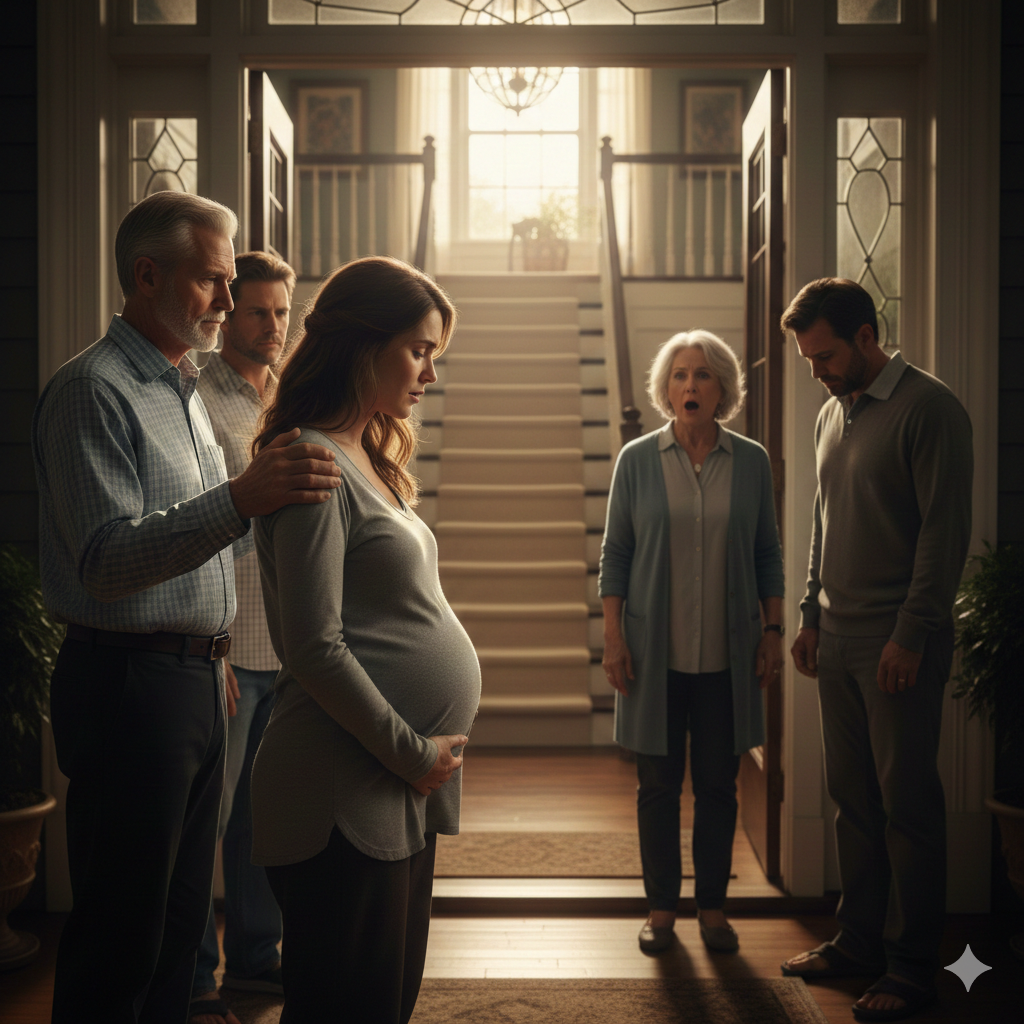
On the porch stood his father.
Behind him—his two brothers.
All three of them, together, before breakfast.
They almost never showed up like this. Family tension had drawn invisible borders between them for years. When they visited, it was stiff smiles and quick exits.
This wasn’t that.
My father-in-law stepped forward and gently moved his son aside—not aggressively, just with the quiet authority of someone who has already made a decision.
Then his eyes found me.
“I owe you an apology,” he said.
His voice wasn’t loud. It didn’t need to be.
“For raising a man who forgot what responsibility looks like.”
The air changed instantly.
My mother-in-law appeared in the hallway, frozen—outrage caught mid-breath, like her mouth didn’t know whether to argue or retreat.
My husband didn’t speak.
He couldn’t.
“I heard about yesterday,” my father-in-law continued. “The groceries. The way you were spoken to. The way no one stepped forward.”
My throat tightened, but I didn’t defend myself. I didn’t explain. I didn’t plead.
He didn’t ask me to.
“I taught my sons to be strong,” he said. “But I realize now I didn’t teach them what strength actually is.”
He paused—slow, deliberate.
“Strength isn’t pride. It isn’t authority. It isn’t standing comfortably while someone else carries the weight.”
His gaze stayed steady on me.
“Strength is showing up. Holding what’s heavy when someone else can’t. Protecting your family before protecting your ego.”
Silence wrapped around the doorway like a blanket.
Then he said the sentence that made my husband’s posture snap rigid.
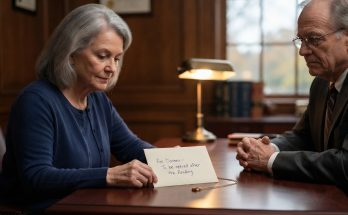
“I’m meeting my attorney today. I’m revising my will.”
My husband’s head jerked up. “Dad—”
His father didn’t flinch.
“For years, everything was to be divided equally between my sons,” he said. “That was the plan. But inheritance isn’t a prize for biology. It’s a reflection of values.”
He gestured toward the two brothers behind him.
“They’ve proven, again and again, they understand responsibility.”
Then he looked back at me.
“And yesterday, so did you.”
My vision blurred at the edges—not tears falling, just that sudden burning pressure when you realize someone finally saw what you endured.
“You were exhausted,” he said, voice softer now. “Carrying my grandchild. And still… you carried what should’ve never been placed in your hands alone.”
He inhaled slowly.
“That told me more about you than any speech ever could.”
My husband looked like the floor had tilted beneath him.
“I will leave what I have to those who demonstrate strength,” my father-in-law said. “My two sons… and my daughter-in-law.”
My mother-in-law finally found her voice—sharp, indignant, trembling. But he lifted a hand.
Not harsh.
Just final.
“This isn’t revenge,” he said. “It’s alignment.”
He stepped closer to me and placed his hand gently on my shoulder.
“Thank you,” he said quietly. “For protecting my grandchild—even when no one protected you.”
And then they left.
No shouting.
No dramatic speeches.
Just the door closing behind something that couldn’t be unheard.

What Changed
The house felt different after that.
Smaller. Quieter.
Like the walls had been holding their breath and finally let it out.
My husband avoided my eyes all day. When he finally spoke, his voice didn’t have its usual certainty. It sounded… cracked. Like something inside him had fractured in a way that might become change—or might harden into resentment.
I didn’t know which yet.
But I knew one thing with brutal clarity:
Strength isn’t always loud.
Sometimes it’s a woman carrying groceries up stairs she shouldn’t have to climb alone.
Sometimes it’s a father admitting he raised a son wrong.
And sometimes it’s as simple as being seen—named—recognized.
That afternoon, I rested my palm over my belly.
A small kick answered me from the inside.
For the first time in months, it didn’t feel like I was carrying everything alone.
Because someone had witnessed what I’d endured.
And in a house that had made me feel invisible… that mattered more than any inheritance ever could.