For three weeks, every call I made to my daughter went straight to voicemail.
I told myself it was grief. Space. The kind of quiet that settles over a house after a loss and makes even a ringing phone feel like too much.
James had died—or at least that’s what Rachel told me—so I tried to be the mother she needed. I left gentle messages. I sent short texts that didn’t demand anything.
“Just checking in.”
“Love you.”
“I’m here whenever you’re ready.”
Most mornings I’d stand at my kitchen window with a mug of coffee, watching the September wind worry the maple leaves in my yard, and I’d rehearse excuses for her silence like prayers.
She’s sleeping.
She’s in therapy.
She’s with the funeral paperwork.
She’s trying not to fall apart.
I was a social worker for thirty-seven years before I retired. I spent decades telling families what grief could do to a person—how it could make them angry, numb, distant, unpredictable. I’d said those words in hospitals and courtrooms and cramped living rooms where the air smelled like stale smoke and old fear.
But knowing something in theory doesn’t make it easier when it’s your own child.
Rachel hadn’t just stopped talking to me. She’d erased herself.
On the fourth day, I drove past her street just to make sure her porch light was on at night. On the ninth day, I dropped off a bag of groceries—soup, crackers, those little applesauce cups she loved as a kid—and left them by the front door with a note.
No response.
On the twelfth day, James’s mother called from Michigan, voice tight and sharp. Helen didn’t have the kind of grief that goes quiet. Her grief came out like steel.
“Have you heard from her?” she asked.
“Not lately,” I admitted.
“She won’t take my calls either,” Helen said. “And she blocked Tom. James’s brother. Who does that after a death?”
“A woman who can’t handle more noise,” I tried.
Helen made a sound that told me she didn’t buy it.
“That funeral wasn’t right,” she said. “Closed casket. No viewing. No chance to say goodbye. Margaret, something’s wrong.”
I wanted to argue. I wanted to defend my daughter the way a mother’s heart does by reflex.
But when I hung up, I found myself staring at the spare key on my key ring—the one Rachel had given me years ago, “just in case,” because that was how she’d always been. Meticulous. Planned. Responsible.
Or so I thought.
The next morning, Mrs. Chen called.
She was Rachel and James’s neighbor in Riverside—an older woman with a calm voice and a sharp eye. We’d met at block parties and the occasional neighborhood barbecue. She always brought a tray of dumplings that vanished in minutes.
“Margaret?” she said, and I could hear in her tone that she’d already talked herself out of calling twice before finally doing it.
“Yes, Mrs. Chen?”
“I don’t want to worry you,” she began, which is always how people start when they’re about to say something that will.
My stomach tightened.
“I’ve been watching the house,” she continued. “Because of Rachel. Because of James. And… there have been strange cars. Coming and going at odd hours. Late at night. Early morning. Not like family. Not like friends.”
“Maybe people checking on her,” I said, even as the words tasted thin.
Mrs. Chen paused.
“They don’t park in the driveway,” she said softly. “They park down the street. They look around before they walk up. Like they don’t want to be seen.”
Something cold settled in my stomach, the way it does right before bad news.
“How long?” I asked.
“Two weeks,” she said. “And Rachel’s SUV… I haven’t seen it in days.”
I tried calling Rachel again after I hung up. Straight to voicemail.
I sent one more text.
“I’m coming by today. I love you.”
No answer.
By the time I grabbed my purse, my hands were already trembling.
The drive from my place to Riverside takes about forty minutes if traffic behaves. That morning it didn’t.
I merged onto the highway with a knot in my chest, the Chicago radio station murmuring about weather and sports and a road closure I barely absorbed. My windshield was speckled with late-summer dust. The sun was bright but not warm, the kind of light that makes everything look too honest.
At a stoplight, I caught myself gripping the steering wheel too hard, my knuckles pale.
It’s nothing, I tried to tell myself.
She’s sleeping.
Her phone is lost.
She’s out running errands.
But every excuse sounded less like a possibility and more like a desperate bargain.
When I turned onto Maple Drive, my heart started beating in my throat.
847 Maple.
Rachel and James’s house sat halfway down the block, a tidy two-story with a small front porch and a narrow strip of lawn that Rachel used to keep trimmed like a golf course.
That lawn looked tired now. The edges were frayed. A few weeds stood up like stubborn little flags.
The driveway was empty.
Rachel’s SUV was gone.
But James’s old pickup truck sat in its usual spot, parked slightly crooked the way he always left it, a thin coat of pollen turning the dark paint a dull yellow-green.
A delivery flyer was wedged in the screen door.
Mail bulged in the box.
No curtains moved.
I sat in my car for a moment, breathing shallowly, and stared at the front window.
Rachel had always been the kind of person who kept her life in motion. Even after James “died,” I expected some sign of her—an empty coffee cup on the porch, a light left on, the hum of a television inside.
But the house looked like it was holding its breath.
I got out and walked up the steps.
I knocked twice.
Then, because I couldn’t stand the silence, I knocked again.
“Rachel?” I called. “It’s Mom.”
Nothing.
I tried the doorknob. Locked.
My spare key felt heavy in my palm.
I slid it into the lock and turned.
The door opened with a soft click that sounded far too loud.
Inside, the air was stale. Not the warm, lived-in smell of a family house—more like the faint, dry scent of closed rooms.
The living room looked normal at first glance.
The same gray couch.
The same throw blanket folded over the arm.
Family photos lined up on the mantle: Rachel in her college cap, James holding a fishing rod, the two of them on their wedding day—Rachel in lace, James in a navy suit, both of them smiling so wide it used to make my chest hurt with happiness.
But then I noticed the dust.
Not just a little dust. The kind that settles like a quiet verdict when no one’s been home in days.
The wedding photo was coated in it.
Rachel would have wiped that clean without thinking.
My pulse thudded in my ears.
“Rachel?” I called again, louder. “Honey?”
Silence.
I walked through to the kitchen.
The counters were mostly clear—Rachel hated clutter—but the room had that faint sour note that makes you look around for a forgotten trash bag.
The refrigerator was stocked.
That was the first thing that confused me.
Milk. Eggs. Deli meat. Pre-cut fruit.
At a glance, it looked like someone had done a fresh grocery run.
Then I checked the dates.
The milk had expired two weeks ago.
The eggs were past their date.
The fruit was starting to soften, the edges gone just slightly translucent.
A bowl sat in the sink with cereal stuck to the sides, hardened like plaster.
The trash can was empty, but the air still carried the faint rot of something hidden.
I opened the pantry.
The cereal box was open. A bag of chips sat half-crushed on the floor. A can of soup was missing from the row.
It was the kind of mess that didn’t look like normal living.
It looked like someone had been here… and then suddenly stopped.
I moved toward the hallway.
Rachel and James’s house had always felt cheerful to me—bright paint, warm lamps, the kind of place where you could hear laughter even when you weren’t in the room.
Now it felt like a stage after the actors have left.
That’s when I heard it.
A faint scratching sound.
Rhythmic.
Deliberate.
It seemed to come from below my feet.
I froze.
For a second, my mind tried to explain it away.
A mouse.
A raccoon.
Old pipes.
But the scratching came again, a slow drag-scratch-drag that didn’t sound like an animal.
It sounded like a person trying to be quiet.
The basement door was in the hallway.
I’d never paid much attention to it before. Rachel and James used the basement for storage—Christmas decorations, old boxes of textbooks, the camping gear James swore he’d use again.
I stepped closer.
When I reached for the doorknob, I stopped so abruptly my breath caught.
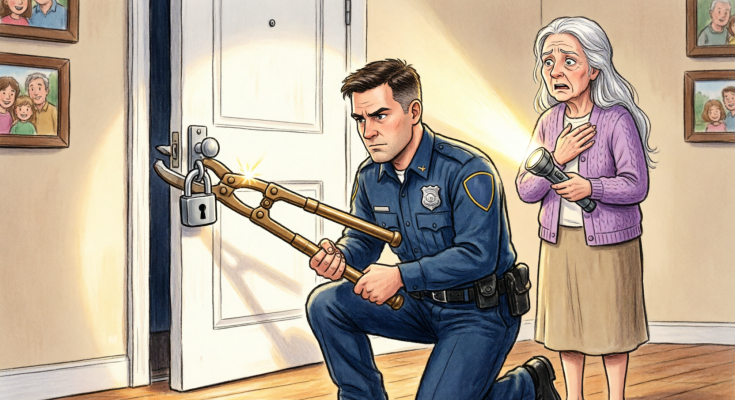
There was a padlock on it.
Not the kind you use for a toolbox.
This one was thick and industrial, securing a metal hasp that had been screwed into the door frame.
The screws looked new.
The wood around them was fresh and pale, like the doorframe had been drilled only days ago.
My mouth went dry.
Why would anyone padlock a basement door from the outside?
The scratching came again.
Louder.
And then—so faint it almost blended into the house’s silence—a voice.
Not a shout.
Not even a full word.
A weak, hoarse whisper.
“Please.”
My blood turned to ice.
I leaned closer, pressing my ear toward the door.
The voice came again.
“Please.”
I knew that voice.
My hand flew to my mouth.
“No,” I whispered.
My fingers fumbled for my phone.
I dialed 911 with shaking hands.
“I need police at 847 Maple Drive in Riverside,” I said the second the operator answered. “I think someone’s trapped in a basement. There’s a padlock on the door and… I hear someone inside.”
The operator asked my name. My address. If I was safe. If the person inside could speak.
I barely heard her.
All I could focus on was that voice.
I pressed my face against the door.
“James?” I whispered, even though my mind was screaming that it was impossible. “James, is that you?”
The scratching stopped.
For a beat, there was nothing.
Then, so faint I almost missed it:
“Margaret.”
My knees buckled.
We had a funeral.
Rachel had told me James had taken his own life.
She had sobbed on the phone and said she found him in the garage.
We had a closed-casket service.
We buried a man in the ground.
And now I was standing in a quiet house in Riverside listening to my son-in-law whisper my name through a locked basement door.
I tried the padlock.
It didn’t budge.