Part 2
Kathy’s soup cooled into a thick, congealed thing while Amber talked about nursery colors she did not care about and Jason answered messages that mattered more to him than his mother’s tears.
I tried to eat my salad. It tasted like paper.
Every few minutes, Kathy looked at Amber’s stomach. Not obviously. Just a quick soft glance, a grandmother’s glance, full of impossible hope. Then she would look at Jason and smile as if she were trying to memorize him as a father before it happened.
She did not know that I had heard him in the hospital.
Eight weeks earlier, Kathy had nearly died.
I had found her sitting on the edge of our bed at six in the morning, nightgown soaked with sweat, eyes unfocused. Her skin was cold and damp. The glucose monitor read 450. I still remember the number. It burned into my head brighter than any fire alarm.
“We’re going to the hospital,” I said.
“Hank,” she whispered, “we can’t afford—”
“Now.”
She vomited twice on the way to Phoenix General. I held a plastic grocery bag under her mouth with one hand and steered with the other, praying the Honda would hold together long enough to get us there.
The doctors called it diabetic ketoacidosis. Severe dehydration. Potassium imbalance. Dangerous. They stabilized her in the ICU, but Dr. Sarah Morrison took me aside afterward.
“Mr. Sullivan, she needs full insulin doses. Every day. No rationing.”
I nodded like a man who had options.
“She could die if this happens again.”
“I understand.”
But understanding did not put seven hundred and fifty dollars a month in my pocket. Understanding did not pay the twelve-thousand-dollar hospital bill. Understanding did not erase the folded papers in my glove compartment from a week before, when another doctor had looked at me and said stage two prostate cancer, PSA forty-seven, treatment recommended immediately, estimated cost seventy-eight thousand five hundred dollars.
I never told Kathy.
How could I tell a woman who was cutting her insulin in half to save money that I had cancer we could not afford to treat?
During that hospital stay, I called Jason thirteen times.
He did not answer once.
Later I learned he and Amber had been at Sanctuary Camelback Mountain for an eight-hundred-fifty-dollar couples massage.
But even that was not what broke me.
On the second day, I stepped out of Kathy’s room and heard Jason’s voice around the corner.
“It’s fifty thousand,” he said. “The policy’s been paid up for years.”
Then Amber, low and sharp: “How much longer do you think she has?”
I froze.
Jason said, “I don’t know. A year, maybe less. The doctor said her kidneys are—”
“So we wait,” Amber said. “Then we deal with the house, the policy, all of it. Your father’s got nothing.”
Jason answered quietly.
“Yeah.”
Not outrage. Not grief. Not “Don’t talk about my mother like that.”
Just yeah.
I stood in that hallway with fluorescent lights above me and the smell of disinfectant in my nose, listening to my son and his wife discuss my wife’s death like it was a delayed payment.
Something inside me broke then.
Not loudly. Not dramatically. It broke cleanly, like a bone under too much pressure.
Two days later, I signed up to drive rideshare at night.
I was seventy-one years old, sick, tired, and ferrying drunk strangers through Scottsdale until two in the morning because I could not let Kathy die for lack of insulin while my son waited for her life insurance.
Now, at Mo’s Ocean Club, Amber cut into her lobster tail and talked about Santorini.
“We’re thinking September,” she said, dipping lobster into butter. “Before the baby comes. There’s this resort with an infinity pool. Four thousand a night, but honestly, you can’t put a price on memories.”
Kathy tried to smile.
“That sounds lovely.”
“Have you ever been to Greece, Catherine?”
“No,” Kathy said. “We never traveled much.”
“Oh.” Amber’s face said she already knew that. “Well, I’ll send pictures.”
Jason’s phone buzzed. He stood abruptly.
“I need to take this.”
Amber glanced up. “Who is it?”
“Derek.”
His business partner.
Jason walked toward the entrance, shoulders tight, phone pressed to his ear. I watched him through the glass partition. He paced near the hostess stand. His free hand clenched and unclenched.
Something was wrong.
Derek Hartman had been there from the beginning, a slick-smiling man with too many teeth and too much cologne. Jason started the business with him after I gave him the inheritance. I had never trusted Derek. He had the kind of handshake that made you count your fingers afterward.
Amber did not seem worried. She poured herself more wine.
Pregnant, I thought. Fourteen weeks pregnant.
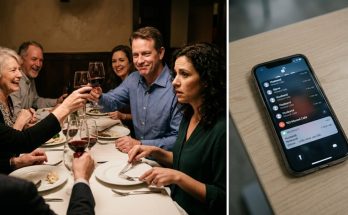
Kathy shifted in her chair and I saw the dark stain on her left stocking.
The ulcer had opened.
A small patch, then larger, spreading above the ankle. She saw me looking and tried to tuck her foot back under the chair.
“Does it hurt?” I asked quietly.
“I’m fine.”
“You’re bleeding.”
“Hank, please.”
There was shame in her whisper. Not because she had done anything wrong, but because illness has a way of convincing good people they are inconveniences.
I wanted to take her home. I should have. But the check had not come yet, and I had not brought her here for dinner. I had brought her here for the truth.
Two weeks before, Amber and Jason had stopped by our house with an early Mother’s Day card.
Amber had been wearing a new Tiffany bracelet. Helen from next door had sent me a screenshot earlier that day from Amber’s social media. Treated myself, the caption said. Because I deserve it. The bracelet cost eighty-five hundred dollars.
Kathy opened the card carefully, smiling before she saw inside.
Blank.
No message. No signature. Nothing.
Amber laughed lightly. “We thought at your age, simple is best. Less clutter.”
Kathy said, “That’s thoughtful.”
Then she went to the bathroom and cried behind the door while Jason sat on our couch and asked me how the Honda was running.
Now he returned to the table, pale and tight-jawed.
“Everything okay?” Kathy asked.
“Fine.”
“You look upset, honey.”
“I said it’s fine, Mom.”
She flinched.
It was small. Almost nothing. But I saw it.
Across the room, a woman sitting alone at table twelve had been watching us for a while.
Dark hair pulled back. Scrubs under a cardigan. Her phone propped near her water glass at an angle that seemed casual unless you knew what you were seeing.
She was recording.
I should have been angry. Instead, I felt a strange calm. Maybe some humiliations need witnesses. Maybe some truths are too heavy to carry alone.
Dessert came.
Amber ordered crème brûlée. Jason ordered chocolate lava cake. Kathy said she was full though she had eaten maybe three spoonfuls of soup. I ordered nothing.
While they ate, Kathy pulled out her phone.
“Jason,” she said carefully, “I wanted to show you something.”
He did not look up.
“I found some old pictures of you. Since the baby’s coming, I thought maybe…”
She turned the screen toward him. I could see the photo from my seat. Jason at four years old, gap-toothed, clutching a red toy fire truck I had saved for two months to buy.
“That was your favorite,” Kathy said. “You carried it everywhere.”
“Uh-huh,” Jason said, scrolling.
“And this one is your first day of kindergarten. You were so nervous, but you wore that little backpack and—”
“Mom, I’m kind of in the middle of something.”
Kathy lowered the phone.
“Oh. Of course. Later.”
Later.
The cruelest word children give aging parents. Later for the story. Later for the phone call. Later for the visit. Later for the apology.
Sometimes later means never, and everyone knows it except the mother still waiting by the window.
I looked at my son and remembered 1984.
Jason was six, burning with fever, pneumonia filling his little lungs. I had sold my paid-off Ford truck to cover the hospital bill and worked sixty-hour weeks for months. That first night, I sat beside his hospital bed and held his small, hot hand.
“I’ll always take care of you,” I whispered. “No matter what.”
Forty years later, he could not look up from his phone when his mother showed him a picture of the boy he used to be.
Tyler returned with the check in a black leather folder.
The table went still.
Amber reached for it first. Naturally.
She opened it and scanned the numbers.
Appetizers. Entrees. Desserts. Wine. Tax. Gratuity.
Total: $687.42.
I already knew. I had watched Tyler print it from across the room. Miguel stood near the bar, eyes on me.
Amber set the folder down.
“Tyler,” she said brightly, “we’re going to need separate checks.”
Tyler blinked.
“Separate checks?”
“Yes. One for us.” She gestured between herself and Jason. “One for them.”
She pointed toward Kathy.
Tyler looked uncomfortable. “Do you mean split evenly, or—”
“No,” Amber said, laughing softly. “We’ll pay for ours. They can pay for theirs. Don’t worry. We’re not paying for her.”
Her.
Not Catherine. Not my mother-in-law. Not Jason’s mother.
Her.
The word moved through the restaurant like smoke.
Jason looked up.
For one desperate second, I gave him one last chance.
He could have corrected her. He could have said, “Amber, stop.” He could have reached for his mother’s hand. He could have remembered the woman who sold jewelry once to pay for his braces, who sat up all night when he had pneumonia, who cried over a fake ultrasound because she still believed there was love in him.
Instead, Jason nodded.
“That’s fine,” he said. “Separate checks.”
Kathy’s face changed.
I watched the moment it reached her. Watched her eyes widen. Watched her mouth part. Watched the tears spill silently down her cheeks, one after another, falling onto the white tablecloth.
She did not defend herself.
That was what broke my heart most. She just sat there and accepted the wound like she had accepted so many others.
The tables around us quieted. Forks paused. Heads turned. More phones came out.
Tyler’s face flushed red.
“I’ll have to ask my manager.”
“Go ahead,” Amber said, pleased with herself.
I took a sip of water.
My hand was steady.
Then I reached into my jacket and pulled out the folder.
It was old cardboard, corners soft from years of handling, elastic band fraying. I set it on the table.
Amber’s eyes narrowed.
“What’s that?”
I did not answer.
I pushed my chair back and stood.
The legs scraped the floor, loud in the hush.
Jason looked up fully for the first time all night.
“Dad?”
I looked at him.
“Six hundred eighty-seven dollars and forty-two cents,” I said. “That’s what this meal cost. That’s what you were about to ask your sick mother to help pay after she ate three spoonfuls of soup.”
Jason’s face tightened. “Dad, don’t—”
“I’m not finished.”
Amber leaned forward. “You’re making a scene.”
“Yes,” I said. “I am.”
Miguel appeared beside Tyler.
“There is no check,” he said clearly.
Amber blinked. “Excuse me?”
“There is no check to split,” Miguel said. “The bill has already been paid.”
Jason stared at him. “By who?”
Miguel looked at me, asking permission without words.
I nodded.
“Mr. Sullivan paid for the meal earlier this afternoon,” Miguel said. “At three o’clock. In cash.”
Amber’s mouth opened slightly.
I placed my palm on the folder.
“Six hundred dollars,” I said. “Our rent money for May. We’re already two months behind. I gave it to Miguel before dinner because I knew you would do exactly what you just did.”
The restaurant went silent enough that I could hear Kathy crying.
Jason’s face drained of color.
“Dad, I didn’t know—”
“You didn’t ask.”
The words came out quiet. That made them worse.
“You didn’t ask if we could afford this place. You didn’t ask how your mother was feeling. You didn’t ask why she barely touched her food. You didn’t ask why her hands were shaking. You didn’t ask anything.”
Amber’s face flushed.
“This is manipulative,” she snapped. “You set us up.”
“No,” I said. “I gave you an opportunity to be decent. You failed in public.”
A murmur moved through the room.
I opened the folder.
The first document was the bank transfer from March 2008.
Two million dollars.
I held it up.
“Do you remember this?”
Jason’s eyes fixed on the paper.
“Dad…”
“Do you remember sitting at our kitchen table after your grandparents died? Do you remember me signing over every cent they left me because I believed in you?”
He swallowed.
“I remember.”
“You promised you’d make us proud.”
His jaw trembled.
I laid the paper on the table and pulled out the hospital bill.
“March tenth,” I said. “Your mother in the ICU. Diabetic ketoacidosis. Twelve thousand eight hundred forty-seven dollars. I called you thirteen times that day.”
Jason closed his eyes.
“You were at an eight-hundred-fifty-dollar spa appointment with Amber.”
Amber’s chair scraped. “This is none of their business.”
“You made it their business when you humiliated my wife in front of them.”
I pulled out another paper.
“My diagnosis. Stage two prostate cancer. Estimated treatment cost seventy-eight thousand five hundred dollars.”
Kathy made a sound beside me.
“Hank?”
I turned to her, and the anger faltered.
Her face had gone white.
“I’m sorry,” I said softly. “I didn’t want you to worry.”
“You have cancer?”
I could not answer. Not in a way that would fix what hiding it had already broken.
Jason stood halfway, then sat down again like his legs had given out.
“You didn’t tell me,” Kathy whispered.
“I couldn’t,” I said. “You were rationing insulin. I couldn’t ask you to carry one more fear.”
She covered her mouth with both hands.
Amber looked from me to Kathy to the phones now raised around the room.
“Okay,” she said quickly. “This is sad, obviously. But Jason and I have our own financial pressures too. You don’t know what we’re dealing with.”
“I know enough,” I said.
Then I pulled out the last receipt.
It was not from a hospital. It was not from a bank.
It was from an online costume shop.
Amber went still.
I held it up.
“Forty-eight dollars,” I said. “Silicone pregnancy belly. Ordered under your name six weeks ago.”
The room inhaled.
Amber grabbed for her stomach.
“Don’t.”
But she moved too quickly. Her chair caught on the table leg. Her heel twisted. She stumbled sideways, and the fitted dress shifted.
The edge of the silicone pad slipped.
Just enough.
Enough for everyone to see.
The fake curve. The seam. The lie strapped to her body beneath cream-colored fabric.
Someone whispered, “Oh my God.”
Another voice said, “She faked it.”
Amber clutched her stomach with both hands, trying to press the belly back into place.
“This isn’t what it looks like.”
“It is exactly what it looks like,” I said.
Kathy stared at her.
The pain on my wife’s face in that moment was worse than the humiliation over the bill. Worse than the blank card. Worse than the soup. Amber had not just lied. She had handed a dying woman a dream and watched her cry over it.
“You told me I was going to be a grandmother,” Kathy whispered.
Amber’s eyes darted to Jason.
He was staring at her like he had never seen her before.
“Amber,” he said. “Tell me that isn’t fake.”
She said nothing.
“Tell me.”
“I had to,” she whispered.
“For what?”
She looked around at the cameras and seemed to realize there was no private corner left for the truth to hide in.
“We needed money,” she said.
Jason’s voice dropped. “What money?”
Amber’s face twisted.
“The insurance. The house. Your parents were going to leave everything eventually.”
Kathy closed her eyes.
I turned to Jason.
“I heard you,” I said.
He looked at me.
“In the hospital hallway. Eight weeks ago. You and Amber talking about your mother’s life insurance policy. Fifty thousand dollars. I heard her ask how much longer Kathy had. I heard you say maybe a year. I heard both of you agree to wait.”
“No,” Jason whispered.
“Yes.”
“I didn’t mean it like that.”
“You said it.”
His face collapsed.
He covered it with both hands and began to sob. Not politely. Not quietly. Huge, ugly sobs that shook his shoulders.
“I’m sorry,” he choked. “Dad, I’m so sorry. Mom, I’m sorry. God, what have I done?”
Kathy stood.
She swayed, and I reached for her immediately. Blood had soaked through the stocking near her ankle. Her whole body trembled, but when she spoke, her voice was clear.
“We’re leaving.”
Jason looked up, destroyed.
“Mom, please.”
She looked at him for a long moment.
“Goodbye, Jason.”
Then she took my arm, and we turned away.
Part 3
For five seconds, the entire restaurant held its breath.
Then someone clapped.
One slow clap from somewhere near the back.
Then another.
Then a woman two tables away stood, tears running down her cheeks, and clapped too. A man near the bar joined. Then the family with teenagers. Then half the room. Then nearly everyone.
The sound rose around us, not like celebration, but like witness. Like strangers saying, We saw it. We saw her. We saw what they did.
Kathy leaned into me. I felt how little strength she had left.
“You’re a good man, sir,” someone said.
“God bless you both,” called another voice.
Amber stood frozen beside the table, hands still pressed over the fake belly. Jason sat collapsed in his chair, weeping.
Miguel approached us through the applause. His face was wet.
“Mr. Sullivan,” he said, voice shaking. “I need to tell you something.”
I could barely hear him over the clapping.
“What is it?”
“I know who you are.”
I frowned.
“I’ve known since you walked in. Since I saw the scar.”
He gestured to my right hand.
“August seventeenth, 1994,” he said. “Warehouse fire on East Van Buren. My father was inside. Roberto Alvarez. Maintenance worker.”
The years fell away.
Smoke. Heat. A steel beam. A man trapped beneath it screaming in Spanish and English and then not screaming at all. I remembered the fire burning through my glove when I grabbed the beam. Remembered dragging him out by the shoulders.
“Your father lived?” I asked.
Miguel nodded, crying harder now.
“Twenty-five more years. He saw me get married. He held my children. He died in his bed with all of us around him because you pulled him out of that building.”
I had no words.
Miguel reached into his jacket and handed me a check.
Five thousand dollars.
“This is from the restaurant,” he said. “For your rent. For medicine. For whatever you need tonight.”
“I can’t accept that.”
“You can,” he said. “You will.”
Then he pressed the original envelope into my hand.
“And this is your six hundred back.”
“Miguel—”
“You gave me twenty-five years with my father,” he said. “Let me give you one night of peace.”
That was when I broke.
I had stood through burning houses and funeral services and hospital bills and the sound of my son waiting for his mother to die. But kindness undid me.
I pulled Miguel into a hug and cried against his shoulder like a child.
When we finally made it outside, the warm Arizona night felt unreal.
The valet brought the Honda around. Kathy was shaking so badly I had to help her into the passenger seat inch by inch. Before I could close the door, Jason came running out.
“Dad!”
I turned.
His suit was wrinkled. His face was streaked with tears. Behind him, Amber appeared in the doorway without the fake belly. Her dress hung loose.
“Please,” Jason said. “Let me explain.”
“You had sixteen years to explain,” I said. “Sixteen years to ask what happened to the parents who gave you everything.”
“I didn’t know how bad it was.”
“You didn’t want to know.”
Amber stepped forward.
“This got out of hand,” she said. “But we can fix it. We can talk about money like adults.”
Jason turned on her.
“How much debt?” he asked.
She froze.
“How much, Amber?”
Her mouth tightened.
“Two hundred thirty thousand.”
Jason stared.
“What?”
“Credit cards. Personal loans. The lifestyle expenses. The business isn’t what you think, Jason. Derek’s been stealing for years and you never paid attention.”
Jason looked like the ground had opened.
“You told me we were fine.”
“You wanted to be fine,” Amber snapped. “You wanted the suits and the car and the dinners. You wanted to feel rich. I just kept the picture looking right.”
“And the pregnancy?”
“I needed time.”
“For what?”
“For them to die!” she shouted, then clapped a hand over her mouth too late.
The words hung in the parking lot.
Kathy made a small sound from inside the car.
Jason stepped back from Amber as if she had become poisonous.
“We’re done,” he said.
“Jason—”
“No. Whatever this was, whatever I thought we had, it’s over. Get away from me.”
Amber’s face hardened. She looked at me then, and for the first time that night, the mask fell completely. Underneath was not glamour. It was panic.
“You ruined my life,” she said.
“No,” I answered. “I just stopped paying for the lie.”
The woman from table twelve came out while Jason and Amber were still standing there. She held her phone down now. Her face was pale, eyes red.
“I’m sorry,” she said to me. “I recorded it.”
“I know.”
“I’m a nurse,” she said. “I saw your wife’s foot. I saw how they were treating her. I couldn’t just sit there.”
“What’s your name?”
“Rachel.”
Something in her face pulled at me. The shape of her eyes. The chin. A memory I could not place.
She hesitated, then said, “Rachel Sullivan.”
My breath stopped.
“My mother was Linda Sullivan,” she continued. “Your father’s daughter. Before he married your mother.”
The world tilted.
I had heard whispers as a child. A woman before my mother. A baby placed elsewhere. A family shame sealed shut because that was what families did back then. My father never spoke of it.
“You’re my sister,” I said.
Rachel nodded, crying now.
“I found out years ago. I didn’t know how to approach you. Then tonight I saw your name on the reservation list from the hostess stand. I thought maybe I’d just… see you. I didn’t expect any of this.”
Kathy reached from the car and took Rachel’s hand.
“You did the right thing,” she whispered.
Rachel posted the video that night.
By two in the morning, millions had seen it. By morning, the whole country knew our shame. Mother’s Day. A sick woman. A fake pregnancy. A son who nodded when his wife said, We’re not paying for her. People argued about us on television. Strangers donated money. Reporters knocked on our door.
I did not answer.
For three days, I kept the curtains closed, dressed Kathy’s foot, checked her glucose, and tried not to think about the fact that the worst night of our lives had become content for people eating breakfast.
On the third day, Jason called.
I let it ring four times before answering.
“Dad,” he said. His voice was raw. “Can I come over? Please. I know I don’t deserve it.”
I looked at Kathy. She was on the couch with her foot elevated, eyes closed but not asleep.
“Tomorrow,” I said. “Two o’clock.”
Jason arrived in jeans and a wrinkled T-shirt. No suit. No watch. No performance.
We sat at the same kitchen table where I had signed over two million dollars sixteen years earlier.
He placed a stack of papers between us.
“I found your cancer paperwork,” he said, voice breaking. “In the glove compartment.”
I said nothing.
“And Mom’s notebook.”
Kathy looked up.
Jason pulled out a small spiral notebook. Her handwriting filled the pages. Dates. Insulin doses. Apologies to God.
He read one line and could barely finish.
“Half dose again. Hank doesn’t know. He’d give me his last dollar and we need it for rent.”
His hands shook.
“I was getting massages,” he whispered. “Buying wine. Letting Amber spend money we didn’t have. While Mom was writing this.”
He put his head in his hands.
“What have I done?”
No one answered him quickly.
Some questions deserve to echo.
Finally Kathy said, “You forgot us.”
Jason sobbed harder.
“I know.”
“You let her make us small.”
“I know.”
“You made yourself small too,” she said.
That made him look up.
Kathy’s face was pale, but her eyes were steady.
“You are not the man you were at that table,” she said. “Not if you choose not to be.”
He reached for her hand, stopping just short as if afraid he no longer had the right.
“Can I try?” he asked.
Kathy looked at me.
I wanted to say no. I wanted to protect her from hope because hope had been used against her too many times. But I saw her face, and I knew she was still his mother.
“You can try,” she said. “But trying is work, Jason. Not words.”
He nodded.
And for once, he worked.
He started a fundraiser called Help My Parents After I Failed Them. The title embarrassed me, but people gave anyway. By August, it had raised more than four hundred thousand dollars. Jason paid Kathy’s medical debt. He paid for my cancer treatment. He bought her an insulin pump. He sold the Porsche. Sold the big house. Filed for divorce. Left the business and turned over documents to investigators.
Derek was arrested for embezzling millions.
Amber was arrested too. Wire fraud. Elder abuse. Identity theft. Criminal harassment. The video had done what private pain rarely does: it made authorities look.
Rachel came three times a week, not as a stranger with a phone anymore, but as my sister and Kathy’s nurse. She changed dressings, taught Jason how to monitor glucose, brought casseroles, and sometimes sat with me on the porch while we talked about the father we had shared in very different ways.
Jason drove me to thirty-five radiation treatments.
Every one.
He sat in waiting rooms with bad coffee and old magazines. He learned Kathy’s medication schedule. He called Dr. Morrison twice a week with questions. At first I thought guilt was driving him. Maybe it was. But guilt burns hot and fast. This lasted.
By December, Amber stood before a judge and pleaded guilty. Five years. Restitution. Probation after release. Derek got eight.
I did not feel victorious.
Justice is not the same as joy. Sometimes justice is only the moment the bleeding stops.
In June 2025, thirteen months after that dinner, Kathy and I sat in Dr. Morrison’s exam room.
Jason had driven us there, then stayed in the waiting room because he said he did not want to intrude unless we asked. That alone told me how much had changed.
Dr. Morrison walked in with two folders and a smile.
“Hank,” she said, “your PSA is point eight.”
I blinked.
“Down from forty-seven. No detectable masses on your latest scan. I’m calling it complete remission.”
Kathy squeezed my hand so hard her ring pressed into my skin.
Then Dr. Morrison turned to her.
“And your A1C is down to seven point two. Your glucose levels have been stable for three months. The pump is working beautifully.”
Kathy cried quietly.
“Jason checks it every morning,” she said. “And every night.”
“I know,” Dr. Morrison said. “He calls me constantly.”
One year and one day after the dinner, we went to Jason’s apartment for Mother’s Day.
Not a restaurant. Not white tablecloths. Not wine chosen to impress strangers.
A small one-bedroom place in Tempe. Thrift-store couch. Mismatched chairs. Roasted chicken in a tiny kitchen. Rachel brought daisies and homemade bread. Jason opened the door before we knocked.
He looked nervous.
“Hi, Mom,” he said. “Happy Mother’s Day.”
Kathy stepped inside.
On the table was a card.
Plain envelope. No embossed flowers. No expensive paper.
Her hands trembled as she opened it, but not from illness this time.
Inside, Jason had written three pages.
He wrote about the toy fire truck. About pneumonia. About the day she taught him to tie his shoes. About the blank card and how ashamed he was. About the baby that never existed and the grandmother she should have been allowed to hope to become honestly someday, not through a lie.
At the end, he wrote, I don’t deserve to be your son, but I am grateful every day that you are still willing to be my mother.
Kathy read it twice.
Then she stood and hugged him.
Jason broke down in her arms.
“I love you, Mom,” he whispered.
“I love you too,” she said. “But don’t waste it this time.”
He held her tighter.
“I won’t.”
I stood in the doorway of that small apartment, watching my wife and son hold each other in a room that smelled like garlic and forgiveness.
The world had not gone back to what it was. It never does. Some words cannot be unsaid. Some betrayals leave marks no apology can smooth over. But Kathy was alive. Jason had come home, not as the polished man in the Porsche, but as the broken son willing to do the work of becoming human again.
And me?
I still had the scar on my hand from a fire in 1994.
I had the scar inside me from a dinner in 2024.
But that morning, when we sat down together at Jason’s little table and Kathy bowed her head to bless the food, I looked at my son and saw him watching his mother with tears in his eyes.
Not looking away.
Not scrolling.
Watching her.
As if he finally understood what she was worth.
As if he finally understood what everything had cost.
On Easter Sunday, my daughter sobbed, “Dad, please come get me. He hit me again.”
Part 2 of 2