Part 1
I should have known something was wrong the moment I saw Amber smile.
Not because it was cruel. Cruelty, I had learned, did not always show its teeth. Sometimes it came polished and perfumed, wearing a designer dress, carrying a leather handbag, smelling faintly of jasmine and money. Sometimes it leaned in close enough to kiss an old woman’s cheek and somehow made the kiss feel like an insult.
It was Mother’s Day, May 12, 2024, in Scottsdale, Arizona, and the evening heat had not yet lifted from the pavement when Kathy and I pulled into the parking lot of Mo’s Ocean Club.
My old 2009 Honda Civic groaned when I shifted into park. It made that grinding noise again, the one I had been pretending not to hear for three months. Kathy glanced at me from the passenger seat but did not say anything. That was one of the thousand little mercies and heartbreaks of being married to the same woman for forty-seven years. She knew the noise meant repairs we could not afford. She knew I knew. She knew I hated myself for every little thing I could not fix.
Instead, she smoothed both hands over the skirt of her pale blue dress.
It was the thrift-store dress. Fifteen years old, maybe more, with tiny pearl buttons at the cuffs and a loose waist she had taken in herself one winter when we still owned a sewing machine that worked. She had ironed it that morning with trembling hands, pressing the fabric slowly, carefully, as if dignity could be steamed into the seams.
“You sure about this?” she asked.
Her voice was soft. Too soft. The kind of soft that meant she was already tired and hiding it.
I looked at the restaurant through the windshield. Glass doors. Valet stand. Big planters with white orchids standing like they had been arranged by someone who thought flowers should look expensive before they looked alive.
“It’s Mother’s Day,” I said, taking her hand. “You deserve a nice dinner.”
Kathy smiled at me, but her eyes moved toward the entrance again. She had been nervous all day. She never said Jason’s name with accusation in it. Not once. Even after the unanswered calls. Even after the blank card. Even after the hospital.
Especially after the hospital.
“He sounded busy when he called,” she said.
“He invited us.”
“Yes, but Amber picked the place.”
She did not say what we both knew. Amber picked places like Mo’s because people like us looked out of place in them.
I squeezed her hand. Her fingers were cold despite the heat.
“We’ll eat,” I said. “We’ll see our son. We’ll come home.”
Kathy nodded. Then she looked down at her left ankle, at the place where the bandage beneath her stocking had already begun to feel too tight. She shifted carefully in the seat, trying not to wince.
I saw it anyway.
I saw everything with Kathy. The slight grayness around her mouth. The way her shoulders slumped between breaths. The tiny tremor in her fingers when she reached for her purse. The way she pretended she was only tired when the truth was that diabetes had been chewing through her body while our money disappeared pill by pill, bill by bill, apology by apology.
“Give me a second,” I told her.
I got out of the car before she could answer and crossed the lot toward the restaurant. It was not open yet, not officially. I had called ahead, and when I approached the entrance, a man in a dark suit stepped outside to meet me.
Miguel Alvarez. Early fifties, clean-shaven, kind eyes that had seen enough rude customers to know when a man walking toward him was carrying more than a reservation problem.
“Mr. Sullivan?” he asked.
“That’s me.”
He shook my hand. His eyes flicked briefly to the scar across my right hand, the shiny old burn that ran from knuckle to wrist. Most people noticed it and looked away. Miguel noticed it and held there half a second too long, as if it had tugged at some memory he could not place.
“How can I help you?”
I reached into my jacket and pulled out the envelope.
There was six hundred dollars inside. Cash. Our rent money for May. We were already two months behind. The landlord had started leaving folded notices taped to the door, the kind that began with formal language and ended with the threat of losing the only place you had left.
I held the envelope out.
“I need you to do something for me.”
Miguel looked at it but did not take it right away.
“What is this?”
“Dinner.”
His eyebrows rose. “Prepayment?”
“Yes.”
“For tonight?”
I nodded, and suddenly my throat felt narrow. I looked over my shoulder at the Honda, at Kathy sitting in the passenger seat, watching me with worried eyes.
“My son and daughter-in-law are bringing us here for Mother’s Day,” I said quietly. “When the check comes, I need you to tell them it’s already been paid.”
Miguel’s expression changed. Not much. Just enough.
“Mr. Sullivan, that’s not usually—”
“I understand. I know this is strange.” I pushed the envelope closer. “There’s six hundred in there. I don’t know what the bill will be. I’m hoping it’s enough. If it isn’t, tell them anyway. I’ll find a way to pay the difference later.”
Miguel looked at the envelope. Then at my car. Then at Kathy.
“May I ask why?”
I swallowed.
“Because I know my son won’t pay for his mother,” I said. “And I won’t let her be humiliated tonight.”
The words landed between us with a weight I had been carrying for months.
Miguel did not speak for a moment. The Scottsdale sun reflected off the restaurant windows and made his face hard to read. Then he took the envelope, folded it once, and tucked it into the inside pocket of his jacket.
“I’ll take care of it,” he said.
“If it’s over—”
“It won’t matter.”
“Miguel—”
“It won’t matter,” he repeated, more firmly. Then his eyes moved again to the scar on my hand. Something flickered there. “And happy Mother’s Day to your wife.”
I nodded, unable to say much else.
Kathy and I drove around the block until six. She asked me what I had talked about with the manager, and I lied. I told her I had confirmed the reservation. She watched my face, and for one moment I thought she would press me, but then she only reached for my hand and held it.
By the time we returned, the valet was outside.
He looked no older than twenty. His gaze slid over the Honda, the faded paint, the dent near the rear bumper, the tired headlights. He did not sneer exactly, but he did not have to. At my age, you learn how young men make judgments with their eyebrows.
I handed him the keys and helped Kathy out.
She leaned on me harder than she meant to. Her left foot touched the ground and her breath caught.
“You okay?” I whispered.
“Fine,” she said immediately. “Just stiff.”
Then I heard the low growl of an engine behind us.
A black Porsche Cayenne rolled up to the valet stand like a predator arriving late because it knew everything else would wait. The paint was so glossy the sunset seemed trapped inside it. The vanity plate read JAYSULLY.
My son stepped out first.
Jason Sullivan, forty-six years old, tall, broad-shouldered, wearing a navy suit that probably cost more than my monthly pension check. He looked healthy. Successful. Expensive. He had my father’s jaw and Kathy’s eyes, though lately he used them less like his mother and more like windows with the curtains drawn.
“Mom,” he said, brightening just enough.
Kathy’s whole face changed.
That was the terrible thing about mothers. They could be starving for love and still act surprised when a crumb fell near them.
“Jason,” she breathed.
He hugged her carefully, as if she were breakable, which she was, though not in the way he thought. Then he clapped my shoulder.
“Dad.”
“Son.”
Amber emerged from the passenger side.
She was blonde in the expensive way, the kind that required appointments and toners and someone telling her which shade looked effortless. Her dress was cream-colored, fitted at the waist, with gold jewelry at her throat and wrists. Her heels were sharp enough to make the sidewalk sound nervous beneath her.
She took one look at Kathy’s dress.
Then she smiled.
“Catherine,” she said, brushing her lips near Kathy’s cheek but not quite touching. “Happy Mother’s Day. That dress is so sweet. Vintage, right?”
Kathy’s smile faltered for half a breath.
“Oh. Yes. I’ve had it a while.”
“I thought so.”
Amber turned to me.
“Hank.”
“Amber.”
There are a thousand ways to say a person’s name. Hers made mine sound like a chore.
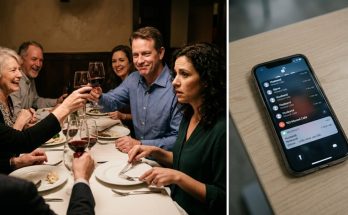
Inside, Mo’s Ocean Club hummed with quiet wealth. Not loud wealth. Loud wealth belonged to people still trying to prove something. This was soft wealth. White tablecloths. Crystal chandeliers. Glasses polished until they looked imaginary. People spoke in low voices because they had never had to raise them to be heard.
Our table was in the corner.
Kathy lowered herself into the chair with relief and one hand slipped briefly toward her ankle. Jason noticed just long enough to ask, “You okay, Mom?”
“Just a little tired.”
Amber was already on her phone.
The waiter arrived with menus and water. His name tag said Tyler. He was polite, nervous in the way young servers get around people who might punish them for breathing too close to the wine.
“Can I start anyone with drinks?”
“Bottle of the Cassis,” Amber said without looking up. “The 2019.”
Tyler nodded. “Excellent choice.”
I looked at Kathy. Her eyes were on the menu, but I knew she was not reading dishes. She was reading prices.
Amber flipped pages with casual confidence.
“Oh my God, they have oysters. Babe, we have to get oysters.”
“Sure,” Jason said, thumb moving across his phone.
“And lobster tail. It’s market price, but whatever. It’s a special occasion.”
Kathy’s hand found mine under the table.
Her fingers trembled.
When Tyler returned, Amber ordered like she was performing for an audience. Oysters Rockefeller. Lobster tail. The wine. Jason added tuna tartare and Wagyu ribeye without lifting his eyes from his screen.
When Tyler turned to Kathy, she straightened a little, trying to look comfortable.
“For you, ma’am?”
“The French onion soup, please.”
It was eighteen dollars. The cheapest item on the menu.
“And for you, sir?”
“House salad.”
Sixteen dollars.
Amber did not even glance up.
For a while, the table filled with the kind of conversation that is worse than silence because it proves silence would have been more honest. Amber talked about spa appointments, about a woman she knew who had chosen a “terrible backsplash” for her kitchen, about how exhausting it was to manage contractors who did not understand “vision.” Jason nodded at intervals but mostly typed on his phone. Kathy tried to ask him about work and he answered with words like “fine” and “busy” and “complicated.”
I watched my son across the candlelight and thought about two million dollars.
Sixteen years earlier, after my parents died in a wreck on I-10, a lawyer had handed me a number I could barely understand. Two million dollars after the house sale, life insurance, investments, savings. My mother and father had lived modestly their entire lives. My father fixed his own lawn mower until the year he died. My mother saved wrapping paper from Christmas and folded it into drawers.
They had left me everything.
And I had given everything to Jason.
I could still see him at our kitchen table in March 2008, thirty years old, bright with ambition, fresh out of business school and talking about real estate development like it was not a gamble but destiny. Kathy sat beside me, stunned when I told her what I wanted to do. But then she looked at our son and softened. She always softened when she looked at him.
“This is your chance,” she had told him.
Jason cried that night. Real tears. He hugged us both, promised he would build something that would make us proud.
“I’ll take care of you,” he had said. “You’ll never have to worry.”
But worry had moved into our house years ago and taken the spare bedroom.
The appetizers came.
Amber ate six oysters without once asking Kathy if she wanted to try one. Jason picked at his tuna while scrolling. Kathy’s soup sat steaming in front of her, untouched.
Then Amber set down her fork, reached into her purse, and changed her face.
It was subtle, but I saw it. The bored woman disappeared. In her place came warmth, staged and bright.
“Catherine,” she said, “Jason and I have news.”
Kathy looked up.
Hope is dangerous when someone cruel knows how to use it.
Amber turned her phone around.
A black-and-white ultrasound filled the screen.
“We’re pregnant,” she announced. “Fourteen weeks.”
Kathy’s hand flew to her mouth.
For one moment, everything cruel and cold at that table melted from her face. She looked twenty years younger. Tears came instantly, shining in her eyes before spilling down her cheeks.
“Oh my God,” she whispered. “Oh, sweetheart.”
She reached across the table and took Amber’s wrist, holding on like she had just been thrown a rope.
“A baby? Jason, you’re going to be a father?”
Jason smiled faintly. “Yeah, Mom.”
“A grandbaby,” Kathy said. “Our first grandbaby.”
Amber let Kathy hold her wrist for exactly two seconds before patting her hand and pulling away.
“We’re very excited,” she said, then lifted her wine glass and took a sip.
I watched the glass.
Maybe I was old-fashioned. Maybe medical advice had changed. Maybe one sip of wine did not mean anything. But Amber kept sipping. And the ultrasound image looked too perfect, too flat, too much like something pulled from a website. I had seen enough ultrasound photos from guys at the fire station bragging about grandchildren. They all had smudges and names and weird angles and the private messiness of real life.
This one looked like a prop.
But what was I supposed to do? Accuse my daughter-in-law of faking a pregnancy over oysters on Mother’s Day?
So I sat there while my sick wife cried with joy over a grandchild I did not believe existed.
“When are you due?” Kathy asked.
“Late October,” Amber said. “Halloween, actually.”
“Oh, that’s sweet.”
“Isn’t it?”
“Have you thought about names?”
“Not really.”
“Do you know if it’s a boy or a girl?”
“Too early.”
Kathy smiled through tears and touched her own chest like her heart hurt from being too full. I looked at Jason, waiting for some sign of tenderness, some recognition of what that moment meant to his mother. But his phone had buzzed, and he was already looking down.
Click Here to continuous Read Full Ending Story👉 Part2: My wife and I went out to dinner with my son and his wife at a restaurant on Mother’s Day.
My wife and I went out to dinner with my son and his wife at a restaurant on Mother’s Day.
Part 1 of 2