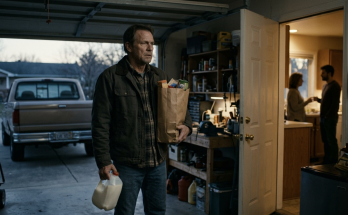
The sky had lost its color by the time Hazel’s boots sank into compacted drifts and she stood on Tyler’s porch, breath misting in the cold like the small clouds that had once been her whispered prayers. Her fingers trembled around the railing; she could feel the house through the wood beneath her hands, the faint vibration of a fridge, the muffled thump of a child’s cartoon from inside. For a moment she let herself pretend she had arrived for a simple, ordinary visit—tea, a hug, the awkward laughter of people who had chosen to be kind to one another despite past wounds—before the wind pushed that thought aside with a gust that rattled the windows and reminded her of how fragile ordinary was now.
She expected the door to be slammed shut, an angry shout, the cold finality of Tyler’s “don’t come.” Instead it opened a crack, then wider when Chloe peered out, hair lopsided from being hastily pulled into a bun, eyes red from the strain of watching weather reports and small, restless children. The recognition in Chloe’s gaze was not a greeting so much as an assessment: she took Hazel in and decided in a fraction of a second whether this woman belonged in the chaos about to swallow them. When Hazel lifted a mittened hand, Chloe’s mouth softened just enough for the woman to step back and say, “Please. Come in.”
Inside, the house smelled of cinnamon, wet laundry, and something baked earlier that had gone half-forgotten on the counter. The lights were low; lamps cast soft ovals around the living room where Tyler sat on the couch, wrapped in a blanket with the kids clustered near him like dark, small planets. He looked older than Hazel remembered, not because of lines or gray but because of the strain that lives in a person who carries too many responsibilities. For a heartbeat they both froze—mother and son, not quite foes and not quite friends—then gravity took over, and confrontation pulled them inevitably closer.
Tyler’s expression was a map of conflicting emotions: icy reserve at the edges, a face carved with the stubbornness he’d inherited from Hazel and then softened by helplessness. He opened his mouth and closed it again. The house hummed with the storm beyond. “Why are you here?” he asked, and his voice was more accusation than question, a shield raised against the fear he couldn’t name.
Hazel’s answer was neither balled fist nor apology born of guilt alone. She had rehearsed a dozen speeches on the drive—the bitter ones, the pleading ones—but the wind had polished her words into something simpler. “Because you’re in trouble,” she said. “Because there are kids in your house.” She could feel Elena’s presence behind the resolution, the echo of Ray’s texts in her pocket, but she kept the focus only where it needed to be: on the people in front of her who would not survive a night of isolation without help.
Chloe moved like someone who had practiced hospitality and crisis management at the same time, shepherding the children toward the small kitchen table and handing Hazel a chipped mug. Tyler watched her hands the way a man watches a weathered pilot steer a plane through turbulence—trusting her competency but worrying about what would happen if the pilot faltered. Only when the kettle began to boil and the house filled with hot steam did the lines in Tyler’s face relax a degree, as if the small domestic gesture made all of them human again.
It would have been easy, in that fragile warmth, to pretend nothing had happened, to sit under throw blankets and swap Christmas anecdotes and carry on as though estrangement had been merely a long vacation. That was not the storm’s bargain. The blizzard would not let them hide behind polite omissions; the wind demanded truth and proximity with the same single-mindedness as a parent demanding supper. As the snow lashed the windows, the close quarters forced conversations into their own collisions—words met words and then, awkwardly, something softened.
Tyler’s first salvo was a quiet, careful thing. “You know,” he began, looking not at Hazel but at the children, “we tried to shut it out. For a while we thought we could just—” He trailed off, as if closing a door on the memory, and Hazel felt the plea in the unfinished sentence: an admission that avoidance had been chosen out of pain, not cruelty. She had wanted to punish him for his decision to exclude her, but hearing his faltering admission, the edges of her anger loosened.
Hazel rocked slightly in the chair across from him, hands wrapped around the steaming mug as if to anchor herself. She could have let that moment be another weapon: a list of hurtful things to fling, a ledger of absence. Instead she opted for something she had grown into slowly since the storm began—a willingness to be vulnerable. “I didn’t think it would matter,” she admitted without the need for theatrical apology. “Not at first. And then everything came down like this.” She made a vague motion toward the window where the world outside had become a wall of white. “And I realized I’d been harder on you than I meant to be. On you and Chloe. On the kids.”
That confession landed between them like a small, warm pebble thrown into cold water; the ripples were not immediate, but they came. Tyler exhaled, a sound that might have been a laugh if he hadn’t been so choked with relief. He said, “You heard me.” His jaw worked. “You should’ve listened when I told you not to come.” There was accusation in that sentence, but behind it was a thread of humility; he had expected rejection and instead had received presence.
Chloe, watching both of them, let out the breath she had been holding and placed a small, sticky hand into Hazel’s. The child didn’t know the contours of the family’s fracture; she only knew that someone’s hand felt safe. Hazel squeezed back, and in that tiny, seemingly inconsequential contact she felt the axis of their relationship shift. The house might have been battered on the outside, but inside that kitchen, the weather’s malice could not reach the basic necessities of care: warmth, food, and touch.
Snow continued to accumulate against the windows as if trying to claim the house for itself, writing a slow, relentless paragraph across the landscape. The generator thumped to keep essential lights alive, and for a brief stretch the world beyond the walls was a rumor. In that rumor Tyler finally prodded the sore places, asking about Hazel’s decision to leave years ago, about the fights that had never been fully fought and the apologies that had been too late. He used the shelter of crisis to ask the questions that had been lodged in his chest like splinters.
Hazel answered with a steadiness that surprised her. She did not make excuses for the past; she acknowledged it—naming nights she had been absent, the ways her judgment had hardened, the times she had chosen principle over presence. But she also told them about what she’d learned in the months since: the hollow ache of regret, the clarity that pain can bring when it is not allowed to blight every moment. Her voice carried stories of small actions she had taken to change—letters she had written and never sent, grief groups she’d attended, the slow reweaving of compassion into the fabric of her habits.
When Tyler listened, his face softened in stages, like snow easing off a roof. He told her, haltingly, about the fear that had driven his insistence on distance, how he believed that protecting his own family meant keeping the past at arm’s length. He confessed his worry that Hazel’s presence might thicken old arguments in place of calming them, that his children’s safety required not just physical shelter from storms but freedom from emotional tumult. Those were honest fears, and Hazel met them with the same honesty she had offered earlier: she admitted she had been volatile, that her brand of love could sometimes feel like pressure.
Their conversation did not bloom into easy sentimentality. There were ruptures that had scabbed over but not healed fully; Tyler reminded her of a Christmas that had gone quiet, of a graduation she had missed, of confidences turned away. Hazel cried—not the theatrical tears of someone seeking absolution but the small, wet honesty of a person naming her mistakes. The children, sensing the adult gravity but too young to parse it fully, clung and asked simple questions about hot chocolate and whether Santa would brave the storm. Those queries, comically ordinary against the background of such deep talk, made them all laugh until their chests hurt and the strain in the room eased.
At one point, when the conversation turned inward and the storm banged a loud punctuation against the roof, Tyler asked the question Hazel had prepared herself for and dreaded in equal measure: “Can we try—” He stopped and swallowed. “Can we try to start over?” The clause was small and vulnerable, like a bird landing on a wire, uncertain whether the perch would hold.
Hazel looked at him, really looked, as if cataloging the changes the years had imposed and the constants they had somehow preserved. Her heart wanted to leap; the mother in her wanted to promise everything at once. But the woman she had been learning to be chose measured hope over immediate absolution. “We can try,” she said slowly, then more firmly. “But it will take time. And you’ll tell me when I step over the line. I’ll listen.” She left space for him to accept or hesitate, to set whatever boundaries he needed. That humility won him over more than a flood of promises ever would; his eyes shone with something like gratitude.
Chloe, who had been mostly a steady presence throughout, finally let herself voice the fear she had been cradling. “I was afraid,” she admitted, fingers worrying at the edge of a blanket. “Afraid this would bring old storms back into our home.” Her admission was small, raw, and immediately acknowledged by Tyler, who said, “And I’m glad you told me. We protect them first.” Hazel reached out and set her hand over Chloe’s in a gesture that spoke of partnership, of a woman finally recognized as more than the other woman in Tyler’s life.
The conversation moved from confessions into logistics—how they’d manage if the electricity stayed out, whether Ray’s updates could be trusted, and how they’d ration food if the storm did not abate. These practical concerns, wrenched from immediate necessity, became the scaffolding around which forgiveness could be built. They planned who would sleep where, how the generator would be monitored, and who would brave a trip to the neighbor’s if a vehicle could be dug out. In mapping out survival, they mapped out trust too: delegations of small, everyday responsibilities that required faith in one another’s competence.
At one point, to clear the air of heaviness, Tyler fetched the old box of board games from under the coffee table. The kids squealed in delight, and for an hour the family reclaimed something ordinary—dice clicking, dry jokes, petty cheating that earned only good-natured groans. Laughter in that room felt like medicine, a remedy that didn’t erase the past but made room for more than regret. Hazel caught Tyler’s eye across the Monopoly board and saw a flicker of the child he once was—mischievous, competitive, soft when it came to family. That flicker refused to be snuffed out.
Outside, the storm showed no mercy, and at intervals the house shuddered under heavier gusts that made even the seasoned adults flinch. Each time the lights dimmed and the generator caught, a small cheer arose like a ritual of relief. Their gratitude for trivial comforts—a steady hum, a plate of warm cookies, the glow of a lantern—felt disproportionate only until Hazel remembered other nights of scarcity, other winters that cued a different kind of desperation. The happiness around those comforts did not erase pain; it simply revealed the capacity of ordinary joys to knit frayed edges.
As the night bent toward early morning, Tyler’s defenses thinned further. He recounted the more intimate fears—Nights he lay awake thinking about how he’d spoken to Hazel when she showed up first at his doorstep years ago; the words he’d hurled to protect a version of himself who was more judgment than forgiving. Hazel answered with confessions of her own: how children’s milestones had haunted her as they happened in photos, not in person; how she had replayed moments and wanted to go back, even though she knew she could not change what was done.
The people they loved in the room became the fulcrum of their conversation—visible talismans of why reconciliation mattered. Tyler watched his children breathe peacefully in the dim light, and something in him shifted toward repair not out of obligation but necessity; for them, he decided, the past needed to be softened. He apologized not for the sake of drama but because the apology changed his posture in the world. Hazel, in turn, apologized without flourish. Her words were plain and true: sorry for the absence, sorry for the pain, sorry for the ways her pride had hardened into armor that kept warmth out as well as it kept hurt at bay.
The first gentle steps of rebuilding were not grand declarations but small acts of service: Hazel staying up through the late hours to listen to a restless toddler, Tyler moving a space heater to the room where Chloe slept, Chloe tucking extra blankets at the children’s feet. Each action was tiny, mundane, but cumulatively they began to form a new grammar for how they lived as an imperfect family. The habits of care, once reacquainted, found a quick rhythm.
Just when the household had settled into a fragile peace, the radio crackled to life with Ray’s voice threaded through the static. He had been on top of things since Hazel first received his warnings, making calls and checking in. He reported that roads might not be passable for another day; crews were overwhelmed in other parts of the county. The news was not good; it meant the enforced closeness would continue. For a moment the word “another” hung heavy in the room, a reminder that their hard-earned détente was not yet secure against the wear of endless proximity.
And yet, in that uncomfortable extension of time, gratitude deepened. The family, now no longer a collection of estranged people under one roof but a communal unit binding together against a common external threat, began to inhabit an unexpected intimacy. They discovered the solace in ordinary routines—preparing meals together, tucking the children in, sharing quiet jokes in the dim light. The storm outside became a backdrop against which fragile reconciliation could find traction; the isolation sharpened the focus on what they still had rather than what they had lost.
Hazel watched Tyler sleep for a few minutes that felt like an unguarded lifetime. The son’s face, softened in rest, revealed those small inheritances that reminded her of earlier, better days: the tilt of his brow when concentrating, the way his mouth softened into a line around a joke. She thought about how differently the next morning might look—about the grudging acceptance that had turned to reluctant warmth and might, with time, become affection again. There was no grand resolution yet, only small, courageous steps taken toward each other in the dim night.
Morning would demand negotiation of reality—the cleanup, the calls to insurance, the ways they would rebuild routines once the roads opened. But for now, barricaded together against the howling outside, they allowed themselves to be present to the healing that had begun. Each apology, each concession, every shared laugh, even the uneasy silences, were pieces of a delicate mosaic. Hazel felt something inside her that she had not in a long time: an unforced hope that perhaps the future could be different, shaped not by old patterns but by the willingness to show up.
She rose before dawn to stoke the fire and found herself thinking of Elena and Ray, of how their nudges had altered the course of a family who might otherwise have drifted apart in the cold. Gratitude for them pooled quiet and deep in her chest, fueling a determination to keep building what had been started tonight. As she poured coffee and wiped down a counter, Tyler appeared in the doorway with a sleep-creased smile and said, simply, “Thank you.” There was no pomp in his voice—only a man who had recognized when he needed help and who was learning to accept it.