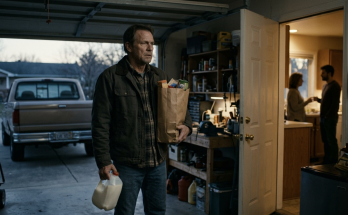
The sky darkened with a cruelty that felt personal, a bruised, low light swallowing the late afternoon as if it wanted to erase the world. Hazel watched from the bay window of Elena’s living room while the first real gusts began to slam across the street, whipping leftover maples and loose trash into frantic, gray choreography. Snow had begun as curious, polite flurries—anemic at first—but now it arrived in solid sheets, driven by wind that sounded like something trying to force its way into the house. Each shudder of the glass tightened the knot in her chest; each overhead gust seemed to measure how quickly normal weather could become an emergency.
Elena moved with a quiet efficiency that came from years of having to keep things in order for other people. She padded from the fireplace to the kitchen, ladling more wood into the grate and checking the thermostat as if the house’s heartbeat might be regulated by temperature. Hazel noticed the practical details—the way Elena stacked logs close at hand, the placement of a flashlight on the side table—because they felt like lifelines she had ignored for herself. The room smelled of citrus-scented candle wax and simmering broth, a domestic comfort that now seemed fragile against the noise of the storm.
Her phone buzzed on the coffee table, the vibration stuttering against a pile of magazines. Hazel reached for it with hands that suddenly felt clumsy, almost foreign, and saw Ray’s name appear on the screen. He rarely texted unless something needed immediate attention. His messages were always brief and direct, as if brevity were a way to force the world into order. She opened it before Elena could ask a question.
RAY: County radio says storm intensifying. Roads are going to be a problem. Keep off them, Hazel. RAY: I pulled up the outlet map. Tyler’s block is getting hit hard. I swallowed at the words, tasting a bitterness that had nothing to do with the coffee Elena had poured for them. Tyler had been explicit—do not come. That message had felt like a verdict, simple and absolute, when he sent it. Hazel had carried it like a stone in her pocket, feeling its weight in every decision. But the stone shifted now, and what was heavy became urgent.
Ray’s second message arrived less than a minute later, impatient as a second thought. RAY: County crews aren’t getting through. Plows are rerouting. No emergency access expected for hours. The sentence landed with the gravity of a gavel. Hazel’s fingers tightened around the phone until the screen blurred. She thought of the house on Maple Lane, of the kitchen table with mismatched chairs, of Tyler’s laugh, a sound she realized she had not heard in years and missed with a selfishness she hated admitting. She could file this information away and let policies and promises hold the rest, or she could move toward whatever the storm might make of that neighborhood.
Elena looked at her then, and Hazel saw the question in the older woman’s face without needing it to be spoken. Elena had been her confidante, not a judge, but something in the arrangement of her eyebrows held a practical concern that didn’t let Hazel slide into denial. “You heard?” Elena asked, keeping her voice low as if doing otherwise might make the weather eavesdrop. Hazel nodded once, a small, decisive motion. “They can’t get to them,” she said, the words arriving as much to herself as to Elena. They carried the hollow echo of authority—the county had spoken, and when institutions could not help, people had to decide what that meant for them.
Hazel’s mind began to assemble the household she was imagining: Tyler, who had shut her out; his partner Chloe, whom Hazel knew in fragments; the children—little bodies with need, mouths and small hands; and Chloe’s mother, the elderly woman who’d always been in the background of holiday photos, crown of soft silver hair and a smile that made Hazel feel awkwardly protective even when Tyler’s coldness suggested otherwise. The thought of them layered together in a house without reliable heat, possibly without power, made Hazel’s reaction less a choice and more an older, uncontrollable reflex. Her instincts organized themselves into a single trajectory—she could not leave children and an elderly woman to fend for themselves if there was a possibility she could help.
Memories arrived in precise, painful flashes: the small boys’ names—Eli and Jonah—said in a tone that held both exasperation and affection; the way Tyler had once adjusted a blanket around a sleeping toddler, careful and almost shy about the tenderness on his face; Chloe’s mother, calling Hazel by a nickname she’d never learned to refuse. None of that erased the months of silence and the sting of being told not to come, but the new images slid in beside the old like light under a door. They complicated the tidy boundary Tyler had tried to draw between them and inserted people who did not—and could not—be punished for his decisions.
Elena watched Hazel pull on her boots in hasty loops, watching the way she breathed as she did it. “You sure about this?” she asked. There was no attempt to moralize; only realism. Hazel closed her eyes, picturing the kids’ faces as if they were photographs on a mantel she had been afraid to dust. “I know he told me not to,” she said. “But I can’t let them be without help, not if they need it.” Her voice was steadier than she felt, an armor she had learned to wear. The thought of Tyler’s explicit rejection still hurt, but it had shifted into a different pain—one sharpened by the knowledge that others might suffer because of it.
Ray’s texts came in a thin cascade as if the wire were fraying under the weight of the storm. RAY: I can check the cameras but roads are closing fast. If you go, be careful. RAY: No guarantees. County said to shelter and wait, but if you decide to move, do it with caution. Hazel read and reread the messages, weighing them like coins. They were advice and warning, not permission. They reminded her that she would be defying the official word, stepping into a gray area that required personal responsibility more than institutional sanction. Responsibility was a language she had always understood; it had been the grammar of her days when Tyler was small and her life was arranged around his needs.
She imagined the grit she’d once had to grit her way through childhood scrapes, the nights she’d stayed awake with a feverish child and the dull, radiating exhaustion of a parent who had no option but to keep going. Maternal urgency was ancient inside her, a muscle she hadn’t exercised in a long time but that tensed now without her consent. It didn’t matter that Tyler had tried to harden the past into a closed door; people in need did not respect boundaries written in hurt. They only knew immediate needs—warmth, light, food, someone to say, I’m here.
Hazel reached for the small emergency kit Elena had on the shelf—a flashlight, a compact first-aid kit, a thermal blanket, hand warmers. She added bottles of water and a thermos of hot broth Elena insisted she take. “You’re not going in without layers,” Elena said, as if discussing a simple errand. Hazel laughed, a short sound that was more a release than amusement. The layers felt symbolic as much as practical—clothes covering old wounds, insulation against both weather and emotion. She wrapped herself in them with deliberate slowness, as if the ritual might change the outcome.
She felt a flicker of irrational hope that maybe Tyler would open the door and let her in, that he would see her at the step and soften in a way that would erase the sting of his earlier message. Then she thought of Chloe’s face in the picture she had seen weeks earlier, the stoic set of her jaw, the weary endurance in her eyes. Whether or not Tyler’s heart was ready to forgive or even to recognize Hazel, others in that house might need practical help that had nothing to do with reconciliation. The thought of being able to offer something concrete steadied her in a way apologies could not.
Outside, the wind practiced its cruelty, and the snow hammered against the windows in sheets. Hazel’s car sat in her driveway like an animal uncertain whether to leave its den, windshield glass frosting over with an impatient pattern. Ray called her once while she was getting gloves on. His voice on the line was low but urgent, the same voice that had once told her where to buy the best winter plows. “Hazel,” he said, “I don’t know if you should go. The county’s message is serious. They’ve rerouted all main responders, and some smaller roads are mines right now.” He paused as if listening to a separate broadcast. “But if you’re set on it, I can send you a live update on the road conditions along Maple Lane.”
She accepted, swiping at a text that let her track plowing reports. The map was a scatter of colored lines—green, yellow, red—each one a pulse of information rendered clinically. The route to Tyler’s house was slapped with red. The red told a specific sort of story: slow, impassable, and fraught. Still, the live camera feed Ray attached displayed a blur of white, the halo of headlights swallowed in a drift. It was impossible to tell distances, to read whether anyone was stranded in a driveway or whether small lights belonged to cars that could still move. The unknown felt both terrifying and combustible; it could ignite action or freeze it in place.
Hazel sat at the kitchen table a long time, watching the feed and letting the wind and the sound of the house sit around her like a cautionary congregation. Her mind moved in the edges of speech, rehearsing possible conversations. Would Tyler answer the door? Would Chloe greet her with cold politeness or a shut fist of fury? How would the children receive a stranger who was, biologically, a stranger no longer but still a woman who had not been present in their lives? She realized that part of her anxiety came from the erosion of the familiar—those roles and routines that had once been fixed and now were blurred into uncertainty. The family had recalibrated without her; she was an old note trying to play in a new chord.
When she imagined the elderly mother-in-law, her concern felt sharper and clearer. Older bodies betrayed the cold more quickly; numb extremities, inefficient circulation, medication needs disrupted by a loss of power. Hazel’s thoughts went automatically to small, practical things—pillboxes, extra blankets, the stove and whether it could be used if the power went out safely. The domestic specifics soothed and frightened her at once: they were problems she could solve in the short term but also problems that illuminated how deeply she had been kept out of their daily life. How many routines, intimate and invisible, had passed into the household’s possession without her being asked or allowed to participate?
The image of the children tightened something in her chest until it felt raw. She remembered Tyler teaching one of them to tie a shoelace, the patience in his hands, the way his voice had lowered to a rhythmic cadence when he was instructing them. Those memories did not reconcile the present argument or wash away the winters of silence, but they were proof of bonds unspoken and perhaps not yet severed. For the first time in months, Hazel felt a fierce, undiluted urge to protect instead of protest, to step in front of need instead of stepping into blame.
Elena put a hand on Hazel’s shoulder, not to dissuade her but to steady. “If you go, take this,” she said, handing over a spare battery pack and a folded thermal shelter tarp she kept in a closet. There was practical love in elbows and small gestures—the difference between advice and aid. Hazel held the items as if they were armor for the trip ahead, as if having the right tool could bridge the distance of hurt. She thought, too, of how many times she had been the giver of such oddments in other people’s crises, and how humbling it was to now accept them from someone she loved.
Her car complained when she pulled out, tires sliding faintly on sheets of white that had already packed in the driveway. The road beyond Elena’s house was worse than she expected, the pavement turning to a sleet-laced mirror and then to muttered banks of blowing snow. Houses diminished into shapes, their windows pinpricks of light. She drove cautiously, slower than she had ever imagined, conscious of every shifting sound beneath the vehicle. Hazard signs—fallen branches, a mailbox that leaned like a tired man—passed in the periphery. The landscape felt altered, made raw by the wind’s obsession. It seemed to Hazel that weather had always had the cruel ability to reveal what was most vulnerable.
Phone notifications kept arriving like landmines. Ray sent another update. RAY: Roadside assistance is overwhelmed. RAY: A car stalled near the intersection of 4th and Maple. People are… Hazel’s thumb hovered before she opened the last text. She wanted the details but feared them like a person afraid to see a wound. She inhaled and tapped the screen. The image Ray attached was a live feed of Maple Lane—a thin ribbon of shoveled walkway between heaped mounds, a mailbox buried to the post. Near the left side of the frame, a small figure moved, bundled and steadying itself against the wind. It was impossible to tell who it was, but the sight felt like the answer to a prayer and the confirmation of a nightmare at once.
She found herself parking a short walk away from Tyler’s house because the snow had become a curtain that even her car would not cut through gracefully. The sidewalk was a tunnel carved out by hurried feet and the wind, and every step felt like an act of persuasion. By the time she reached the front walk, she had to steady herself against the gusts, holding gloves to her ears as if that could shut out more than the cold. The house stood squat and familiar, its porch light a small beacon. She realized with a strange, painful clarity that she had once known every nail and creak of this place; now it belonged to another age, and she was an intruder who carried with her both the tools of care and the history of absence.
Hazel hesitated at the threshold, inhaling until the cold burned deep into her lungs and made her cough. For a breathless moment, she considered turning back to the safety of Elena’s warm living room, to the hearth that offered company and no questions. But on the porch, the wind folded up a scrap of something—paper, perhaps, or a thin napkin—and it snagged on the railing like a tiny pale flag. The sight struck her hard, a domestic proof that people lived here, that small things could be displaced by great ones and still matter. She knocked, each sound muffled by the weather, three times in quick succession. The rhythm felt like a prayer in Morse code.
At the door, she heard movement—a hesitant shuffle, the thumping of a foot against the floor as someone approached. The latch clicked, and a crack of warm light opened onto breath fog and a face she did not expect. It was Chloe, hair pulled back, eyes wide and tired, wearing an expression that held equal measure caution and concern. For an instant, neither spoke. Hazel recognized accomplishment and exhaustion in Chloe’s posture, and in return Chloe recognized a face that carried the complicated history between them. The weather lent a certain democracy to their present: it made both women equal in need and equal in distrust.
Chloe’s hand stayed near the doorknob, and Hazel saw the tension at her knuckles, the way she held herself like someone who had rehearsed every possible response. “You shouldn’t be out,” Chloe said, voice low. There was a breathy astonishment to it, as if the world had been expected to keep its boundaries intact and had failed. Hazel’s answer was simple and practical. “I couldn’t stay away,” she said. The words were honest and stripped of plea. They landed in the small space between them like a stone thrown into still water, ripples radiating outward long after the impact.
Chloe opened the door wider with a reluctant invitation that was part mercy and part pragmatism. “We’ve got a weird situation,” she said, glancing back down the hallway. Behind her the house felt small and warm, steam from a kettle rising in lazy rings. The sounds of the children were distant—soft, occasional thumps on the stairs and the murmur of a television. “My mother’s not moving very well,” Chloe said, the sentence blunt and immediate. “We’re low on a few supplies if the power goes.” Hazel’s heart planned its next move with the careful logic of someone who knew how to triage comfort: blankets, a warm drink, check on medications. She moved inside without ceremony, her body knowing the choreography of care even if her presence made the choreography awkward.
The elderly woman, Mrs. Calder, sat in the living room wrapped in a thick shawl, her hands folded in her lap and her eyes clouded with a soft confusion that made Hazel’s chest ache. She moved with a slowness that betrayed an age that could not be hurried. Yet when Hazel knelt and offered her hand, the old woman’s fingers closed around hers with a surprising strength and an almost imperceptible warmth. It was a tiny claim of connection that made Hazel feel, unfairly perhaps, like she had arrived at a threshold the house had resisted revealing to her. The children drifted in and out of the rooms like small planets, drawn by curiosities that had nothing to do with adult histories.
Tyler watched from the kitchen doorway, his posture a museum of conflicting emotions. In the dim light his face looked simultaneously anguished and protective, the familiar lines of his jaw sharpened by worry. He had a newness about him too—a man who had learned to shoulder different responsibilities in absence of someone else—and it complicated Hazel’s instinctive reactions. They did not speak at first; the space between them was full of weather, the buzz of a kettle, and the small sounds of domestic life continuing despite the storm. Finally Tyler stepped forward and said, “Mom.” The single word was as heavy as a contract and as fragile as a truce.
Hazel felt the old hurt tug at her but it did not snap the way she feared. Instead, something steadier rose beneath it: a sense of mission that felt more like duty than triumph, as if this intrusion were precisely the kind of obligation she had long been made to accept. “I couldn’t let the kids and your—your grandmother—be without help,” she said, each syllable deliberate. Tyler’s glance flicked to the children and then to the matron in the chair, and his expression softened in a slow, reluctant thaw. It did not cure years of silence, but it reopened a conversation the storm had cracked wide enough to force them into.
They set to work with a crooked, uneasy efficiency that felt both foreign and familiar. Hazel found herself pulling blankets from closets she had once known by touch, laying them across the couch and tucking small legs into warmth. She checked the little plastic container on Mrs. Calder’s side table, making sure pills were within easy reach and that a list of dosages was pinned nearby. She boiled water on the gas stove to avoid draining an electric kettle should the power fail, stirring the broth into mugs that smelled of rosemary and home. Each small action was an act of reparation—practical, useful, and humble—and it surprised Hazel how quickly her body remembered the roles she had once performed without thinking.
Tyler kept the phone with one hand, his thumb moving across the screen as if expecting Ray’s updates to arrive like a lifeline. In moments when the conversation faltered, he watched the weather reports with a focus that seemed newly serious. The children, sensing the adult tension but understanding its language only in small pieces, clustered around a board game on the floor, their laughter a fragile bright thread that cut through the storm’s heavy curtain. Hazel watched them, feeling the old, complicated affection rise like a tide toward a shoreline she had not expected to reacquaint with.
There were silences that felt like landmines and moments that glowed like unexpected bridges. Tyler would ask a practical question—a request for a spare blanket, an inquiry about Mrs. Calder’s medication—and Hazel would respond without the ancestral wariness that had defined their last months. Their hands brushed at times, an accidental communication that felt electric with the history of all they’d misplaced. They did not sidestep the past; instead, they let the present press on their worn differences until something new, rough-hewn, began to fit into place.
Outside, the storm raged on as if it had found a drama to applaud. Inside, the house hummed with suppressed activity and low conversation—patchwork kindnesses and awkward apologies mingling under the low light of lamp shades. Ray’s updates continued to arrive; his practical voice through text reassured that county crews were still not reaching the block but had set up a hotline for non-critical checks. RAY: Focus on heat and meds. RAY: Don’t risk travel if you can avoid it. The messages seemed both an anchor and a caution, reminding Hazel that what she had done was not a step into triumph but into careful, necessary help.
As they settled into a rhythm of makeshift care—blankets, hot drinks, checking on medication schedules—Hazel sensed the atmosphere between Tyler and herself shifting subtly. There were no grand reconciliations, no speeches about apology and forgiveness. Instead, there was a series of tiny, functional movements that felt more honest: Tyler offering her a cup of tea; Hazel fetching a heavier slipper for the old woman; a child handing Hazel a drawing that he had made in crayon, believing, without any agenda, that it was a token of welcome. Each small act formed a new grammar between them, one not predicated on erasing the past but on allowing small mercies to shape a possible future.
Night pressed against the windows and the wind did not relent, but the house had an interior warmth that began to subdue the panic Hazel felt when she first arrived. She sat on the couch near Mrs. Calder and watched Tyler check batteries and ration the little supplies they had. In a quiet moment, Tyler turned toward her and said, voice rough, “I wasn’t sure where you stood.” It wasn’t an admission of guilt—for him such confessions were rarely that simple—but it was a recognition, raw and human. Hazel answered with the clearest truth she could manage: “I stand where my children and people who can’t fend for themselves need me.”
He took that in for a long time, the lines of his face softening as if the weather outside had melted something brittle inside him. They did not repair the years by candlelight, but they lit a path where something like caution could become curiosity, and where wounded defenses might loosen enough to allow small acts of trust. The storm had done what prudence and pride had failed to: it had rendered all the petty reasons for estrangement trivial in the face of immediate need. For now, at least, the priority was clear: keep the house warm, keep Mrs. Calder stable, keep the children safe. Everything else could wait.
Hazel lay awake that night on the couch, a patchwork of blankets tucked up around her sleeves, listening to the wind batter the eaves and the slow, even breaths of someone sleeping nearby. She thought of Ray’s steady texts and Elena’s practical love, and of how a woman who had once taught another to braid hair now sat in a house where the familial script had been rewritten without her. She did not know what would happen after the storm—whether Tyler would return to the hard line that had kept them apart or whether this night would begin a slow undoing of old resentments. The possibilities felt both terrifying and promising.