I yanked it, rattled it, pulled so hard my wrists hurt.
Still nothing.
The operator’s voice kept asking questions.
“Ma’am, do not try to force entry if you’re alone—”
“I can’t just stand here,” I said, voice breaking.
I ran to the garage.
James’s toolbox sat on the workbench, exactly where it always had.
I grabbed a hammer.
Back in the hallway, I raised it and swung.
Metal rang.
The padlock didn’t crack.
I swung again.
And again.
My arms started to ache. My hands stung from vibration. My breath came in sharp little bursts.
Behind the door, I heard a weak shift, like someone dragging themselves closer.
“Hold on,” I said, tears spilling down my face. “Hold on, sweetheart. They’re coming.”
The sirens felt like they took a lifetime.
In reality, it was twelve minutes.
Twelve minutes of me standing there with a hammer, my heart pounding so hard I thought it might split my ribs.
When the police arrived, Officer Valdez and his partner moved fast.
They took one look at the padlock and the fresh screws, and Valdez’s face tightened.
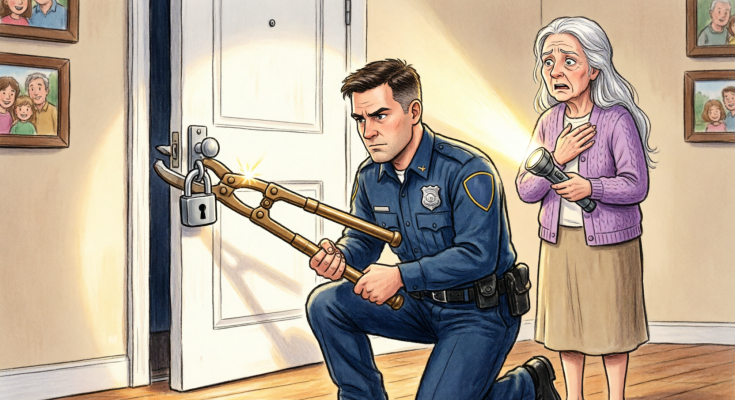
“Get bolt cutters,” he told his partner.
I hovered nearby, shaking.
“James is in there,” I said, the words tasting like madness.
Valdez glanced at me.
“Ma’am, step back,” he said gently. “We’ve got this.”
His partner came back with cutters. They positioned them on the lock.
With one sharp squeeze, the metal snapped.
The door swung open.
The smell hit us first.
Not blood.
Not death.
Something worse in its own way—unwashed body, old air, sour dampness. The smell of a place that wasn’t meant to hold a living human being.
The basement stairs descended into darkness.
Officer Valdez went down first, flashlight cutting through the gloom.
He stopped halfway.
“Jesus Christ,” he breathed.
I pushed past him, ignoring his protest.
The beam of the flashlight landed in the corner.
And there, chained to a support beam, was my son-in-law.
James looked like he’d aged twenty years.
His clothes hung off him as if they belonged to someone else. A beard, matted and uneven, covered his jaw. His eyes were sunken, glassy, and impossibly tired.
A thin mattress lay on the concrete floor beside him. An empty water bottle. A bucket that made my stomach twist.
That was it.
That was all he’d had.
I collapsed to my knees.
“James,” I choked. “Oh my God. James.”
His lips moved, but the sound that came out was barely a breath.
Officer Valdez was already on his radio.
“Ambulance. Now,” he snapped. “We’ve got a male, severely—”
I didn’t hear the rest.
All I could see was James’s wrists.
The chains had rubbed the skin raw.
He tried to lift his head toward me.
“Margaret,” he whispered, and there was such relief in that one word it shattered me.
“The funeral,” I said, voice trembling. “We had a funeral. Rachel said—Rachel said you were dead. She said you—”
James shook his head weakly.
Tears gathered in the corners of his eyes.
“No,” he rasped.
The ambulance arrived in a rush of footsteps and equipment.
Paramedics crowded the basement, voices brisk, practiced.
“Sir, can you tell me your name?”
James tried.
His voice cracked.
They checked his vitals, started an IV, wrapped a blanket around his shoulders.
When they lifted him onto the stretcher, he grabbed my hand with a grip that felt like pure willpower.
“Rachel,” he whispered.
“She did this.”
I swallowed hard.
“I know, sweetheart,” I said, even though my mind still couldn’t accept it. “I know.”
As they carried him up the stairs, the sunlight from the open basement door fell across his face.
For a second, I saw the James I remembered.
The man who used to bring Rachel flowers on random Tuesdays.
The man who helped me carry boxes into my attic without being asked.
The man we had supposedly buried.
Then the stretcher rolled out of the house, and I stood in the hallway shaking like a leaf.
Officer Valdez placed a steadying hand near my elbow.
“Ma’am,” he said, voice low. “We need to ask you some questions.”
I nodded, though my head felt full of fog.
Outside, neighbors stood on lawns, eyes wide, phones in hand.
Mrs. Chen stood at the edge of her porch, one hand pressed to her mouth.
When our eyes met, she didn’t say “I told you so.”
She just nodded once, solemn.
Like she’d been afraid of this and called anyway.
At the hospital, the doctor told me James was lucky to be alive.
“Severely dehydrated,” he said. “Malnourished. Infections from restraints. If he’d been down there much longer—”
He didn’t finish.
He didn’t have to.
They estimated he’d been in that basement at least three weeks. Maybe four.
The timeline matched exactly with when Rachel called to tell me James was dead.
I sat in the waiting area for hours, my purse on my lap, staring at a blank wall while everything I thought I knew rearranged itself into something ugly.
A nurse brought me water I didn’t remember asking for.
“Are you family?” she asked gently.
“I’m his mother-in-law,” I said, and the words felt strange.
Like the relationship had shifted into something else entirely.
James’s mother, Helen, arrived that evening after a frantic drive from Michigan.
When she walked into the hospital, she didn’t look like a woman who’d come to mourn.
She looked like a woman who’d come to fight.
Her eyes found mine across the waiting room.
For a moment, I expected anger. Blame. Accusation.
Instead, she crossed the room and wrapped her arms around me.
“Thank you,” she said into my shoulder, voice breaking. “Thank you for finding him.”
I couldn’t speak.
I just held her, and we both cried in a way that felt like it came from the bottom of the earth.
Later that night, Detective Morrison arrived.
She was in her forties, hair pulled back, eyes alert but not unkind. She had the kind of calm that comes from seeing too much and learning how not to let it show.
She sat across from me in a small consultation room off the hallway, notebook open.
“Mrs. Hartley,” she said, “I’m sorry you’re going through this. I need you to walk me through what happened over the past month. Start with the day you were told your son-in-law had died.”
I swallowed.
“My daughter called me,” I said. “September twelfth, around nine in the morning. She was… hysterical. She said she came home from her morning run and found James in the garage.”
“Did she say how he died?” Morrison asked.
“She said he’d ended his life,” I said carefully. “She said there was a note.”
“Did you see the body?”
“No,” I admitted. My cheeks burned. “Rachel said it was too traumatic. She said the medical examiner released him directly to the funeral home. We had a closed-casket service.”
Morrison’s pen moved.
“And you didn’t think that was suspicious?”
The question landed like a slap.
I clenched my hands together.
“James had been depressed,” I said. “He lost his job six months earlier. He’d been struggling. Rachel said he was seeing a therapist, but… he stopped going.”
I heard how weak it sounded even as I said it.
Morrison nodded once, like she’d heard that explanation many times.
“What about documentation?” she asked. “A death certificate?”
“Rachel showed me one,” I said. “It looked official. Signed by a Dr. Chen at County Medical.”
Morrison’s eyes flicked up.
“Dr. Chen,” she repeated.
I thought of Mrs. Chen next door and felt briefly dizzy.
“No relation,” I added quickly. “Mrs. Chen is their neighbor. This was… someone else.”
Morrison nodded.
“We’re looking into that,” she said. “Mrs. Hartley… did your daughter have any financial motive?”
The air in the room seemed to thin.
I didn’t want to answer.
But I’d spent my career telling people hard truths.
I forced myself to be honest.
“James had life insurance,” I said. “Half a million dollars. Rachel was the beneficiary.”
“Has she collected?”
“I don’t know,” I said. “I think there’s a waiting period. Thirty days. Which would be… in two days.”
Morrison closed her notebook slowly.
“Then we’re on a clock,” she said.
She leaned forward.
“I need you to tell me everything you know about your daughter’s activities over the past month. Any changes in behavior. Any new relationships. Any unusual spending. Anything that didn’t sit right.”
So I did.
I told her how Rachel had seemed calm at the funeral—almost detached, like she was acting a role she’d rehearsed.
How she’d immediately started talking about selling the house.
How she’d said she might move to California, “for a fresh start,” as if grief were a bad neighborhood you could simply leave.
How she’d asked me not to visit because she needed time to grieve alone.
How she’d blocked James’s family from contacting her, insisting they were “making accusations” and she couldn’t handle the stress.
Red flags I’d seen, then ignored, because the alternative was unbearable.
Morrison listened without interrupting.
When I finished, she nodded.
“Thank you,” she said. “We’re going to need a statement from Mr. Hartley when he’s stable enough. For now, he needs medical care and rest. We’ll keep an officer at his door.”
I stared at her.
“Rachel is my daughter,” I whispered.
Morrison didn’t flinch.
“I understand,” she said quietly. “And I’m sorry. But someone locked a living man in a basement and staged a funeral. That wasn’t a mistake. That was a plan.”
The word plan hit me like a stone.
Because Rachel had always been a planner.
James slept for long stretches over the next two days.
When he woke, he drifted in and out, eyes unfocused, the IV line taped to his hand.
Sometimes he’d blink at the ceiling like he couldn’t trust it.
Sometimes his breath would speed up until the nurse had to talk him down.
The first time he managed more than a few words, I leaned close, afraid to miss any of them.
“Water,” he said, voice raw.
I held the straw to his lips like he was a child.
When he finished, he squeezed my hand weakly.
“She told you I was dead,” he whispered.
I nodded, tears burning.
“I’m sorry,” I said. “I’m so sorry.”…………………………..