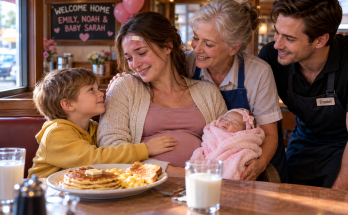
We returned to the beach house four months later.
Not because everything was finished.
It wasn’t.
Court cases move more slowly than fear.
Victor pleaded guilty to multiple federal charges and agreed to testify about the historical network.
Mark pleaded not guilty at first.
Then investigators matched his access codes to stolen reserve transactions, recovered surveillance records from his storage unit, and authenticated the dash-camera footage from Carol’s crash.
His attorney changed strategy.
A plea followed.
Margaret fought longer.
Evelyn’s notebook hurt her.
David Senior’s recording hurt more.
Bank records did the rest.
Richard pleaded guilty to the offenses prosecutors could still bring and entered a cooperation agreement concerning public corruption investigations that reached beyond our family.
His age and assistance would matter at sentencing.
So would decades of misconduct.
He finally seemed to understand both facts could exist together.
David pleaded guilty too.
He did not ask me to write a letter supporting leniency.
That mattered.
He asked for one thing before sentencing.
Permission to speak to Liam.
I left that decision to our son.
Liam agreed.
They met in a park with me nearby.
I did not listen.
Later I asked, “How was it?”
Liam shrugged.
“Sad.”
“Did he apologize?”
“Yes.”
“Did you forgive him?”
“No.”
Then, after a moment:
“Maybe someday.”
I nodded.
“That’s yours to decide.”
He looked at me.
“I know.”
That was perhaps the most important thing either of us had learned.
Chloe’s divorce proceeded.
Mark’s criminal case made the financial part complicated, but not impossible.
The money he stole from the boys’ accounts was included in restitution claims.
She stopped apologizing every time she asked a lawyer a question.
She stopped calling Richard before making decisions.
She found a job managing a small vacation-rental office.
She hated it for three weeks.
Then discovered she was good at it.
Carol’s legal resurrection became a minor bureaucratic epic.
The state corrected her death record.
Her Social Security status had to be restored.
Banks wanted affidavits.
Insurance companies wanted documents proving the woman sitting in front of them was not committing fraud by being alive.
One clerk stared at Carol for almost a minute before saying, “I’ve never had this happen.”
Carol answered, “Neither have I.”
I laughed so hard I had to leave the office.
Our relationship did not return to what it had been.
That was impossible.
Instead we built something less innocent and more truthful.
She stopped saying, “I didn’t tell you because I wanted to protect you.”
Whenever the sentence began forming, she caught herself.
Sometimes she replaced it with:
“I was afraid.”
That I could hear.
I learned to say:
“I’m angry.”
Instead of:
“I’m fine.”
Progress was embarrassingly ordinary.
The disputed inheritance took longer.
After forensic accounting, restitution proceedings, and negotiated claims, a substantial portion of Carol’s estate was determined to have come from legitimate assets.
Funds traced to identifiable victims or unlawfully diverted accounts were surrendered.
Some money went into restitution pools.
Some ownership remained contested.
I stopped checking the number every week.
Daniel’s Massachusetts trust was confirmed legitimate.
So was most of his Harbor Point interest.
After legal fees, restructuring, and decades of corporate changes, the asset was worth less than the wildest early estimate and far more than I expected.
For once, money arrived without somebody forging my signature.
I almost did not know how to feel about it.
I used part of it to create a legal fund for victims whose identities had been used in the old network.
Not because I wanted to become my mother.
That distinction mattered.
I asked.
I hired professionals.
I established independent oversight.
Nobody needed to trust my good intentions.
Good intentions had caused enough damage.
The beach house remained ours.
Liam had insisted on paying rent.
I refused.
He insisted again.
We compromised.
He paid utilities.
Then he complained constantly about electricity prices.
That reassured me more than almost anything else.
Normal problems.
Beautiful, irritating, normal problems.
When Carol and I drove down for our first weekend there, Chloe had already moved most of her things into a nearby apartment.
She and the boys had stayed at the house while the divorce stabilized.
Now she wanted her own place.
Before leaving, she replaced the white mugs she had bought during those strange weeks with blue ones.
“For Liam,” she said.
He examined them.
“They’re too nice.”
Chloe laughed.
“Then chip one.”
He did two weeks later.
Accidentally.
I was absurdly pleased.
On the first evening back, I stood on the porch where the whole thing had begun.
Same hydrangeas.
Same salt air.
Different locks.
Liam joined me carrying two glasses of lemonade.
“No cookies?”
“I’m traumatized by bakery boxes now.”
He handed me a glass.
We watched the ocean beyond the dunes.
“Do you ever think about that day?” he asked.
“Every time I see the driveway.”
“Sorry.”
“For what?”
“Not telling you sooner.”
I turned toward him.
“We discussed this.”
“I know.”
“You were scared.”
“I was also trying to handle it myself.”
“Yes.”
“Wonder where I learned that.”
I gave him a look.
He smiled.
“Too soon?”
“Probably.”
Then I laughed.
He did too.
Carol came outside.
She carried the wooden recipe box.
The original.
Investigators had returned it after photographing every card.
I stared at it.
“I thought we agreed no hidden evidence.”
“There isn’t any.”
“What’s inside?”
“Recipes.”
“Actual recipes?”
“Mostly.”
“Mostly?”
She smiled.
“One card has your father’s terrible chili.”
“That qualifies as evidence of something.”
She sat beside us.
I opened the box.
Peach cobbler.
Cornbread.
Pot roast.
Lemon chicken.
Ordinary handwriting.
Ordinary stains.
For years, those cards had been codes.
Now the codes were gone.
Investigators had what they needed.
The recipes could become recipes again.
I found the peach cobbler card.
The red numbers along the bottom remained.
Liam looked over my shoulder.
“Account numbers?”
“Formerly.”
Carol said, “I should make a clean copy.”
“No.”
She looked at me.
“Why?”
“Leave it.”
The card was part of what happened.
I no longer needed every scar erased before I could use the thing carrying it.
We made the cobbler that evening.
It was too sweet.
Carol blamed the peaches.
Liam blamed Carol.
I blamed both of them.
We ate it anyway.
Two weeks later, Richard received his sentence.
I attended.
So did David Senior.
The brothers sat on opposite sides of the courtroom.
Richard spoke before sentencing.
He did not call his crimes mistakes.
I noticed that.
He called them choices.
He admitted that he had spent years believing providing jobs and supporting his family offset the corruption beneath his businesses.
“It did not,” he said.
He apologized to people whose names and finances had been used.
He apologized to Carol.
To Chloe.
To David.
To Liam.
To me.
I accepted hearing it.
Nothing more.
David was sentenced several weeks later.
His term was shorter than it might have been because of cooperation, restitution, and evidence he supplied against Victor.
Still prison.
Before marshals took him away, he looked at Liam.
Liam raised one hand.
David did the same.
No dramatic reconciliation.
No promise.
Just recognition.
Sometimes that is enough for a beginning.
Mark’s sentence came later.
Chloe did not attend.
She took the boys to the aquarium instead.
When I asked whether she wanted to know the number of years, she said, “My attorney can tell me if it affects us.”
That was all.
Mark had occupied enough of her life.
Margaret eventually entered a plea after several financial institutions produced records her lawyers could not explain away.
She requested a meeting with me as part of her cooperation.
I declined again.
Carol understood.
“I would have gone.”
“I know.”
“Does that bother you?”
“No.”
She smiled.
“That may be the nicest insult you’ve ever given me.”
The investigation eventually identified thirty-one living people whose identities had been used without meaningful consent.
Others were dead.
Several families received restitution.
Some never learned exactly what had happened because the records were incomplete.
There was no perfect accounting.
No final ledger where every stolen dollar returned to the correct hand.
That bothered me for a long time.
Then one investigator said something I remembered.
“Justice isn’t the same as reversing time.”
I knew that already.
I just had not wanted it to be true.
A year after my surprise trip, Liam graduated from his first stage of college studies and transferred into a university program closer to the coast.
He kept the beach house.
Two roommates moved in.
One left dishes everywhere.
The other owned a dog that believed my bedroom belonged to him.
The house became noisy.
Surfboards returned to the patio.
Shoes accumulated beside the door.
The expensive white mugs disappeared one by one.
Life reclaimed the place from evidence.
On the anniversary of the day I discovered Chloe there, I flew down again.
This time Liam knew.
He picked me up at the airport.
“You realize surprises are allowed,” he said.
“Not in this family.”
“Fair.”
Carol came the next morning.
She had stopped hiding her gray hair.
She said dyeing it felt like too much administrative work after having to prove she was alive to six government agencies.
David Senior visited occasionally.
Richard wrote letters from prison.
Carol answered some.
Not all.
That was her choice.
I never asked what they wrote.
That was mine.
One evening, Carol and I walked along the beach.
The tide was low.
Wet sand reflected the sky.
She moved more slowly because of the old injury from the crash.
I matched her pace.
After a while she said, “Do you forgive me?”
I had known the question would come eventually.
I had rehearsed answers.
None survived the moment.
“I forgive some things.”
She nodded.
“And others?”
“I’m still working out what forgiveness would mean.”
“That’s fair.”
“I don’t want it to mean what our family used to make it mean.”
“What was that?”
“Pretend it didn’t happen so everybody can be comfortable.”
Carol looked toward the water.
“I don’t want that either.”
“I can love you and still believe you hurt me.”
“Yes.”
“I can understand why you were afraid without agreeing with what you did.”
“Yes.”
“I can be grateful you’re alive and furious that you stayed dead.”
She laughed softly.
“That one seems especially reasonable.”
I smiled.
Then she took my hand.
I let her.
We walked until the house lights came on behind the dunes.
Liam was cooking.
Smoke poured from the kitchen window.
I stopped.
“What is he doing?”
Carol sniffed.
“Your father’s chili.”
“Oh, no.”
We hurried back.
The smoke turned out to be onions burned in a pan.
Liam claimed the recipe was badly written.
Carol claimed Daniel had been a terrible cook.
I opened windows.
The dog stole a piece of bread.
Someone knocked at the front door.
Every person in the kitchen froze.
For one ridiculous second, the past returned.
Gray SUV.
Forged deed.
Unknown number.
Someone watching.
Then Liam laughed.
“We cannot live like this.”
He opened the door.
Chloe stood there with the boys and a grocery bag.
“Why does it smell like a tire fire?”
“Family recipe,” Liam said.
She came inside.
Nobody checked the county property records.
Nobody hid a phone.
Nobody whispered.
Dinner was terrible.
The evening was wonderful.
Later, after everyone went to bed, I stood alone in the kitchen.
The wooden recipe box sat on the counter.
Beside it lay the brass key that had opened Carol’s compartment.
Investigators had returned that too.
For months I had kept it in a drawer.
That night I picked it up.
It no longer opened anything important.
The compartment was empty.
The records were in evidence.
The secrets had names.
The crimes had case numbers.
The dead who were truly dead could finally be mourned.
The living no longer needed funerals to disappear.
I carried the key outside.
For a moment I considered throwing it into the ocean.
That would have been dramatic.
My family had done enough dramatic things with evidence.
Instead I brought it back inside and placed it in the recipe box.
Not hidden.
Just kept.
Liam appeared in the doorway.
“Couldn’t sleep?”
“No.”
He opened the refrigerator.
“What are you doing?”
“Looking for food.”
“You ate three bowls of chili.”
“That was survival training, not dinner.”
He found leftover cobbler.
Then he noticed the key.
“You keeping it?”
“Yes.”
“Why?”
I thought about that.
“Because getting rid of something isn’t the same as being free of it.”
He nodded as though that made sense.
Maybe it did.
He ate directly from the dish.
“Use a plate.”
“I’m an adult.”
“Adults use plates.”
“That feels legally questionable.”
I handed him one.
He accepted it.
Before leaving, he looked around the kitchen.
“You know what’s weird?”
“Everything?”
“Besides everything.”
“What?”
“I used to think owning this house would make me secure.”
“And now?”
He shrugged.
“It’s a house.”
I smiled.
“Yes.”
“A good house.”
“Yes.”
“But still a house.”
Exactly.
Four hundred thousand dollars had once seemed like the center of the story.
Then the deed disappeared.
Then identities disappeared.
Then dead people returned.
Then millions appeared beneath names belonging to people who had never agreed to carry them.
In the end, the property mattered.
Money mattered.
Restitution mattered.
But none of them were safety.
Safety was knowing the person beside you would tell you the truth before deciding what you were strong enough to hear.
It was Liam calling when he was frightened.
Carol admitting when she was afraid.
Chloe making decisions without asking permission.
David accepting consequences without calling them sacrifice.
It was evidence handed over instead of buried.
Questions answered instead of managed.
The next morning, sunlight filled the kitchen.
Carol made coffee.
Liam complained about an early class.
Chloe texted that one of the boys had forgotten his backpack.
The dog barked at nothing.
Ordinary life was noisy.
I had once thought peace would feel like silence.
I had been wrong.
Silence was where my family had hidden everything.
Peace sounded like people speaking.
Before leaving for the airport, I walked through the house once.
Not checking for missing documents.
Not searching for strangers.
Just looking.
At the chipped blue mug beside the sink.
At Liam’s shoes by the door.
At sand tracked across the floor.
At the photograph of my mother and son that now stood where Chloe’s family pictures had once been.
I stopped on the porch.
A year earlier, I had arrived carrying cookies and believing I knew exactly what I had given my son.
A house.
Security.
A future.
What I found instead was a stolen deed and a family history built on people deciding that secrecy was protection.
We had recovered the house.
We had recovered money.
Against every expectation, I had even recovered my mother.
But the most important thing we recovered was smaller.
The right to know.
The right to choose.
The right to hear an unbearable truth and decide for ourselves what to do with it.
Liam leaned out the front door.
“Mom, you’re going to miss your flight.”
“I’m coming.”
“You said that five minutes ago.”
“I know.”
He held up the bakery box Chloe had brought.
“Take these.”
I stared at it.
“Absolutely not.”
He laughed.
I walked down the steps.
My rental car was in the driveway.
Only mine.
No gray SUV waited at the curb.
No stranger watched from across the road.
I looked back once.
Liam stood on the porch.
Carol appeared behind him.
The house was loud, imperfect, legally ours, and no longer carrying the weight of what everyone had hidden there.
I raised my hand.
They waved.
Then I got into the car and drove away.
This time, nobody needed to disappear for the people they loved to be safe.
The End
Read more original stories on Feel Every Story.
I Came Carrying Cookies for My Son, but Someone Else Opened the Door to the House I Bought Him
Part 16 of 16