“Mommy, you can have my food. The baby is hungry too.”
Those words broke my heart.
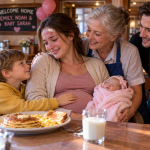
My five-year-old son, Noah, was sitting beside me in a small roadside diner, staring at the plate of pancakes on our table.
He hadn’t eaten a proper meal since yesterday morning.
Neither had I.
I was seven months pregnant, with swollen feet, an aching back, and a small white bandage covering the cut on my forehead.
My name is Emily Carter.
And that morning, I had exactly $4.75 left in my purse.
Four dollars and seventy-five cents.
That was all I had after leaving the house where my husband had made our lives miserable.
I hadn’t planned to leave that morning.
But when Noah stood between his father and me, spreading his tiny arms and crying, “Daddy, please don’t hurt Mommy,” I knew we couldn’t stay another night.
I grabbed his little yellow sweatshirt, my purse, and the car keys.
We drove until the gas light came on.
Then we stopped at the first diner we could find.
Inside, the smell of coffee, fresh pancakes, and bacon made Noah’s stomach growl.
He looked up at me.
“Mommy, can we eat here?”
I smiled, even though my eyes burned.
“Of course, sweetheart.”
The truth was, I didn’t know how we would pay.
We sat in a booth by the window.
A young waiter named Daniel approached our table.
“Good morning. What can I get you two?”
I looked at the menu.
Then at Noah.
“Just one plate of pancakes, please. And a glass of water.”
Daniel glanced at my pregnant belly.
“Nothing for you, ma’am?”
I shook my head.
“I’m not hungry.”
It was a lie.
I was so hungry that my hands were trembling.
But Noah needed food more than I did.
Daniel didn’t argue.
He simply nodded and walked toward the kitchen.
A few minutes later, he returned carrying a large plate.
Three pancakes.
Scrambled eggs.
Toast.
And two glasses of milk.
I stared at the food.
“I’m sorry,” I whispered. “I only ordered one small plate.”
Daniel smiled gently.
“I know.”
He placed the plate in front of us.
“The kitchen made a little extra.”
I immediately reached for my purse.
“Sir, I don’t have enough money for all this.”
His expression changed when he saw the bandage on my forehead.
Then he noticed Noah holding tightly to my cardigan.
“Ma’am,” he said softly, “you don’t need to worry about the bill.”
I shook my head.
“I can’t accept charity.”
Daniel pulled out the empty chair across from us.
“Then don’t call it charity.”
He looked at Noah.
“What’s your name, buddy?”
“Noah.”
“That’s a good name.”
Noah lowered his eyes.
“Are you going to make my mommy leave?”
Daniel went completely still.
“Why would I do that?”
Noah’s little voice began to shake.
“Because Daddy said nobody wants us.”
I felt my entire body go cold.
“Noah,” I whispered.
But my son kept talking.
“He said Mommy is useless because she doesn’t work anymore. And he said the baby is going to make everything worse.”
Daniel’s smile disappeared.
For several seconds, he said nothing.
Then he leaned closer to Noah.
“Listen to me, buddy. Your daddy was wrong.”
Noah looked up.
“Really?”
“Really.”
Daniel pointed toward the pancakes.
“And in this diner, nobody leaves hungry.”
For the first time that morning, Noah smiled.
But I couldn’t stop crying.
I turned toward the window, hoping Daniel wouldn’t notice.
He did.
He quietly placed a box of tissues beside me.
Then he walked away.
Twenty minutes later, Noah had finished almost everything on his plate.
He leaned against my shoulder, his eyes growing heavy.
“Mommy?”
“Yes, baby?”
“Can we stay here forever?”
I kissed his blond hair.
“I wish we could.”
That was when Daniel returned.
But he wasn’t alone.
Standing beside him was an older woman with silver hair and kind brown eyes.
She wore a simple blue apron.
“My name is Margaret,” she said. “I own this diner.”
My heart sank.
I thought she had come to ask us to leave.
I immediately stood, holding Noah’s hand.
“I’m sorry. We’ll go. I promise we weren’t trying to cause trouble.”
Margaret gently touched my arm.
“Sweetheart, sit down.”
Her voice was so warm that I almost started crying again.
She pulled a chair beside me.
“Daniel told me you might need some help.”
I looked down.
“We’re fine.”
Margaret glanced at my forehead.
Then at my belly.
Then at Noah, who was gripping my hand.
“Emily,” she said quietly, after asking my name, “you don’t have to pretend you’re fine here.”
Something inside me broke.
I covered my face.
And cried harder than I had cried in years.
I told her everything.
About losing my job when my pregnancy became complicated.
About my husband controlling every dollar.
About sleeping with my bedroom door locked.
About Noah hiding under his blankets whenever his father started shouting.
And about the morning we finally escaped.
Margaret listened without interrupting.
When I finished, she wiped her eyes.
Then she reached into her apron pocket and pulled out an old photograph.
It showed a young woman holding a little boy.
The woman looked remarkably like me.
“That’s my daughter,” Margaret whispered.
“Her name was Sarah.”
I waited.
Margaret’s fingers trembled around the photograph.
“She came to this diner fifteen years ago with a bruise on her cheek. She told me she’d fallen.”
Her voice cracked.
“I believed her.”
She looked at Noah.
“Six months later, I buried my daughter.”
My hand flew to my mouth.
Margaret took a deep breath.
“I promised myself that if another mother ever walked through those doors looking the way Sarah did, I would never ignore it again.”
Then she held my hands.
“You and your children are not going back there.”
I stared at her.
“But I have nowhere to go.”
Margaret smiled through her tears.
“Then we’ll find somewhere safe.”
That afternoon, she helped me contact a local domestic violence shelter.
Daniel made sure Noah had a warm meal packed for later.
And Margaret drove us to a clinic, where a doctor checked my injuries and made sure my unborn daughter was safe.
For the first time in months, I could breathe.
But the part that changed my life happened three weeks later.
Margaret called me.
“Emily, can you come by the diner? There’s something I’d like to discuss.”
When I arrived, she handed me a small envelope.
Inside was a photograph of a little apartment above the diner.
It had two bedrooms.
A tiny kitchen.
And a window overlooking the street.
“I’ve been fixing it up,” she explained.
I looked at her, confused.
“It’s beautiful.”
Margaret smiled.
“I need someone to help with the diner office a few mornings each week. Daniel says you’re good with numbers.”
I nodded slowly.
“I used to do bookkeeping.”
“Then I have a job for you.”
My eyes widened.
“And the apartment?”
She placed a key in my hand.
“It comes with the job. We’ll work out an affordable rent once you’re back on your feet.”
I couldn’t speak.
Noah tugged on my cardigan.
“Mommy, does it have a bed?”
Margaret laughed softly.
“Two beds, sweetheart.”
Noah’s eyes lit up.
“One for me and one for the baby?”
I nodded through my tears.
“Yes, baby.”
He wrapped his little arms around my belly.
“We have a home!”
Six months later, my daughter was born.
I named her Sarah.
Not because Margaret asked me to.
She never would have.
But because I wanted that name to carry a different ending.
A happy one.
On the day I brought my daughter home from the hospital, Margaret was waiting outside the diner with Daniel and Noah.
There were pink balloons tied to the railing.
A homemade cake sat on the counter.
And a small wooden sign hung above our apartment door.
It read:
WELCOME HOME, EMILY, NOAH & BABY SARAH.
Margaret held my daughter in her arms and began to cry.
“She looks so peaceful,” she whispered.
I put my arm around her shoulders.
“That’s because she’s going to grow up somewhere safe.”
Margaret kissed Sarah’s tiny forehead.
Noah reached up and took her hand.
“Grandma Margaret?”
She looked down at him.
“Yes, sweetheart?”
“Does this mean we’re your family now?”
Margaret looked at me.
Then at my children.
And with tears running down her face, she answered:
“You became my family the moment you walked through that door.”
That was three years ago.
Today, Noah is eight.
Sarah is a happy little girl who calls Margaret Grandma.
And I manage the diner’s accounts while raising my children in a home filled with laughter instead of fear.
Sometimes, when I’m closing the diner, I look at the booth near the window where we sat that first morning.
I can still picture my little boy offering me half his pancakes because he thought the baby and I needed them more.
And I remember the waiter who noticed we were in trouble.
The woman who decided not to look away.
And the kindness that gave my children a second chance.
Because sometimes, the person who saves your family isn’t someone you’ve known your whole life.
Sometimes, it’s a stranger who sees your pain and decides that you shouldn’t have to face it alone.
THE END.