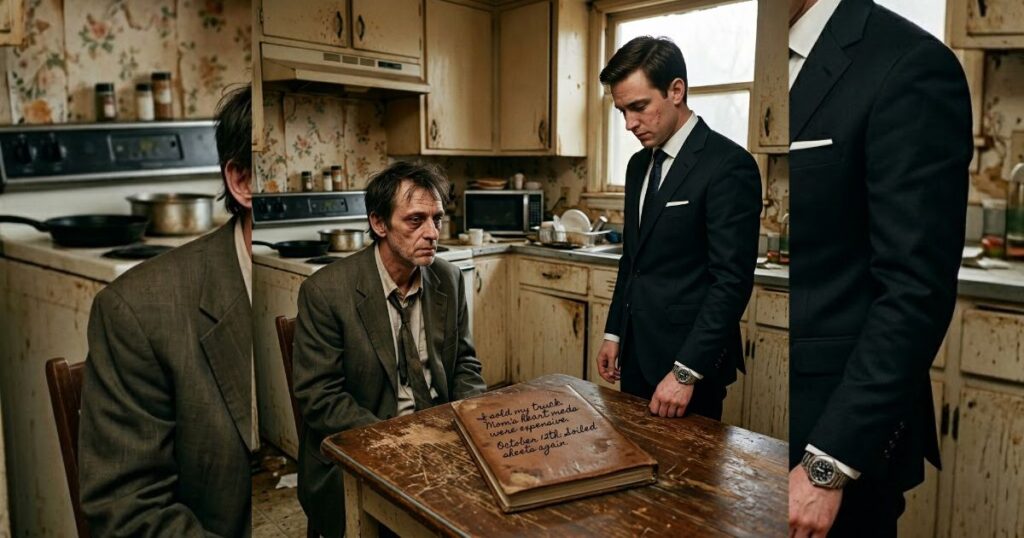
I wore a $3,000 custom suit to our mother’s funeral, ready to generously split the family estate 60/40 with my brother. Then he threw a stained notebook at my chest.
“Why is the yard dead, David?” I demanded, running a finger over peeling wallpaper in the hallway.
“I sent two grand a month. I paid for private landscaping and contractors. What did you do with the money?”
David just sat at the scratched kitchen table in a suit two sizes too big.
He looked ten years older than me, even though he’s three years younger.
His hands were calloused, and the dark circles under his eyes looked like actual bruises.
I sighed, pulling up a chair and checking my Swiss watch.
“Look, the housing market is hot right now,” I said smoothly. “We can flip this place fast. I don’t need the cash, so I’ll be generous. You take 60%, I’ll take 40%. Fair?”
I waited for him to thank me. I was the “Good Son.”
I lived in a high-rise in Chicago, but my monthly checks were what kept this house afloat.
David slowly stood up, walked to a junk drawer, and pulled out a cheap, spiral-bound notebook.
He tossed it onto the table. It landed with a heavy thud.
“Read it,” he whispered, his voice completely hollow.
It was a care log.
October 12th: Mom screamed for six hours straight. She doesn’t remember who I am. I had to change her soiled sheets four times. She bit me. I’m bleeding, but I can’t afford an ER co-pay, and I can’t leave her alone.
November 3rd: Medicare denied the claim for her new heart meds again. Michael’s check covered the property taxes, but not the pharmacy. I sold my truck today to pay for her pills out-of-pocket.
December 25th: Mom had a total breakdown. She cried because her ‘successful son’ didn’t call until 8 PM. I ate a cold sandwich on the floor by her bed just to keep her calm.
January 15th: Slipped lifting her from the tub and felt my spine pop. I don’t have my own health insurance anymore. I took six Advil and kept going.
I closed the notebook. I couldn’t swallow.
David looked me dead in the eye.
“You sent $2,000 a month, Michael. And I appreciate that.”
He pointed a shaking finger at me.
“But while you were sending checks, you were sleeping eight hours a night. You had European vacations. You had a life.”
He slammed his hand against his chest.
“I lost my fiancé because I couldn’t leave this house. I quit my engineering career so Mom wouldn’t rot in some understaffed, state-funded nursing home!”
His voice cracked, shaking with years of suppressed rage.
“You sent money to fix problems. But a bank transfer doesn’t clean up diarrhea at 3 AM.”
“A check doesn’t endure the insults of a mind destroyed by dementia.”
“Sell the house,” he whispered, turning his back to me. “Keep every single penny. I don’t want a dime. I already paid my share with my life.”
He walked into Mom’s old room and closed the door.
I sat alone in the silent kitchen, looking at my Italian leather shoes.
Suddenly, I didn’t feel like the hero anymore. I felt sick.
I paid for the pills, but he put them in her mouth.
I bought the expensive casket, but he held her hand until her last breath rattled out of her chest.
I drove straight to a local law firm that afternoon.
I drafted a quitclaim deed, transferring 100% of the house and the land to David.
I also set up a trust to cover his living expenses, health insurance, and retirement gap for the next ten years.
It wasn’t a gift. It was back pay.
In so many American families, there is a “Satellite Child” and a “Cane Child.”
The Satellite revolves from a distance, shining brightly and sending resources.
The Cane stays, supports the crushing weight, and gets leaned on until they snap.
Don’t ever think your financial contribution weighs more than the physical and emotional sacrifice of an unpaid family caregiver.
If you are the one who left, have the decency not to judge the dust on the shelves.
And when it’s time to divide an inheritance, remember this.
The health, the sanity, and the years that a caregiver sacrificed have a price tag that no piece of real estate can ever match.
Family justice isn’t about dividing everything by two.
It’s about recognizing who gave what.
PART 2
By sunset I had signed the house, the land, and ten years of my income over to my brother.
Before midnight, he shoved the whole folder back across the kitchen table.
It hit my chest and slid into my lap.
I looked down at the clean stack of legal paper.
Quitclaim deed.
Trust documents.
Insurance paperwork.
A monthly distribution schedule.
Everything I had set up in one frantic afternoon because I finally understood I had been measuring love in wire transfers.
David stood in the doorway of the kitchen with his hands at his sides.
He looked exhausted.
Not ordinary tired.
Not funeral tired.
The Brother Who Sent Money and the Brother Who Gave His Life
Part 1 of 2