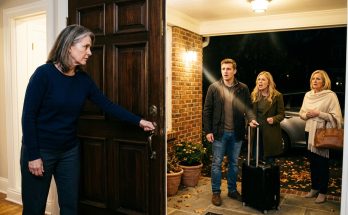
Sarah asked me to tell Detective Morales that everything had been a misunderstanding.
I looked at the printed messages again.
There was nothing unclear about them.
She had collected my documents.
She had discussed using my signature.
She had planned the timing of the distance message.
She had suggested using Leo to frighten me.
“This was not a misunderstanding.”
“Mom, please.”
“You knew what you were doing.”
Her expression crumpled.
“You’re really going to let them take me?”
That sentence carried forty years of history.
Sarah had skipped school at sixteen.
I persuaded the principal to reduce the punishment.
She damaged a friend’s car in college.
I paid.
She quit her first serious job without notice.
I apologized to the manager.
Whenever consequences approached my daughter, I had stepped between them.
I called it motherhood.
Now Sarah expected the same protection.
But this time, a ten-year-old boy had been frightened so adults could steal $85,000 from his grandmother.
“I’m not doing anything to you,” I said.
I placed the messages on the table.
“You did this.”
A floorboard creaked.
Leo stood in the hallway wearing pajamas.
He looked from Sarah to Detective Morales.
“Why are the police here?”
Sarah moved toward him.
Morales stopped her gently.
“Is Dad coming back?” Leo asked.
I knelt.
“Your mother needs to answer some questions.”
“Did she do something?”
“That’s for other adults to decide.”
Sarah began crying.
Leo stepped closer to me.
“Are they taking Mom?”
“She has to go with the detective.”
“Am I going too?”
“No.”
His lower lip trembled.
“Promise?”
“I promise.”
Sarah was allowed to change and gather what she needed.
Before leaving, she hugged Leo.
He did not hug her back.
She whispered that she would return soon.
Detective Morales cautioned her against making promises she could not control.
I watched my daughter walk toward the detective’s vehicle.
She was not handcuffed.
She looked back once.
I saw fear.
I also saw accusation.
Some part of Sarah still believed her mother should fix this.
I remained where I was.
Leo came beside me.
“Grandma?”
“Yes?”
“Is Mom leaving because I didn’t cry right?”
The question cut through every defense I had.
I pulled him against me.
“No.”
“Dad said I had to sound scared.”
“I know.”
“He said we’d keep the house if I helped.”
“You were never responsible for that house.”
“But maybe if I cried better, you would’ve signed.”
I held his face gently.
“No adult who loves you should make you responsible for frightening another person into giving them money.”
Leo nodded.
But guilt remained in his eyes.
That was when I understood the deepest damage Sarah and David had done.
Money could be recovered.
Credit could be repaired.
Property could be protected.
A child’s belief that his parents were safe people was harder to rebuild.
Later that morning, a child-services worker named Michelle Reed arrived.
She inspected the guest room, spoke privately with Leo and asked whether I could manage temporary care.
“I’m sixty-seven,” I told her. “I can manage.”
For the first time that day, someone smiled.
Michelle explained that emergency placement would likely be requested.
Sarah might eventually receive supervised visits.
David would not be allowed access while investigators believed Leo could be used again.
Through the doorway, I watched my grandson playing with Michael’s old measuring tape.
“I’ll do whatever he needs.”
Michelle asked whether Sarah and David depended on me financially.
“They did.”
“Did?”
“They asked me to leave their lives.”
I looked at the folder of evidence.
“So I took my money with me.”
Martha arrived after Michelle left.
She carried enough groceries for a week.
When she hugged me, I finally cried.
Not because I regretted stopping the payments.
Because I had spent years believing that if I gave enough, solved enough and forgave enough, I could keep my family intact.
I had been wrong.
Martha stayed with Leo while I met attorney Elaine Porter.
Elaine was small, silver-haired and so composed that even terrible possibilities sounded manageable when she described them.
I placed everything on her desk.
Bank statements.
SUV documents.
Messages.
The fraudulent loan.
The forged power of attorney.
Elaine read silently.
When she finished, she removed her glasses.
“We protect your house first.”
I nodded.
“Then your credit.”
“Yes.”
“And then your legal independence.”
I frowned.
“What does that mean?”
Elaine tapped the power of attorney.
“If people are willing to forge a document giving them control over your property, we cannot assume this is the only document they considered.”
She explained the possibilities.
Gift agreements.
New powers of attorney.
False claims of verbal authorization.
Even allegations that I could no longer manage my own finances.
“My daughter knows I’m competent.”
Elaine looked directly at me.
“We are no longer planning around what your daughter knows. We are planning around what the evidence shows she is willing to say.”
The sentence stayed with me.
Elaine arranged an urgent title search.
No lien had been recorded.
The home-equity loan had been stopped before funding.
My house remained mine.
The SUV was harder.
Because I had guaranteed the loan, simply refusing payment could damage my credit.
Elaine advised making one direct payment to the lender while she pursued a legal solution requiring Sarah and David to refinance or surrender the vehicle.
“You’re protecting yourself,” she said. “You are not resuming their allowance.”
That distinction mattered.
I paid the lender directly.
Not Sarah.
Not David.
That evening, my sister Joanne called.
Sarah had contacted her.
Joanne sounded furious.
“How could you let your own daughter be arrested over money?”
“It isn’t over money.”
“She says David pressured her.”
“I have her messages.”
“Families should handle problems privately.”
“Fraud doesn’t stop being fraud because relatives commit it.”
“She could lose everything.”
I looked toward Leo.
He had fallen asleep on the sofa with one of Michael’s old blankets pulled to his chin.
“She was willing for me to lose everything.”
Joanne lowered her voice.
“Michael would hate seeing this family destroyed.”
Pain moved through me.
For years, invoking my dead husband might have ended the argument.
Not anymore.
“Michael would hate what happened to his wife and grandson.”
Joanne became silent.
I ended the call.
By the following morning, David faced charges related to the forged documents, identity theft and the coercion involving Leo.
Sarah was charged for her role as well.
David remained in custody.
Sarah eventually obtained release on bond.
Neither could contact me directly.
Her contact with Leo was supervised.
At the emergency custody hearing, Sarah wore the black dress she had worn to Michael’s funeral.
Her attorney described her as a wife manipulated by a controlling husband.
Then the prosecutor produced Sarah’s messages.
The judge read the one about Leo.
Sarah lowered her head.
Temporary custody was granted to me.
When the gavel fell, my daughter cried.
I felt no triumph.
Victory is the wrong word for watching your child lose custody of hers.
Outside the courtroom, Sarah’s attorney approached.
She wanted me to know Sarah was sorry.
“She can communicate through my attorney.”
“She says David manipulated her.”
“She gave him my documents.”
“She was under severe pressure.”
“She suggested using her son against me.”
The attorney called it a terrible mistake.
“No,” I said.
Sarah stood beyond the courthouse doors.
“She made many decisions. Calling all of them one mistake erases every opportunity she had to stop.”
Three days later, David’s lawyer proposed a bargain.
If I described the fraudulent loan as a family misunderstanding, David would agree to surrender certain assets and cooperate in selling the SUV.
Elaine asked whether I wanted to consider it.
“Would lying help the criminal case against them?”
“It could weaken parts of it.”
“Then no.”
We would solve the vehicle problem legally.
I would not protect myself by helping them rewrite what they had done.
The storage company called next.
Sarah and David had failed to pay.
Furniture, kayaks, exercise equipment and abandoned business supplies might eventually be sold.
The manager asked whether I wanted to cover the balance.
“No.”
“Some possessions may have sentimental value.”
“Then their owners should pay for them.”
I hung up.
Something surprising happened.
I did not feel guilty.
Over the next several weeks, Leo struggled.
He had nightmares.
Sometimes a car slowing outside convinced him someone was coming to take him away.
I found a therapist, Dr. Patel.
I paid her directly.
That taught me something I should have understood years earlier.
Helping Leo did not mean handing money to Sarah.
Love could pay for therapy without financing a home theater.
Love could buy a child lunch without buying his father an expensive SUV.
Love could provide shelter while keeping the door locked.
Sarah’s supervised visits were difficult.
During one, Leo asked why she had told his father to take him.
Sarah said she had been confused.
Leo stared at her.
“But you typed it.”
Sarah began crying.
Her tears did not repair what the message had broken.
Weeks passed.
Then Detective Morales called.
Police had recovered additional evidence from David’s warehouse.
Security cameras had been installed there and connected to cloud storage.
One recording concerned Leo.
Another, Morales said, concerned me.
The following morning, Elaine and I went to the station.
Morales led us into a room containing a monitor.
The recording had been made roughly six weeks before the fraudulent loan application.
The camera showed an office area.
My property documents lay across a desk.
My deed.
My driver’s license.
My tax information.
Sarah sat before them.
She held a pen.
Then she began writing my name.
Again.
Again.
Again.
My daughter filled an entire page practicing my signature.
David entered.
They discussed whether I might notice.
Sarah said I would not.
Why?
Because I trusted her.
I felt Elaine’s hand move toward mine.
I could not look away.
The conversation continued.
If the bank contacted me, Sarah planned to claim everything concerned the SUV refinancing.
If I became suspicious, she would cry.
She would blame David.
She said I always forgave her.
My stomach turned.
Her defense had existed before the crime was discovered.
It was not something fear created afterward.
It had been part of the plan.
Then Sarah opened another folder.
The label faced the camera.
EMERGENCY GUARDIANSHIP—AMBER MITCHELL.
I stopped breathing.
Inside was a petition describing me as confused, forgetful and incapable of managing my finances.
It requested temporary authority over my property and accounts.
There was even a supposed medical statement from a doctor I had never met.
David asked whether she truly believed a court would declare me incompetent.
Sarah explained that immediate success was unnecessary.
An accusation might be enough to create confusion, delay access to my accounts or place temporary authority in her hands.
If I refused the loan, they had intended to attack my competence.
I thought of every forgotten grocery item.
Every harmless moment when I searched for my glasses.
Every joke about getting older that I had made in front of Sarah.
Had she been collecting those too?
The video continued.
Morales placed another page before me.
A statement supposedly from Leo.
It claimed I had forgotten his name.
That I had become confused while driving.
That I left the stove burning.
At the bottom appeared Leo’s signature.
I looked at Morales.
“Did he write this?”
“He signed a blank sheet.”
My grandson remembered Sarah asking him to practice his name.
I closed my eyes.
She had stolen my identity.
Then she had borrowed her son’s identity to help prove that mine could no longer be trusted.
Elaine squeezed my hand.
I opened my eyes again.
On the recording, Sarah was explaining why the guardianship plan would work.
Her confidence was remarkable.
I was older.
I disliked conflict.
I protected family secrets.
Most importantly, she believed outsiders would trust a concerned daughter before believing an elderly mother accused of confusion.
For years, I had thought Sarah’s greatest weakness was dependence.
I had been wrong.
She had studied my weaknesses too.
My generosity.
My grief after Michael died.
My fear of losing Leo.
My instinct to rescue her.
My reluctance to expose family problems.
Every kindness had become a tool she believed she could turn against me.
Detective Morales stopped the recording.
The monitor went black.
For a long time, none of us spoke.
Then Elaine asked whether I wanted a few minutes.
“No.”
My voice sounded unfamiliar.
Not louder.
Steadier.
I removed Michael’s brass level from my handbag. I had started carrying it after the night Leo was taken.
I placed it beside the forged guardianship petition.
Sarah had believed she could make something crooked look straight.
She had believed I would cry, forgive her and quietly repair the damage before anyone saw what our family had become.
She had believed nobody would trust my version once she called me confused.
I looked at Detective Morales.
“What happens next?”
“We continue building the case.”
“And if you need me to testify?”
Morales studied me.
“Would you?”
Months earlier, I might have worried what testimony would do to Sarah.
I might have wondered what Michael would think.
I might have calculated how much humiliation I could absorb if doing so spared my daughter consequences.
Not anymore.
“Yes,” I said.
Elaine turned toward me.
I picked up the guardianship petition bearing the lies about my mind, my home and my grandson.
My daughter had spent years learning that I would always save her.
Now she was going to discover what happened when I finally stopped.
Click here to continue reading: PART 5: The Guardianship Lie Was Only a Backup Plan, Until We Learned Someone Had Already Used It Against My Bank Accounts
My Daughter Asked Me to Disappear, Then Discovered She Had Sent My Money Away With Me
Part 4 of 24