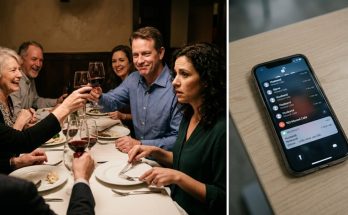
Daniel’s public statement was released on a Monday morning.
I had not asked for it.
His attorney sent Nina a draft first because it mentioned me and the company.
The original version was too emotional.
Corporate counsel stripped it down.
What remained was four paragraphs.
Daniel acknowledged that he had authorized improper transactions.
He accepted responsibility for governance failures.
He confirmed the ongoing investigations and his resignation.
Then came the paragraph I read three times.
Claire Morgan provided the capital that enabled the company to survive its earliest financial crisis, created core financial controls, and retained controlling ownership throughout the company’s growth. Statements I made suggesting that she was financially dependent on me or uninvolved in the company’s success were false.
I stopped reading.
Nina watched me.
“You can ask him to remove it.”
“No.”
“You don’t owe the public your personal history.”
“I know.”
“Then?”
“He broke that history publicly.”
She understood.
“Let him correct it publicly.”
“Yes.”
The statement went live at nine.
By ten, reporters were calling.
By eleven, former employees were messaging me.
By noon, Melissa had deleted three old social-media posts joking about my supposed retirement.
I found that almost funny.
Almost.
Marcus printed Daniel’s statement and taped it inside a supply cabinet.
“Why there?”
“Because you’ll throw it away if I put it in your office.”
“I’ll throw it away here.”
“I made copies.”
“You’re exhausting.”
“Leadership.”
Clearway’s new sign arrived that week.
The old Prescott letters came down one at a time.
I watched from the parking lot.
P.
Then R.
Then E.
There was no satisfaction in it.
Only strangeness.
For years, I thought removing Daniel’s name would feel like justice.
Instead, I remembered helping choose the original font.
I remembered Daniel insisting the letters needed to be visible from the highway.
I remembered standing beside him the night the first sign lit.
We had taken a photograph.
He kissed me afterward.
That man had existed.
So had the man who forged my signature.
Grief became easier when I stopped demanding that only one version be real.
Clearway went up the following morning.
No surname.
No monument.
Employees applauded because Marcus had somehow turned installation into an event.
I stood beside Harold and Evelyn.
She had accepted the permanent role.
Chief Financial Controls Officer.
Her title made Marcus nervous.
That was another reason I liked it.
Our new chief executive search produced five finalists.
I removed myself from the final scoring round after interviews.
Harold protested.
“You’re controlling shareholder.”
“Yes.”
“So why not choose?”
“Because the committee exists for a reason.”
He smiled.
“You really are serious about this.”
“I’ve had an educational quarter.”
The board selected Elena Ruiz.
Twenty years in logistics.
Operationally sharp.
Financially conservative.
No connection to any family involved.
Her first question after accepting was whether she could move my old desk.
I said yes.
Marcus objected on historical grounds.
Elena moved it anyway.
I liked her immediately.
Outside the company, consequences developed more slowly.
Leonard surrendered the Project Continuity originals and began cooperating.
Investigators did not accept his version of Tom Bell’s disappearance without corroboration.
North Quarry remained an active investigation.
The truck was real.
The payment was real.
What happened to Tom still required proof.
Graham’s records created different problems.
His outside fund had used Northcrest diligence materials without authorization.
Northcrest opened its own claims against him.
Victor’s counsel initiated discussions with investigators.
Halcyon expanded its disclosure regarding historical Fairmont practices.
No single arrest solved everything.
No courtroom scene tied every thread neatly.
The truth entered different systems at different speeds.
I learned patience.
Samuel Cho’s family received something more immediate.
Halcyon’s archived occupational records corroborated his complaints about exposure and inadequate protective equipment.
Evelyn brought the confirmation to her mother.
She returned to work two days later.
I did not ask how the conversation went.
At lunch, she sat across from me.
“She believed he stopped trying.”
“Your father?”
“Yes.”
Evelyn looked at her hands.
“He got quiet near the end, and she thought that meant he gave up.”
“But he kept records.”
“Yes.”
She swallowed.
“She cried because she spent thirty years being angry at him for surrendering.”
I waited.
“She wasn’t angry anymore.”
That was enough.
Richard cooperated too.
His relationship with Daniel remained strained.
His relationship with Patricia became something neither of them knew how to name.
They had lived separated for more than a year while performing marriage publicly.
Now the performance was over.
Patricia moved into a rented apartment.
Richard stayed in the family house temporarily.
Melissa sold her townhouse to fund restitution.
She returned most of the company money she could trace to herself.
Her apology to me came in three sentences.
I was cruel because I benefited from making you look dependent. I knew more than I admitted. I am sorry.
I believed those three sentences more than the elaborate explanations she used to give at dinner.
I did not respond.
Forgiveness was not an administrative requirement.
Our divorce moved faster than the investigations.
Daniel and I had no children.
The house would be sold.
Our ordinary marital accounts were straightforward once disputed corporate assets were separated.
The four-point-three-million-dollar Preservation Reserve remained mine.
I still had not touched it.
One afternoon, Nina found me staring at the statement.
“You know refusing the money doesn’t reverse what happened.”
“I know.”
“Giving it away doesn’t either.”
“I know.”
“You’ve been talking to Daniel.”
“Unfortunately.”
She smiled.
“What do you want?”
The question stopped me.
For years, that had been the hardest question.
What did I want?
Not what was fair.
Not what saved the company.
Not what protected Daniel.
Not what Dad intended.
Not what employees needed.
Me.
“I want to keep some.”
“Then keep some.”
“I want part of it used for Fairmont families.”
“Do that.”
“And remediation gaps.”
“Do that.”
“Is it really that simple?”
“No.”
She smiled.
“But the decision can be.”
I created an independently administered support fund for families with documented Fairmont-related claims.
Another portion went toward remediation reserves not covered by responsible parties.
The rest remained mine.
No apology attached.
No memorial.
No name.
Just money redirected according to choices I made.
The divorce hearing was administrative.
Neither Daniel nor I attended.
At 10:14 on a Wednesday morning, Nina texted one word.
Final.
I was in a Clearway risk meeting.
Elena was arguing with Marcus about warehouse expansion.
My phone vibrated.
I read the message.
Then put it face down.
Nobody noticed.
For nine years, I had been Mrs. Prescott in restaurants, charity dinners, family photographs, company events.
Legally, I was Claire Morgan again.
Emotionally, there was no switch.
I still knew Daniel’s coffee order.
Still recognized his footsteps.
Still occasionally woke expecting him beside me.
Divorce changed status faster than habit.
That afternoon, he asked to meet.
We chose a coffee shop halfway between our new homes.
He looked thinner.
No expensive watch.
No tailored suit.
Just a gray sweater and jeans.
“How’s Clearway?”
“Still standing.”
“Marcus?”
“Still complaining.”
“Good.”
“Elena started.”
“I heard.”
“What are you doing?”
He looked into his coffee.
“Waiting.”
“For the investigation?”
“Yes.”
“And working?”
“A friend has a warehouse operation.”
“What do you do?”
“Whatever he tells me.”
I raised an eyebrow.
Daniel laughed.
“I know.”
“How is taking orders?”
“Educational.”
We sat quietly.
Then he said, “I’m sorry.”
He had said it before.
This time he kept going.
“I’m sorry I called you the biggest mistake of my life.”
My chest tightened.
“I’m sorry I let them laugh.”
I looked away.
“I’m sorry I spent years describing your work as nothing because admitting what you did made me feel less successful.”
The room seemed too bright.
“I’m sorry I treated your competence like an accusation.”
That one reached somewhere deeper.
Daniel’s eyes reddened.
“And I’m sorry I loved you in a way that required you to become smaller whenever I felt small.”
I looked at him.
For once, there was nothing I needed to correct.
“I believe you’re sorry.”
Hope appeared in his face.
Small.
Automatic.
Painful.
“That doesn’t mean we should be married.”
The hope disappeared.
“I know.”
“You can be sorry and still have done something permanent.”
“I know.”
“I can love parts of who we were and still not come back.”
His mouth tightened.
“Do you?”
“What?”
“Love me.”
I could have lied.
“No” would have been cleaner.
Instead I said, “Part of me probably always will.”
He closed his eyes.
“But that isn’t enough.”
“No.”
“Why?”
“Because love became the reason I was expected to absorb consequences you wouldn’t.”
He nodded slowly.
“And I can’t build another life like that.”
“I understand.”
Daniel cried then.
Quietly.
He turned toward the window.
My body remembered what to do.
Reach across.
Take his hand.
Tell him we would figure it out.
I did none of those things.
Not because tenderness was weakness.
Because touching him would create a promise I could not keep.
After a minute, he steadied.
“There’s something I’ve wanted to ask.”
“What?”
“If I had told you everything before Northcrest closed, what would you have done?”
“I would have stopped the sale.”
“Redwood?”
“Disclosed the liability.”
“My dad?”
“Told him to get counsel and tell the truth.”
“My mother?”
“Same.”
“And me?”
That answer required thought.
“It would have depended on when you told me.”
“When was the last point?”
I looked at him.
“Before honesty became something I had to investigate.”
He lowered his head.
“That early?”
“Yes.”
He absorbed it.
Then he gave a sad smile.
“I kept thinking I had more time.”
“So did I.”
We left separately.
Outside, Daniel paused.
“For what it’s worth, marrying you wasn’t the biggest mistake of my life.”
I looked at him.
“What was?”
He shook his head.
“I’m still figuring that out.”
Good.
For once, he did not package regret into a perfect line.
He simply walked away carrying it.
That night, I drove to Dad’s lake house.
Most evidence had been moved into secure custody.
The dining table was finally visible again.
I put Arthur’s photograph back on the mantel.
Not the heroic father I had once imagined.
Not the compromised man I briefly feared he was.
Arthur.
Someone who had made frightened choices, preserved what he could, and left me instructions to choose records over reputation.
Complicated.
Human.
Loved.
Outside, the lake moved quietly under moonlight.
For the first time in months, unfinished things did not frighten me.
The investigations were unfinished.
Fairmont was unfinished.
Daniel’s legal future was unfinished.
Tom Bell’s case was unfinished.
But my marriage was not.
That ending hurt.
It was also clear.
Click here to continue reading: PART 28: A Year After Daniel Called Me His Greatest Mistake, We Met Again and Finally Understood What Neither Love Nor Money Could Undo
At Our Anniversary Dinner, Daniel Raised His Glass and Turned Nine Years of Marriage Into a Joke Everyone Else Enjoyed
Part 27 of 27