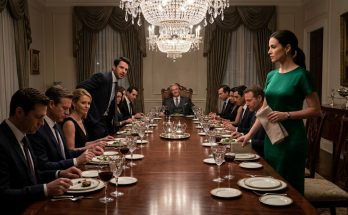
Arthur remained standing.
Martin Hale looked as though he wished he were anywhere else.
Robert Ellis removed his glasses, polished them unnecessarily, then put them back on.
Daniel sat to my right.
I waited.
Arthur eventually pulled out a chair.
He did not sit.
“You planned this.”
The accusation came quietly.
I looked at him.
“Planned what?”
“Last night.”
“No.”
“You knew who I was.”
“Yes.”
“You knew Sterling was negotiating with Crestwood.”
“Yes.”
“And you said nothing.”
“I wasn’t there for business.”
His laugh had no humor in it.
“You expect me to believe that?”
“I don’t need you to believe anything.”
Martin shifted.
“Arthur, perhaps we should—”
“No.”
Arthur finally sat.
His stare never left me.
“This was a test.”
“No.”
“You came into my home under false pretenses.”
“I came as Julian’s girlfriend.”
“You concealed your position.”
“I didn’t introduce myself with my résumé.”
“You let me think you were an employee.”
“I am an employee.”
Daniel coughed into his hand.
Arthur shot him a look.
I continued.
“You made assumptions. I didn’t correct them.”
“That is deception.”
“No. It’s silence.”
He leaned forward.
“And this morning, after one dinner, you killed a billion-dollar transaction.”
“No.”
His jaw tightened.
“What do you mean no?”
“I mean the transaction was terminated because Crestwood no longer has adequate confidence in Sterling’s management and governance.”
“You are Crestwood.”
“I lead it.”
“You made the decision.”
“Yes.”
“Then don’t hide behind corporate language.”
Daniel spoke for the first time.
“The decision was reviewed and approved by the investment committee.”
Arthur barely glanced at him.
“Because she told them to approve it.”
I folded my hands.
“If you came here to argue that our governance process is defective, this is an unusual strategy.”
Martin closed his eyes.
Robert looked down at the table.
Arthur ignored both of them.
“This is revenge.”
“No.”
“You expect me to accept that?”
“I expect nothing from you.”
His composure cracked slightly.
“You pull our financing hours after leaving my home and call it coincidence?”
“I didn’t call it coincidence.”
“Then admit it.”
“I’ve already explained the reason.”
“You were insulted.”
“Yes.”
“And now you’re punishing me.”
“No.”
He slapped one palm on the table.
“Then what exactly do you call this?”
“Due diligence.”
The room went silent.
Arthur stared.
I let the words sit between us.
Then I continued.
“For five months, our team reviewed reports of senior turnover, centralized decision-making, retaliation against dissent, public humiliation, and a management culture where people are afraid to deliver information you dislike.”
His expression changed.
Not shame.
Recognition.
He knew exactly what I was referring to.
“Disgruntled former employees.”
“That was Sterling’s position.”
“Because it’s true.”
“Last night suggested otherwise.”
His mouth tightened.
“You’re using a private dinner as corporate evidence.”
“I’m using observed behavior to evaluate whether previously disputed evidence is credible.”
Robert finally intervened.
“Ms. Bennett, with respect, that raises concerns.”
“Which concerns?”
“The context.”
“What about it?”
“Arthur did not know he was being evaluated.”
I looked at him.
“Precisely.”
Robert stopped.
Daniel leaned back.
He did not need to say anything.
The point was obvious.
People behave differently under scrutiny.
Arthur had believed no scrutiny existed.
He showed me the version of himself his employees described.
Martin cleared his throat.
“Chloe—Ms. Bennett—”
“Chloe is fine.”
He nodded.
“I’ve reviewed portions of the turnover data.”
Arthur turned sharply.
Martin continued before he could interrupt.
“There are legitimate concerns.”
Arthur’s face hardened.
“Not now.”
Martin looked at him.
“That is part of why we’re here.”
“No. We are here because she pulled the deal.”
“We are here because the deal was pulled.”
“That is what I said.”
“It isn’t.”
The correction was mild.
Arthur treated it like betrayal.
I watched his expression change.
Martin saw it too.
For one second, he looked afraid.
Then something steadied in him.
Perhaps the fact that the financing was already gone.
Perhaps the realization that fear had accomplished nothing.
“We need to understand why,” Martin said.
Arthur stared at him.
“I understand why.”
“No,” I said. “You don’t.”
His gaze returned to me.
“Enlighten me.”
“You think this happened because you insulted someone richer than you realized.”
He said nothing.
“That is not the problem.”
“Then what is?”
“You should not need to know someone’s net worth before deciding whether they deserve basic respect.”
Arthur leaned back.
“This is moral theater.”
“No.”
“It absolutely is.”
“I invest money. Culture affects money.”
He laughed.
“Now we’re pretending manners determine enterprise value?”
“No. Information flow does. Judgment does. Retention does. Succession does. People telling the truth when leadership is wrong does.”
I slid Priya’s revised risk summary across the table.
Martin reached for it.
Arthur did not.
“Sterling’s expansion problem did not begin with interest rates,” I said. “It began when internal objections to your growth assumptions were ignored.”
Arthur looked at Martin.
Martin remained focused on the document.
I continued.
“Three senior leaders flagged demand risk before the expansion.”
“That’s false.”
“It’s documented.”
“They disagreed with the scale. That’s different.”
“Two left within six months.”
“They weren’t strong enough for the next phase.”
“There it is.”
His eyes snapped back to mine.
“What?”
“The assumption that disagreement indicates weakness.”
“That is not what I said.”
“You’ve said versions of it throughout the transaction.”
Robert spoke carefully.
“Arthur, the board minutes do reflect dissent.”
“Of course they do. Boards debate.”
“Did the dissent change the plan?”
“No. Because I was right.”
Martin looked up.
“We lost four hundred million dollars.”
Arthur turned on him.
“Temporary losses.”
“Cash losses are still losses.”
“You know why the market changed.”
“I also know we borrowed on projections that several people said were too optimistic.”
Arthur’s voice dropped.
“Whose side are you on?”
The question hung there.
I looked at Martin.
He looked tired.
Not surprised.
That told me this was familiar.
He answered carefully.
“Sterling’s.”
Arthur’s face did not soften.
He wanted loyalty to himself.
Martin had offered loyalty to the company.
Not the same thing.
I leaned back.
“This is why the transaction is over.”
Arthur looked at me again.
“You think one argument proves your case?”
“No.”
“Then why say that?”
“Because you just asked your CFO whose side he’s on for telling you an uncomfortable fact.”
Arthur glanced at Martin.
For the first time, some uncertainty appeared.
It vanished quickly.
“You’re twisting this.”
“I’m observing it.”
He stood.
“This meeting is pointless.”
Martin looked alarmed.
“Arthur.”
“No. She’s made up her mind.”
“Yes.”
He stared at me.
The honesty surprised him.
“You won’t reconsider?”
“Not under the current structure.”
His posture changed.
Slightly.
There.
Negotiation.
“What structure?”
I looked at Daniel.
He remained neutral.
I turned back to Arthur.
“Sterling would need a credible governance plan that materially reduces founder concentration.”
Arthur’s eyes hardened.
“Meaning?”
“Independent board authority. Real succession. Operating decisions insulated from unilateral override. Protection for senior leaders who raise dissent.”
“You want control.”
“No.”
“That’s exactly what you want.”
“If I wanted control, the term sheet would say control.”
“You want to neuter me inside my own company.”
“Sterling is public enough, indebted enough, and dependent on outside capital enough that it stopped being only your company a long time ago.”
That struck him.
His face darkened.
“I built it.”
“Yes.”
“From nothing.”
“I know.”
“You think your spreadsheets entitle you to tell me how to run it?”
“No.”
“Then what gives you the right?”
I held his gaze.
“The fact that you asked us for a billion dollars.”
Martin looked down again.
Arthur did not answer.
For a moment, anger had nowhere to go.
Then his expression shifted.
He sat.
When he spoke again, his voice was calmer.
Too calm.
“All right.”
I recognized the change.
Arthur Sterling was trying another approach.
“Last night was regrettable.”
Daniel glanced at me.
I said nothing.
Arthur continued.
“I had been drinking.”
“You were.”
“I was protective of my son.”
“You were.”
“I made assumptions.”
“You did.”
“And perhaps I expressed them too aggressively.”
There it was.
Not apology.
Reframing.
I waited.
Arthur spread his hands.
“I’m willing to apologize.”
“To me?”
“Yes.”
“No.”
That startled him.
“No?”
“I don’t need one for the deal.”
“That’s not what I meant.”
“Then apologize if you believe you owe me one.”
He hesitated.
Just long enough.
He did not believe it.
He believed apologies were transactional.
Martin saw it.
Robert saw it.
Arthur saw them seeing it.
His face tightened.
“Fine.”
He looked directly at me.
“I apologize for what I said.”
The words were correct.
Everything else was missing.
No acknowledgment.
No understanding.
No remorse.
Just currency offered in exchange for capital.
I nodded once.
“Thank you.”
Relief flashed across his face.
Then I added:
“The termination stands.”
The relief vanished.
“You just said—”
“I accepted your apology.”
“And that changes nothing?”
“It changes whether you apologized.”
Arthur stared at me in disbelief.
“You’re enjoying this.”
“No.”
“Yes, you are.”
“I’m really not.”
“You get to humiliate me now.”
I looked at him carefully.
“No, Arthur.”
His breathing had become heavier.
“That is the difference between us.”
He said nothing.
“I have no interest in humiliating you.”
I gestured toward the risk summary.
“I’m interested in whether Sterling can be trusted with Crestwood’s capital.”
He looked at the paper as if it had insulted him.
Then his phone vibrated.
He pulled it out.
His eyes moved across the screen.
His face changed.
Martin saw it.
“What?”
Arthur did not answer.
Robert’s phone vibrated next.
Then Daniel’s.
Three seconds later, mine.
A financial-news alert.
STERLING ENTERPRISES FINANCING TALKS WITH CRESTWOOD CAPITAL COLLAPSE.
The leak had happened faster than I expected.
Arthur looked at me.
“You leaked it.”
“No.”
“Who else knew?”
“Too many people.”
Martin was already reading.
His face had gone pale.
“Shares are down six percent premarket.”
Arthur stood again.
“This is catastrophic.”
“No,” Martin said quietly.
Arthur turned.
“What?”
“Not yet.”
The word yet changed the air.
Martin looked at me.
“Have you signed with anyone else?”
I did not answer.
He understood.
Arthur followed his gaze.
Then he understood too.
“Mercer.”
Nobody spoke.
His expression sharpened.
“You’re funding Mercer.”
“I haven’t said that.”
“You don’t need to.”
He looked at the clock on the wall.
Then toward the glass corridor outside.
At that exact moment, Maya appeared with three visitors.
Mercer’s CEO.
Mercer’s CFO.
And their chairman.
Arthur saw them.
They saw him.
Nobody stopped walking.
The Mercer executives continued toward the main conference room.
Arthur slowly turned back to me.
All the anger left his face.
What remained was fear.
Not of me.
Of what came next.
Click here to continue reading: PART 7: Mercer Walked In as Sterling’s Shares Fell, and Arthur Discovered That Losing My Money Was Only the First Consequence
Julian Had Warned Me About His Father, but Nothing Prepared Me for the Question Waiting at the Front Door
Part 6 of 27