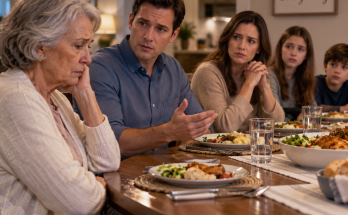
The question came before anyone had finished dinner.
Daniel lowered his fork beside a slice of roast chicken, glanced briefly toward his wife, Renee, and rubbed his thumb along the edge of his napkin. It was a small nervous habit I remembered from childhood. He used to do something similar with his shirt hem whenever he had broken a lamp or forgotten homework.
“Mom,” he said, “have you thought about getting a place of your own?”
Across the table, my fifteen-year-old granddaughter Lily stopped chewing. Ethan, her younger brother, stared down at his potatoes. Renee reached for her water glass and left her fingers resting around it without taking a drink.
Nobody asked what Daniel meant.
That told me enough.
I was seventy-one years old. I had lived under my son’s roof for nearly two years, ever since my husband Harold died and Daniel convinced me that remaining alone in our Tucson house would be unbearable.
And three months before that dinner, I had won eighty-nine million dollars.
Nobody sitting at the table knew.
Daniel believed I was a widow living mainly on retirement income and the proceeds from selling my old home. Renee believed the same. Lily and Ethan knew even less about my finances.
My secret existed in another world populated by attorneys, financial advisers, tax specialists, carefully drafted trusts, and documents stored in locked cabinets. I had followed professional advice and changed almost nothing about my daily life.
So there I sat in the guest room I had gradually begun calling my bedroom, folding their towels and packing school lunches while possessing more money than anyone in our family had ever imagined.
Daniel cleared his throat. “We’re starting to feel a little crowded.”
“We?” I asked.
His eyes moved toward Renee.
She finally released her glass. “Lily’s getting older. Ethan is too. Everyone needs more privacy. We thought you might actually enjoy having somewhere that was completely yours.”
The word enjoy almost made me smile.
Two years earlier, Daniel had stood in my Tucson kitchen while half of Harold’s clothes still hung in our closet and told me the opposite.
“You shouldn’t be alone right now,” he had insisted.
I had resisted at first. The house contained thirty-eight years of marriage. Harold’s coffee mug was still beside the sink. His gardening gloves were in the garage. A paperback lay facedown on his nightstand at the exact page he had never finished.
Every room hurt, but leaving it felt like another death.
Daniel kept asking.
Finally I sold the house.
I packed photographs, dishes, books, Harold’s pocket watch, and dozens of things whose value existed only because he had touched them. Most went into storage when Renee explained that their Scottsdale house lacked space.
The first months with them had been gentle.
Daniel carried my boxes himself. Renee bought the tea I liked. Lily knocked before entering my room. Ethan asked whether I could read to him even though he was already old enough to read perfectly well by himself.
Then routine settled over us.
I woke earliest, so I began making breakfast.
Renee’s mornings were chaotic, so I packed lunches.
Daniel worked late on Tuesdays, so I drove Ethan to soccer.
One dinner became three dinners each week, then four. I handled deliveries, waited for plumbers, folded laundry while watching television, watered plants when the family traveled, and stayed with the children whenever Daniel and Renee wanted a weekend away.
Nobody ordered me to do any of it.
That was partly why I failed to notice when favors became expectations.
“Would you mind getting Ethan?” became “Can you get Ethan?”
Eventually it became, “I need you to get Ethan.”
Daniel’s gratitude faded more subtly. Thank-yous became quick smiles. Quick smiles became nods. Then even the nods disappeared.
I told myself that was what happened inside families. Love became comfortable enough that people stopped keeping score.
Then, several months earlier, I passed Daniel and Renee’s bedroom and heard my name.
I stopped before I meant to.
“She lives here without paying anything,” Renee said.
There was irritation in her voice rather than cruelty.
“We cover the mortgage, groceries, utilities. Everything.”
I waited for Daniel.
I expected him to mention the school pickups. The meals. The laundry. The weekends I had rearranged so he and Renee could travel. I expected something as simple as, She’s Mom.
Instead he sighed.
“I know.”
I returned to my room before they could discover me.
Those two words remained with me.
Not Renee’s complaint. People become frustrated. Married couples say uncharitable things behind closed doors.
It was Daniel’s answer.
I know.
Not one word about what I contributed.
Around that same period, Daniel and Renee became obsessed with a Craftsman house on Willow Creek Lane.
It had four bedrooms, mature trees, broad eaves, white porch railings, and a backyard large enough for Ethan to leave a bicycle in three different places and still claim he had looked everywhere for it.
Renee created spreadsheets comparing mortgage scenarios.
Daniel studied the garage and talked about shelves and a workbench.
Lily selected an upstairs bedroom from the online photographs.
Ethan wanted whichever room was closest to the stairs.
They toured the property three times.
I joined them once.
While the others examined closets and discussed financing, I wandered onto the porch.
An old wooden swing hung there from dark chains.
I touched its weathered armrest.
For one absurdly vivid moment, I could see Harold sitting there with tea balanced on his knee, watching the grandchildren race through the yard.
He would have loved it.
I never told anyone that.
The family already considered Willow Creek their dream. There seemed no reason to insert my feelings into it.
Then they lost the house to a cash buyer.
For weeks, Daniel refreshed the listing page hoping the transaction might fail. Renee complained about investors driving ordinary buyers out of desirable neighborhoods. Even the children asked whether they could occasionally drive past the place.
During those same weeks, none of them noticed that my own life had changed beyond recognition.
Three months earlier, after a routine appointment, I had stopped for gasoline.
I bought a lottery ticket.
There was no intuition. No dream. No meaningful anniversary attached to the numbers.
Two days later, sitting at the little desk in Daniel’s guest room, I checked the results.
Then I checked again.
Then I found another website because I became convinced the first one had made an error.
Eighty-nine million dollars.
Ethan was playing a video game down the hall. Renee was running the vacuum downstairs.
The ordinary sounds made the number feel even more impossible.
I did not scream.
I did not telephone Daniel.
My first call went to an attorney.
My second went to another attorney because Harold had spent forty-three years teaching me that important financial decisions deserved more than one opinion.
Eventually I hired Richard Coleman, an estate attorney whose calm manner made eighty-nine million dollars sound like a complicated plumbing problem.
During our first serious meeting, he asked me one question.
“Who concerns you most?”
“Myself.”
He smiled.
“That’s a promising answer.”
Richard warned me about sudden generosity, scams, relatives I had not heard from in decades, investments proposed by old acquaintances, and the temptation to solve every loved one’s difficulty simply because I suddenly could.
He did not tell me to distrust Daniel.
He specifically advised against turning my family into an experiment.
“Secure your position first,” he said. “Then make decisions when you aren’t frightened, excited, guilty, or trying to prove something.”
So I returned home.
I cooked dinners.
I drove Ethan to soccer.
I listened to Renee discuss retirement communities without telling her I could purchase the entire building.
And slowly I discovered an unexpected advantage to secrecy.
Clarity.
Nobody could flatter me for money they did not know existed.
Nobody could resent a gift I had refused to give.
What I saw was simply how they treated Margaret Briggs when Margaret Briggs was only Mom, Grandma, and an aging widow occupying their guest room.
That was why Daniel’s question hurt so deeply.
“When did you want me gone?” I asked.
His expression tightened. “Mom, nobody said gone.”
Renee leaned forward. “There’s no deadline.”
“Then what are we discussing?”
“A transition,” she said.
I looked at Lily.
Her eyes were wet.
She immediately looked away.
Something passed through me then—not suspicion exactly, but recognition.
Lily had known this was coming.
Perhaps everyone had.
I placed my napkin beside my plate.
“Excuse me.”
Daniel started to rise. “Mom—”
“I’m fine.”
I walked outside before he could follow.
The evening air smelled of warm stone and damp soil from the sprinklers. Patio lights cast small circles across the yard.
I sat alone with an old notebook Harold had given me.
For several minutes I listened to the faint clatter of plates through the kitchen window.
Then I wrote five lines.
Move out.
Stay calm.
Protect what belongs to me.
Find a home.
Remember tonight accurately.
The last instruction mattered most.
I knew my own weaknesses.
Daniel could apologize tomorrow and I might immediately minimize everything.
Renee could cry and I would probably comfort her.
Lily could ask me to stay and I might unpack before breakfast.
Harold once told me I could give away my final piece of bread while insisting I had already eaten.
He meant it affectionately.
He was also right.
Through the window I saw Daniel clearing dishes while Renee spoke beside him.
Nobody came outside.
That became another detail I promised myself not to rewrite later.
The next morning, at exactly eight, I telephoned Richard.
He answered quickly.
“Good morning, Margaret.”
“I’m ready.”
There was a brief silence.
His voice became businesslike.
“What happened?”
“My son asked me to find somewhere else to live.”
Richard did not offer outrage on my behalf.
I appreciated him for that.
“Do you need temporary accommodation?”
“Yes.”
“You already have it.”
I frowned. “What does that mean?”
“I reserved a furnished apartment three weeks ago.”
Despite everything, I laughed.
“You planned my escape?”
“I planned an option.”
“When can I use it?”
“Today.”
I looked around the guest room.
Harold’s photograph stood beside my bed. He was wearing his old baseball cap crookedly, smiling at whoever had taken the picture.
Probably me.
“A driver can collect you around noon,” Richard said.
“Fine.”
“Margaret?”
“Yes?”
“Do not make any large decisions today because you’re hurt.”
I looked through the window at the backyard.
Then an image came to me.
White railings.
Broad porch.
Old trees.
A wooden swing.
“There is one thing.”
Richard sighed lightly. “I’m listening.”
“Willow Creek Lane.”
“What about it?”
“I want to know whether the cash buyer completed the purchase.”
Silence.
Then Richard said, “Interesting timing.”
My fingers tightened around the phone.
“Why?”
“Laura Jensen called yesterday.”
Laura was the real-estate agent Richard had quietly retained for me.
“The buyer has missed two deadlines,” he continued.
I sat on the bed.
“What happens now?”
“They have forty-eight hours to provide proof of funds.”
“And if they cannot?”
“The sellers may terminate the contract.”
I looked at my notebook.
Find a home.
Yesterday those words had meant independence.
Now, suddenly, they had an address.
Click here to continue reading: PART 2: I Packed Two Suitcases and Left Without Arguing, Then the House My Family Lost Suddenly Became Available Again
At Dinner My Son Asked Me to Move Out, Unaware I Had Been Keeping an Eighty-Nine-Million-Dollar Secret
Part 1 of 28